Express Cargo Sorting

Stansted Airport in Essex is FedEx’s biggest cargo hub in Britain. David Priestman grabbed a tour of the busy facility.

A giant of the logistics world, FedEx has a turnover of $90bn, 500,000 staff in 200 countries, handling over 16 million items per day. Since the acquisition of TNT in 2016 the company, founded over 50 years ago by Fred Smith, its President, has strengthened its road freight network and European presence, with 10% of its employees here.

Stansted is foremost among 68 depot stations and 6 hubs in the UK. Around 400 of FedEx UK’s 10000 employees are based here, the fourth busiest airport in Britain. From Stansted there are direct connections to Paris CDG (the hub for Asia-Europe freight) and Liege in Europe, plus two daily flights from the USA – Indianapolis and Memphis, the global hub. 60% of items handled here are imports, 40% exports.

Import sorting

Managing Director of Ramp and Gateways Operations for Northern Europe, Alun Cornish, has been with the company for 20 years. The tour started with the customs hold ‘cage’. “When regulations change we see an increase in goods held temporarily in the cage,” he informed me. “FedEx are ready for the new UK government Customs Declaration Service, even with the further delays till March. The new import system is the next step in the modernisation of our Stansted operation.” Imported items requiring declaration are intercepted automatically by the sorters and held for customs duties or inspection. The UK Border Force has its own area and staff within the warehouse. About 8% of total volume comes to the cage, with 5700 packages there on average, at any one time.

The import sort facility is adjacent to the airside apron at Stansted, with ULD (unit load device) air containers fed directly on to a castor floor. A manifest is provided to HMRC as each cargo plane lands. A new installation by Vanderlande has doubled throughput capacity to 6000 items per hour, to cater for demand. Phase two was still being completed when I visited. A dangerous goods area is utilised for compliance checks on such items going onwards domestically by truck. “This is a fundamental part of our value proposition,” Cornish stated. FedEx are focusing on increasing the quantity of pharmaceutical and medical freight here, as they are priority products. The facility has fridges, freezers and dry ice here for them.

The new parcel sorting system will speed up the processing of imports. It is equipped with technology from Sick that captures data points via barcode scanning, providing instant updates to the FedEx operations team and the customer receiving the goods. “This is the brains of the system,” Cornish informed. The system has the flexibility to connect to a range of different outfeeds, meaning parcels can be loaded into a number of different types of vehicles for onward connection. For example, a flight from Paris CDG arriving at 04.00 is unloaded, delivered to the import sorters, split and loaded on to trucks to the other hubs or on to vans to the final delivery destination that day.

Export sorting

$25m has been invested by FedEx in a number of projects to improve the Stansted facility. The new exporting system was introduced to speed up the flow of goods through the facility, resulting in approximately 80% of shipments bound for international markets being scanned and processed by machines. Capacity is determined by the speed of the sorter through the x-ray scan tunnels, and the system maintains gaps between packages by selecting which belt to send them on. Accuracy has improved and the system can handle various dimensions. Some items, such as liquids, are still sent for manual x-ray in a separate room. FedEx’s customer service teams assist with new export compliance issues. Sniffer dogs are deployed on site – 5 Springer Spaniels, each with trained expertise for specific substances, such as explosives.

Rob Peto is the VP of Operations, UK and Ireland. He said growth in 2023 was driven by ecommerce and sales team success with big intercontinental freight contracts. “We have a great product portfolio; we can do bespoke special services, high priority or cheap deferred freight. I look at where we have imbalances (between inbound and outbound loads) and the capacity to align them. Our job is to help our customers be successful, to connect.”

Greening parcels

Peto and his team analyse trade lane trends and develop services such as FedEx International Connect Plus – an ecommerce offering to give retailers customer access globally. FedEx Delivery Manager enables day-specific and alternative delivery locations to be selected and tracked. For urban, last mile delivery in the UK the company is now using some British-made third generation e-cargo bikes to reduce emissions. They can carry up to 170kgs. Some electric vans are deployed, mainly in London. FedEx has set a target of achieving net zero by 2040, with half of new vehicles being EVs by 2030. Trucks for line-hauling are trialling alternative fuels.

I asked Peto whether FedEx, like many logistics businesses, are finding it challenging to recruit and retain staff? “Its fine,” he replied. “There are always hotspots. We did see driver shortages but ensured we covered that via training and with partners.” FedEx utilise jobs fairs and colleges for local hiring. “The reduction of passenger airline staffing in winters means we can pick-up those looking for more work then,” added Cornish.

Express Cargo

Going airside

Boeing 777 dedicated freighters are the main aircraft used for transatlantic and intra-Europe routes. New aircraft are quieter, emit less CO2 and use sustainable fuels. They are referred to as ‘purple tail’ – the company’s own fleet – with passenger airlines’ belly capacities used as well.

The flight from Indianapolis arrived, on time, and I was pleased to be able to witness it being unloaded first-hand by literally squeezing myself from the behind the cockpit, back between the ULDs and the bare fuselage wall. Every possible square metre of space is utilised on a freighter! The upper deck is offloaded first, via the skeet castor floor on to a giant scissor lift. The ULDs and the assorted palletised consignments are moved swiftly. Each has an overhead fire suppression system, developed by FedEx, that can puncture the ULD before pump injecting argon-based foam. They certainly must help the pilots relax and focus on flying.

Read More:

FedEx and TNT Express


PartnerLink Program for Supply Chain Challenges

Kinaxis, a global provider of supply chain management solutions, announced a strategic expansion of its PartnerLink program, designed to fortify the supply chain resilience of businesses worldwide.

Launched in 2021, the PartnerLink program has rapidly evolved into a leading network of over 170 partners and 2,500+ certified consultants, offering unparalleled expertise in supply chain transformation. This expansion introduces a suite of enhancements including:

• Partner Relationship Management Portal – this new portal will serve as a dynamic, all-in-one communications hub with customizable dashboards to access valuable sales resources, marketing and deployment support, training and certification information, event news, product materials and more.

• First-Ever Global Partner Roadshow – a series of exclusive, in-person events across APAC, EMEA and North America with industry-specific deep-dive presentations from Kinaxis and industry thought leaders and a first-hand look at key product roadmap innovations.

• New Certifications – expanded list of certifications will ensure highly-skilled consultants remain on the cutting edge of new technological developments and implementation best practices.

• New Tiering System – a comprehensive tiering framework will provide access to various financial and business benefits, from training and tools to market development funds, partner advisory councils, sandbox demo environments and more. Partners will automatically enter the Silver tier and upon meeting revenue, certification and specialization requirements, graduate to higher tiers.

Supply chain orchestration

These initiatives are set to equip Kinaxis‘ partners with advanced tools, resources and knowledge, enabling accelerated deployment and optimization of supply chain solutions.

“With labour disputes, cyber-attacks and the escalation of conflicts in global hotspots like Eastern Europe and the Middle East all threatening the movement of goods globally, businesses have never had a greater need for supply chain solutions that enable them to prepare for and respond to unexpected disruptions,” said Conrad Mandala, senior vice president, global partner organization at Kinaxis. “The investments we are making in our PartnerLink program will strengthen our position to capitalize on this demand and deliver on our global growth objectives by ensuring our partner ecosystem has the tools they need to help customers achieve supply chain resiliency no matter what risks appear on the horizon.”

Read more here:

Kinaxis Drives Digital Transformation for Volvo


Home Fitness Warehouse Automated

The retail company Sport-Tiedje is automating its new logistics centre with driverless transport systems from ek robotics. In Osterrönfeld near Rendsburg, nine transport robots from the VARIO MOVE series and four fully automated VNA MOVE narrow-aisle forklift trucks will optimize the home fitness expert’s transport and warehouse processes.

A small sports store in the center of Schleswig has developed into Europe’s leading home fitness specialist over the past decades. Sport-Tiedje GmbH employs around 700 people in 10 European countries. Due to the company’s strong growth, the previous central warehouse in Büdelsdorf reached its capacity limits. The dimensions of the new central warehouse in Osterrönfeld near Rendsburg are correspondingly future-oriented: Over 51,000 m² of warehouse space offers room for order picking, storage and handling of goods. The driverless transport system from Hamburg-based manufacturer.

North German partnership

ek robotics ensures efficient warehouse automation with decades of high availability. The automated guided vehicle fleet comprises nine vehicle models from the modular VARIO MOVE L series, which are responsible for linking incoming goods, order picking and outgoing goods. The high-bay warehouse will also be operated automatically in future and will contribute to an efficient material flow between the areas. The four fully automated narrow-aisle stackers will store and retrieve pallets precisely in the high-bay warehouse with 30 aisles and a length of 80 m each. “The AGV from ek robotics will support the staff on site and significantly improve processes in the central warehouse,” says Christian Grau, Managing Director of Sport-Tiedje.

AGV

Warehouse Automated

ek robotics is one of the world’s leading manufacturers and system integrators of innovative high-tech transport robotics for production and warehouse logistics. At five locations worldwide (Hamburg, Germany, headquarters), Reutlingen (Germany), Milan (Italy), Prague (Czech Republic) and Buckingham (UK), the transport robotics specialist with over 300 employees creates intelligent, networked and flexible transport solutions for the fully automated, internal material flow of its globally active customers.

Read more here:

ek robotics’ New Commissioning & Layout Engineer


Logistics Property Scheme Kick-off

St. Modwen Logistics, one of the UK’s leading logistics developers and managers, has started construction on the first phase of its 1.2m sq ft scheme in Meaford. The company is regenerating the site of a former power station at St. Modwen Park Meaford and will firstly deliver two new sustainable warehouses totalling 112,000 sq ft.

Rated BREEAM ‘Excellent’ and with EPC A certification, the units will benefit from a wide range of measures to support occupiers in their net zero journeys and reduce operational energy consumption, including rooftop solar panels, smart LED lighting that reduces energy consumption by 10%, as well as EV charging points and smart metering.

Due for completion in Q4 2024, the first phase of development at the Park will include market-leading infrastructure and has already secured a much-increased power capacity of 9.2 MvA – making the entire Park suitable for advanced manufacturing companies and logistics occupiers alike. On top of the scheme’s main masterplan, the site can also deliver build-to-suit facilities of up to 633,000 sq ft within 12 months of an agreement, including cross docked units with outline planning permission already obtained. Detailed planning is in place for two large units of 193,000 sq ft and 359,000 sq ft and capable of delivery in 2026.

Logistics Property Scheme

The new phase of development at the Park will create hundreds of jobs and will also provide new green spaces alongside retained woodland, boosting local biodiversity and adding value to the local community.

The development builds on a £4.2 million investment of Government Growth Deal funding which delivered infrastructure works at St. Modwen Park Meaford, including a new roundabout on the A34, improvements to Meaford Road and a new access serving the Park. The work, which also received a significant funding contribution from St. Modwen Logistics, was carried out by Staffordshire County Council on behalf of the Stoke-on-Trent and Staffordshire Local Enterprise Partnership.

Situated between J14 and J15 of the M6 motorway, the logistics property scheme is strategically located on the M6 corridor. The development is situated just off the A34 dual carriageway, with access to the significant catchments of Stoke-on-Trent to the north and Stafford to the south.

Jake Shilston, Development Director at St. Modwen Logistics said: “Having successfully delivered over 2.2 million sq ft of high-quality logistics space in Stoke and secured a range of high-quality occupiers across our developments, this latest phase of development at our Meaford scheme builds on our exceptional track record in the region, helping to address the under-supply of best-in-class industrial workspace. Our capacity at Meaford to deliver a significant volume of additional space, with both detailed and outline planning in place, also positions us to meet the future demands of Staffordshire’s diverse customer base. With additional power of up to 9.2 MvA already secured, we have confidence in our ability to service the varied needs of businesses of all sizes based in the region.”

Philip White, Deputy Leader of Staffordshire County Council and Cabinet Member for economy and skills, added: “We have worked with St. Modwen Logistics from the start of site development at Meaford in 2016 to ensure access and connections to highways are delivered through the Government’s Growth Deal funding. Supporting business development and providing necessary infrastructure is a priority to the county council and we have a strong track record of working with developers as they bring sites like this forward. The logistics sector plays a prominent role in the local economy, creating thousands of jobs and attracting additional investment. St. Modwen Park Meaford is in a prime location close to both the M6 and A50/A500 corridors where we expect to see considerable jobs growth in coming years.”

St. Modwen Logistics delivered 1.3 million sq ft of modern warehouse space in 2023 and has a long-term pipeline of 23 million sq ft.

Read more here:

Plans Approved for 670,000 sq.ft. UK Distribution Centre


Transforming Ecommerce Warehouse

Next day delivery is a logistical challenge that warehouses often require an upgrade to achieve. David Priestman visited such a facility in Birmingham.

BES are a plumbing, gas and heating trade supplier selling products and brands ranging from Bosch tools to Danfoss thermostats, Grohe taps to Grundfos pumps, Triton showers to Bostik glue. This inventory, in a 80,000 sq. ft. DC in central Birmingham, with 15000 SKUs and 1500 orders per day is a challenge in terms of suitable storage, picking and despatch. The company went from a paper-based operation to an automated voice and WMS solution in a project with Koerber Supply Chain.

The key benefits were: 15% reduction in total staff hours used; 43% increase in productivity; 88% reduction in training time for new staff; 50% reduction in staff needed to check orders after picking; 5 tonnes of paper saved per year (750,000 sheets) + printing costs; Pick-up times on collection orders reduced to 30 minutes

Flexible Solution Required

“We brought technology to the workplace,” Operations Manager Steve Standley told me. BES is a 45-year-old company and ecommerce took-off during covid. “Initially, for the extra orders, we just hired more staff. But that made us top-heavy for pick and pack. We needed to speed up and possibly reduce the head count,” he explained. The old system saw orders generate two copies of every despatch note. One went round the warehouse and one to the customer. There was a lot of walking involved as staff went round the facility to find and collect each item for an order. Having automated these processes considerable efficiencies have been made. BES upped staff pay and amended hours as well.

“It was a bit chicken and egg,” Standley said. “Should we introduce technology first or introduce efficient practises?” A new picking solution was required to help with the additional volumes. Installation, which commenced in March 2023 and was completed last August, needed to be done whilst order numbers continued to grow. “Testing was straightforward,” Standley recalls. “Training is easy. Showing new starters the aisle and stock locations is the main thing.”

Major customers order in big quantities. Plumbers purchase parts for regular jobs. Consumers buy items for home delivery. BES ship via DX for odd sized and large products (overnight via the DX network), DPD for regular parcels and Royal Mail for items under 2kg. The decision was made to divide the DC into four zones, accordingly, from bulk down to small, plus a VIP area. Workers now wheel a roll cage of small or medium totes to the appropriate zone to pick into up to 20 totes at a time, before returning to the loading area.

Order Prioritisation

Another challenge for the upgrade project was to reduce the time taken to pick items meant for collection by customers on-site to be halved, to just 30 minutes. Instead of printed orders being sifted through, the new picking system recognises the warehouse’s own postcode as the destination. “It then jumps to the front of the queue to pick immediately,” Standley informed. “It’s hard to get the balance between collection orders and ones for delivery. An unique balance is achieved.”

The new system includes Koerber WMS, voice tech, modules and middleware, plus the four Kardex Megamat carousels (pictured) that were already in use at the DC. The picker no longer needs to input part numbers on the carousel’s control panel. This is a no-touch solution thanks to the Koerber API ordering items in batches. Quite a lot of work was done by Koerber in achieving this interface. “We did have two staff per machine,” Standley continued, “now one person goes to it (and says ‘Ready’) when around 30 orders are ready. So they can go, pick elsewhere and come back. There’s less walking involved.”

What about fast-moving items and stock location? “We wanted accuracy. Quality was paramount.” Standley emphasised. “Phase 2 of the project will take us further, handling inbound products from suppliers and maybe having a dedicated area for fast-movers. We’re also looking at same-day delivery options.”

Read more here:

Find your Warehouse Rhythm


Latest Automation Innovations at LogiMAT

Fives will present its complete ecosystem of smart and automated solutions at the LogiMAT tradeshow in Stuttgart, Germany (Hall 1 at Booth 1A61 & Hall 3 at Booth 3A30) from March 19 to 21st. This event will also be the opportunity to showcase its innovations designed to optimize the performance in material handling and automation.

Fives, through its Smart Automation Solutions Division, is an industry leading provider and integrator of cutting-edge, smart, scalable, and sustainable material handling solutions to increase warehouse automation. From retail and distribution to e-commerce, food, and 3PLs, as well as parcel and postal, Fives serves various business sectors, through an extensive range of technologies and software for conveying, sorting and picking the widest range of goods, worldwide.

Fives is dedicated to support its clients, providing them with comprehensive solution that increase speed, flexibility, capacity and scalability, to optimize the efficiency of their intralogistics
processes and deliver the right item, to the right place, at the right time. As a “customer-oriented company, Fives supports industrial companies throughout the entire life cycle of their facilities. From design to operations, Fives provides them with tailor-made and high-performance turnkey solutions, as well as aftermarket services ranging from spare parts, field service, maintenance programs, to retrofit solutions, anywhere in the world.

One innovation ahead

The rise of Industry 4.0 is deeply transforming the industry in various sectors. Automation innovation is key for addressing real-life challenges, such as digitally assisted remote services facilitating
AI-driven information collect and predictive maintenance. For over 60 years, Fives has been innovating, developing technologies that have become market standards. Anticipating customer needs, Fives invests in future technologies, expanding its solutions portfolio to collaboratively transform supply chain facilities with clients.

Take order picking to the next level

Speed, visibility, and reliability are essential for the success of logistics operations. To address the challenges associated with managing large order volumes while ensuring precise inventory management and efficient tracking of flows, Fives offers a warehouse automation solution based on the “Pallet-to-Robot” process, a new technological brick for automated pallet preparation.

A flexible, versatile, and scalable solution, AgileP2R ensures complete automation of order picking and adapts to the variability of logistics operations. It is designed for multi-product layer-pallets preparation and multi-product case-pallet preparation, and offers a choice of equipment, thus enabling customized adaptation possibilities.

For layer picking, Agile P2R features on one or more robots equipped with a layer gripper that can adapt to various pallet sizes. This gripper handles product-layers, up to 38 cm in height, using various technologies: suction, depression, clamping, security curtain.

For case picking, one or more robotic cells equipped with case grippers, which are adapted to all types of loads and take the fragility of the products into account, make up heterogeneous pallets. For both preparation modes, the use of AMRs complements robotics for maximum flexibility. 360° management software controls the entire process, and powerful algorithms automatically calculate and control the positioning of layers and cases to optimize pallets. Finally, a buffer area allows product pallets to be placed as close as possible.

Read more here:

Automation Solutions for Swedish Sorting Centre


Methanol-Powered Vessels

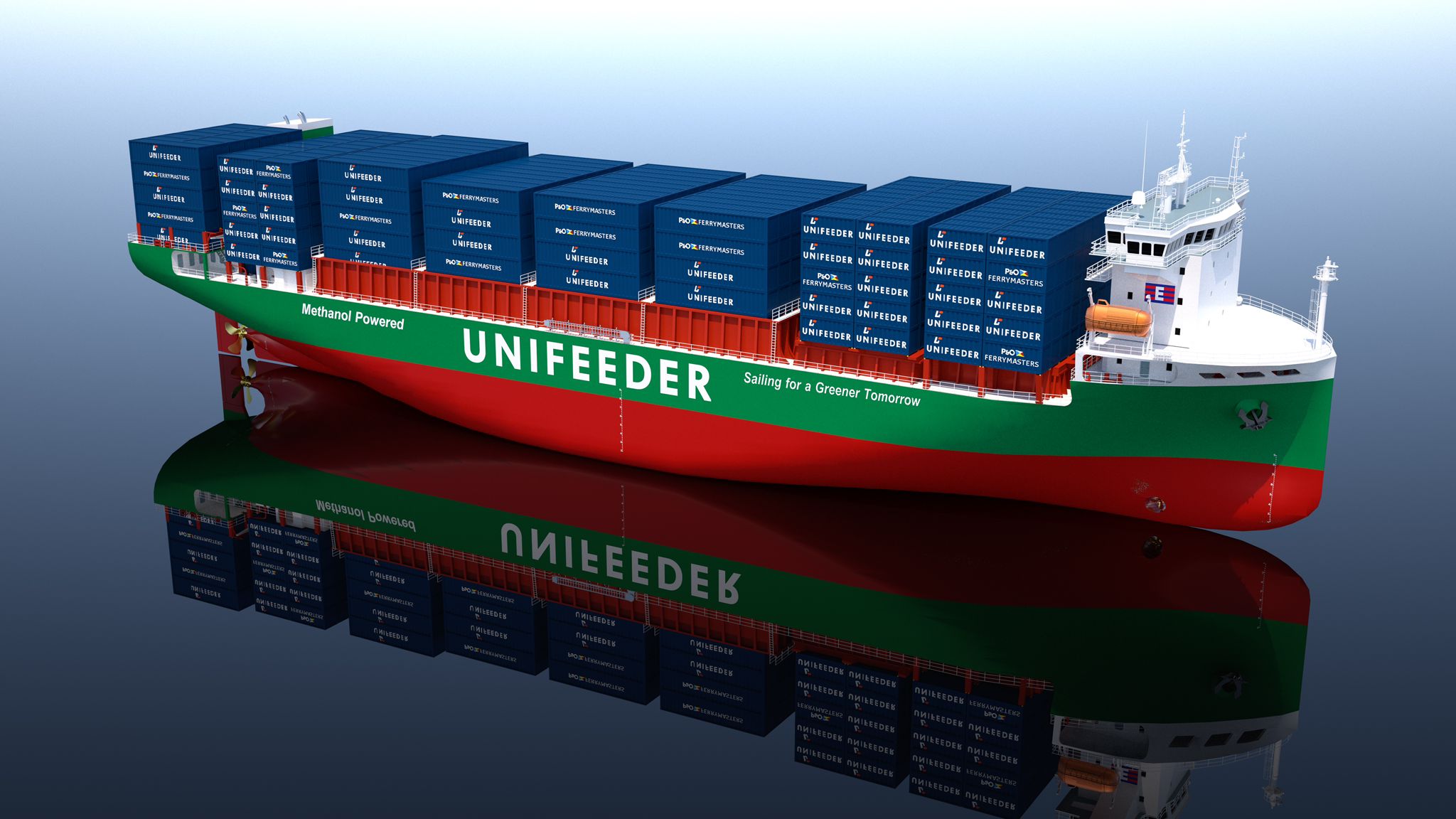
Unifeeder Group has successfully completed a long-term charter agreement for two additional methanol-capable container feeder vessels. This follows the agreement for two initial vessels announced in October 2023, underscoring the group’s commitment to greener shipping solutions.

The latest agreement is in partnership with German-based ship owning group Elbdeich Reederei and Norwegian shipowner MPC Container Ships (MPCC), who are responsible for one vessel each. The 1250 twenty-foot equivalent unit (TEU) vessels, scheduled for delivery in 2026, will be deployed on Unifeeder’s European network. The addition of these new vessels reinforces the group’s ongoing efforts to reduce emissions across its network. Simultaneously, Unifeeder is enhancing fuel efficiency throughout the fleet while increasing the utilisation of biofuels in its conventional vessels.

In alignment with its parent company, DP World, Unifeeder collaborates with industry partners to address the challenge of renewable methanol supply. This requires off-take commitments to establish production at the scale needed to replace conventional fossil fuels within the industry.

Methanol-Power

Jesper Kristensen, Group CEO of Unifeeder Group, said: “Building upon our commitment to methanol-powered vessels last year, this marks another significant stride towards the green transformation of our fleet and operations. We anticipate the vessels to enter into operation in the next two years, advancing our steadfast commitment to sustainable solutions. We offer our customers alternatives that align with their sustainability journeys while making meaningful progress towards our own ambitious decarbonisation goals.”

The investment in the two new additional ships further supports Unifeeder Group’s ambitious decarbonisation plan. Surpassing the industry average, Unifeeder has committed to a 25 per cent reduction of emissions by 2030 and to reach net-zero by 2050 with no new fossil greenhouse gas emissions. It aims to achieve this by emphasising fuel-efficient practices, regular maintenance and refitting processes of the existing fleet and fostering a culture of learning and collaboration, sharing best practices across markets to drive effective carbon reduction strategies.

Unifeeder Group is part of DP World Marine Services, which announced in December 2023 it had reduced its carbon footprint by more than 16% in 2023 from its 2019 baseline of 2,118 ktCO2e by creating efficiencies across its operations. DP World also joined the First Movers Coalition, setting a target for 5% of its marine power to come from zero-emissions fuels by 2030, marking its commitment to decarbonisation – a sentiment echoed by the Unifeeder Group.

Similar news here:

Unifeeder Invests in Methanol-Powered Vessels

Extensive Material Handling Lineup at LogiMAT

LogiMAT 2024 will see the first showcasing of an extensive lineup of material handling products from Bobcat. The global rebranding and integration of Doosan Industrial Vehicle (DIV) under the Bobcat brand with its range of forklift trucks and warehouse equipment, will provide even more solutions to help Bobcat customers to accomplish more. From 1st January 2024, all of the company’s material handling equipment has been produced in the signature Bobcat colours – white and orange.

The Bobcat brand is world famous for an extensive range of compact machines, which are used in construction, the agricultural sector, landscaping, demolition and many other industries. Bobcat loaders and telehandlers, which can be equipped with attachments such as pallet forks, buckets, grabs, bale clamps or dump hoppers, are often used for material handling and logistics tasks. So the addition of a complete range of IC and electric forklift trucks and warehouse equipment is a natural extension to the Bobcat range.

“Through our unwavering commitment to innovation and excellence, we have significantly broadened our product portfolio to not only meet the needs of our loyal customers but also to inspire and empower new customers to conquer their toughest challenges,” said Scott Park, CEO and Vice Chairman of Doosan Bobcat. “With an expanded range of solutions, we’re empowering even more customers to accomplish more.”

Bobcat Material Handling Products at LogiMAT

At LogiMAT 2024, the Bobcat product display will include diesel and electric forklifts, reach trucks and warehouse equipment such as pallet trucks and stackers. The display will also include Bobcat’s TL25.60 super compact telehandler, which allows work in tight spots without compromising performance, thanks to the machine’s compact dimensions and excellent manoeuvrability.

Lineup at LogiMAT
Lineup at LogiMAT

The Bobcat material handling products on the stand at LogiMAT include:

Diesel forklifts: • D160S-9, • D50SC-9

Electric forklifts: • B25NS, • B20X-7 Plus, • B80NS

Reach truck: • BR16J-9

Warehouse equipment: • BPL18S-7 pedestrian pallet truck, • BPR20S-7 ride-on pallet truck, • BDR13S-7 double stacker, • LSM12N-7 pallet stacker

These models are representative of products from the comprehensive Bobcat range for the logistics and material handling market, which include various lines: a series of diesel forklift trucks with lifting capacities from 2 to 16 ton; a series of LPG forklift trucks with lifting capacities from 2 to 7 ton and a series of electric forklift trucks with lifting capacities from 1.2 to 10 ton. The latter segment also includes a line of electric forklifts with three wheels for light work from 1.2 to 2 ton. As mentioned above, the warehouse solutions include pallet trucks, stackers and reach trucks.

Read similar news here:

Doosan Forklifts Transition to Bobcat Brand

Supply Chain Optimisation Key to Retail

Businesses across all sectors are looking to AI, whether it’s to improve productivity and efficiencies within their operations or to offer a more personalised experience to customers, writes Faki Saadi (pictured), Director of Sales, UK, Ireland and France at SOTI. A message echoed at the National Retail Federation conference, which saw retail giants such as Amazon, Walmart and Victoria’s Secret reveal new AI-enhanced offerings.

However, a recent SOTI study revealed that underwhelming in-store device experiences and frustrations with deliveries and returns processes are tempering consumer excitement for AI, with just one in five British shoppers looking forward to its arrival in the retail market. Before more brands integrate advanced technologies, either in-store or online, it is critical that they nail down the basics to provide a frictionless experience and gain consumer trust.

Need for Speed

A key consideration for many shoppers before they make any purchase is the expected delivery time. In fact, 42% of UK consumers now expect to pick up an item ordered online from a physical store on the same day of purchase and 43% will look elsewhere if delivery or pick up of an item exceeds two days.

The ability to offer this level of service to shoppers lies in having an optimised supply chain. Through the integration of AI and implementing a fleet of connected devices, businesses can access essential intelligence data to better manage inventory, re-route stock depending on requests for products and ensure logistical operations are strategically planned.

This eliminates any manual processes that are slowing down procedures and creates a network of connected warehouses and distribution channels, that can react and adapt depending on a company’s current needs. As such, brands will now be in a stronger position to guarantee both fulfilment and consumer satisfaction.

Removing Blind Spots

Consumers demand direct exposure to retailer’s supply chains, requiring a synchronised reflection of what is available, through what channels and in what time period. True transparency is key to helping consumers feel in control during their journey through the sales funnel while offering them the flexibility to shop where it is most convenient for them. The appetite is clear, with nearly three quarters (73%) of shoppers expressing a desire to always know where their order is within the delivery process. For brands to offer this level of insight, they need to invest in supply chain optimisation so that they can access accurate real-time data and intelligence.

Through this, organisations will benefit from having immediate detection and reaction to operational challenges by integrating both device and operational data, including status of on-time deliveries, inventory status and driver behaviour. This will allow retailers to provide precise information directly to consumers, on when a product has been dispatched, when it has been received by a local courier and how far that parcel is from the recipient at any time on the date of expected delivery.

We have seen this in action through our work with DPD. This logistics giant has achieved greater visibility and control of its entire mobile operations, making it far easier to meet expectations and increase customer satisfaction.

Fluid Returns

For many shoppers, the ability to return an item in a convenient way can be enough for them to choose one retailer over another. Nearly three in five (59%) UK consumers say they would be more likely to choose a retailer if multiple return points were offered. Therefore, it is essential that brands offer a variety of couriers, returns lockers or the option to drop products off at any branch nationwide or at partner stores. But, how can retailers make that happen and still maintain visibility over all the moving parts?

From the point of a customer registering a return, to arranging delivery back to the warehouse and getting inventory processed into the system to be sold again, businesses should be making use of connected devices to retain as much data as possible. By developing an optimised supply chain, this data can then be made accessible and shared between various warehouses so that stock can be re-distributed to areas in need and operations managers can have a clear view of any movements in the facility. By integrating a fully automated process, retailers can then improve efficiency and ensure that the return journey is smooth and uninterrupted.

The Takeaway

Customer loyalty is becoming increasingly fickle, and all organisations should be using every tool at their disposal to build and retain it. A SOTI customer, American Airlines, which leverages remote control help desk tools to maintain customer satisfaction, proves that having the right technology at your fingertips can exponentially improve the overall experience of your customer base.
So, as retailers look ahead to advanced technologies like AI, it is critical that they revise their existing tech strategies now, both in-store and across the supply chain, so that when they do make the transition to AI, consumers are receptive, excited and optimistic.

Read similar news here:

Shoppers Ditch Sustainability for Bargains


Automated Hand-Scanning Upgrade

The automation of hand scanning processes increases productivity at inbound and outbound areas of logistics hubs dramatically. Now, a milestone upgrade to SICK’s Lector65x image-based code reader family has made it quicker and easier to set up and use the technology in high-volume operations.

Hand-held barcode readers are still widely used to ensure the traceability of goods and packages, for example in retail, warehousing and parcel sorting operations. However, this process not only takes time, but picking and putting down the hand scanner while handling the object risks repetitive stress and strain to the operator.

With a SICK Lector654 matrix camera installed above their workstation, operators can instead present the package to the scanner at the most ergonomic height, confident of highly-reliable read rates. With SICK’s innovative dynamic focus function, the camera can adapt flexibly to the working distance and the position of the code. Meanwhile, the operator can use both hands where necessary to handle more bulky or heavier objects.

Increase Productivity and Throughput

“In many logistics operations, the pressure is on to increase throughput, maximise productivity and eliminate any processes that could lead to delay or stoppages,” comments Darren Pratt, SICK’s UK Product Manager for Identification.

“SICK’s Lector654 offers a simple solution that is easy to set up without major changes to existing working areas. Operators can then work without the delays, interruptions and unplanned downtimes which are unavoidable when using hand scanners.

“Some overhead camera set-ups have a fixed focal point, but with the Lector654’s dynamic focus, adapting the workstation for people of different heights can be automated.”

The SICK Lector654 adapts flexibly to the position of the code, thanks to its extensive field of view and depth of field. Used for hand presentation, it can read a wide range of common 1D and 2D code types, while onboard decoding algorithms ensure maximum read performance and high-throughput even for difficult-to-read codes.

Hand-Scanning

The SICK Lector654 reliably identifies and decodes all common 1D, 2D and stacked code formats. With a high-resolution CMOS sensor, the Lector654 has the resolution to read all object sizes from large to small. Thanks to both dynamic focus and brightness adjustment, the Lector654 produces the highest quality images, which can also be recorded for other track and trace purposes, if required.

The SICK Lector654 also shares the high-performance features of SICK’s Lector65x family of image-based code readers. With a frame repetition rate of 40 Hz and real-time decoding, Lector65x track and trace systems reliably identify 1D, 2D and directly marked codes at high speeds. Training and installation time are minimised thanks to the camera’s function buttons, auto setup, an aiming laser, an acoustic feedback signal, and a green feedback LED.

With SICK’s 4Dpro common communications platform, the SICK Lector65x family of image-based code readers communicate easily with other SICK devices, for example for volume or weight measurement, and share their data and parameters, linking seamlessly with factory control and data systems. Compatible with TCP/IP, EtherNet/IP, PROFIBUS, serial and CAN interfaces, the Lector 65x cameras also have a MicroSD card slot to enable parameter cloning and image storage.

Read similar news here:

Right for Size: SICK Upgrades Volume Measurement System

Subscribe

Get notified about New Episodes of our Podcast, New Magazine Issues and stay updated with our Weekly Newsletter.