Versatile Rolling Container System

Returnable transport packaging (RTP) has moved on significantly since the emergence of that retail staple, the metal roll cage. Manufactured from durable plastic, Loadhog says its Dolly Max Rolling Container System delivers more versatility, a safer user experience, greater manoeuvrability and improved vehicle fill.

Many retailers are turning away from single-use packaging and looking to RTP to provide sustainable and costeffective transport of goods between their distribution centres and stores. While pallet loads are usually stretch wrapped on automated wrappers and ship from the DC, returning goods from the stores requires time-consuming manual wrapping or boxing up. Roll cages have helped overcome the drawbacks of pallets and boxes in the supply chain but they have their own disadvantages, being notoriously difficult to handle and often featuring sharp metal touchpoints.

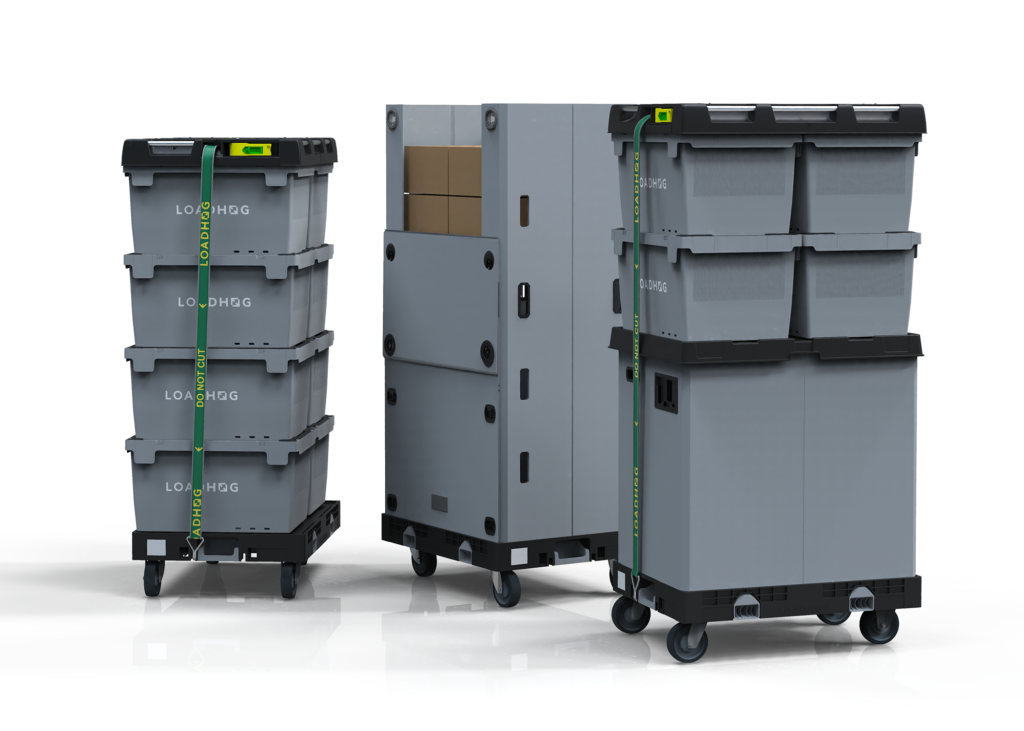
The latest Dolly Max Rolling Container System from Loadhog takes the humble roll cage to a new level, according to its manufacturer. This modular system features the Dolly Max wheeled deck, which can be used in conjunction with containers (for segregated products), a foldable sleeve (for bulk items/uglies) or – with the addition of a shelf – a combination of the two in a hybrid solution for mixed goods. The sleeve is fixed to the Dolly Max by two foot-operated locks avoiding the need for staff to bend down to secure it in place. It also features a drop-down door for easy access with picking in warehouses and replenishing at store level.

With its mix-and-match design, Loadhog says it is the most versatile rolling container system on the market, giving users the flexibility to adapt to the fluctuating nature of goods within their supply chain. Loads can be secured with Loadhog’s reusable Half Euro Pallet Lid, which features retractable straps and an integrated tensioning mechanism. Other accessories include a quick-connect
pull handle, a sleeve tray for containers to be stacked on and a tow hitch to link dollies in a train for easy manoeuvrability around warehouses and stores.

One-Touch Brake

The lightweight Dolly Max is easy to manoeuvre and features an easyaccess, one-touch brake that is more ergonomic than the simple castor brakes found on roll cages. The ease of brake
application encourages use, enhancing safety for employees, and the innovative mechanism ensures the unit remains still even on a sloped tail lift.

Loadhog says the Dolly Max system offers 20% more vehicle fill compared to standard roll cages, reducing carbon footprint. In addition, the embodied carbon of the recycled polypropylene system is significantly less than that of roll cages manufactured from coated metals, securing further sustainability gains. Also, the tare weight and footprint of the Dolly Max system enable it to be utilised on all vehicle types, even smaller sprinter vans.

As well as avoiding the need for a forklift or pump truck, the system can also be attached to automated guided vehicles (AGVs) for easy manoeuvrability around the DC. The system has been designed for fast deconstruction to ensure efficient returns, with containers nesting, sleeves folding, and the Dolly Max frame featuring castor cups for stable stacking. The return ratio is typically
Loadhog also offers labelling, tracking and branding options for all elements of the system to safeguard both packaging assets and goods. Of course, branding enhances the in-store aesthetic,
especially if the packaging doubles up as a product display unit.

The versatility of the Dolly Max has resulted in a recent order for 10,000 units, which will be used for nationwide distribution of automotive products. Having supplied RTP solutions to many high-street brands – including Harvey Nichols, Pets at Home, Sky, TK Maxx and Dunelm – Loadhog says it has considerable expertise in meeting the logistics needs of today’s retailers.

similar news
Next Gen Rolling Container System


Sweet, Fast Industrial Doors

The production of confectionery in Holešov, Czech Republic, has a long tradition dating back to 1863. At that time, Philip Kneisl started producing sugar whistles and sticks and became one of the first manufacturers of sweets in the Bohemian countries. And just as it was in the 19th century, today the Holešov plant is the most important confectionery manufacturer on the Czech market. While the delicacies are still produced according to traditional recipes, the operating equipment meets the most modern standards. Thirteen Efaflex high-speed doors provide key functions for securing the production area.

The fastest door with the fastest service

“Our company’s priorities are safety and quality. We place great value on the safety of our employees and, of course, that of our customers. That’s why we chose Efaflex high-speed doors. They meet these high requirements and function reliably even in continuous operation. Last but not least, Efaflex offers flexible customer service that resolves problems in the shortest possible time”, explains Radek Ponižil, industrial engineer at Nestle. The spare parts are produced in the Czech Republic and Efaflex can deliver most of them within 24 hours – an exceptional level of service.
Although production began in the 19th century, the Holešov plant now has cutting-edge equipment that meets all the requirements for modern food producers. Both raw materials and finished products pass through the high-speed Efaflex doors upon arrival and delivery.

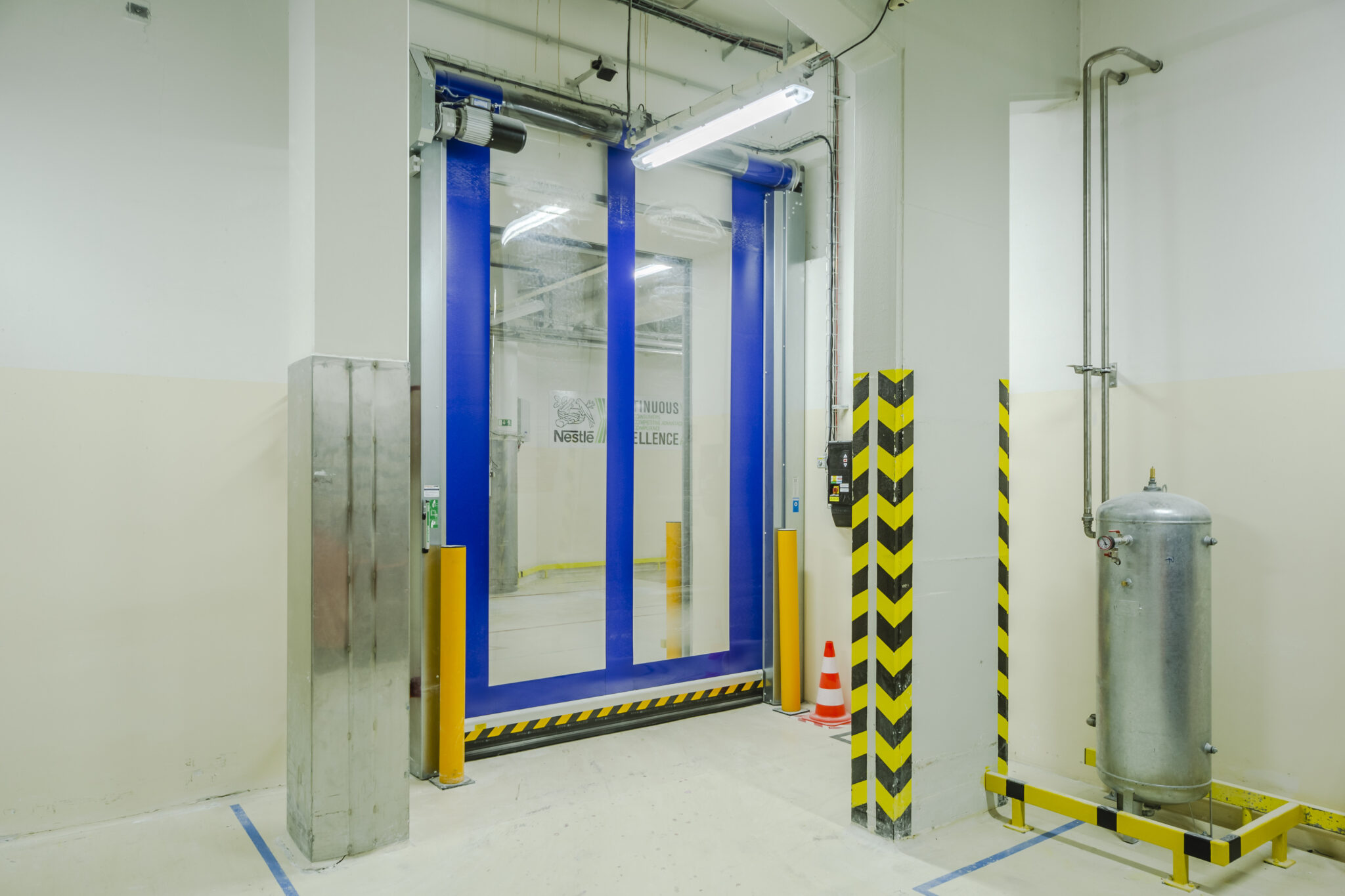
Most of the doors are the EFA-SRT® Premium model. The main reason the customer chose these doors was their fast opening speed, which reaches up to 2.5 m/s. This is particularly important in food processing plants: by opening and closing quickly and remaining open for as short a time as possible, the doors minimise the penetration of particles into the processing plants. This is important, for example, for the doors that separate the outdoor areas from the production areas.

In addition, the doors help to accelerate logistics processes, save energy, and create a more pleasant climate for employees in the halls. Another advantage of Efaflex products is their long service life and reliable operation, as they can handle hundreds of load cycles every day without problems. For instance, the EFA-SRT® ECO can handle up to 150,000 load cycles per year. Another door with a special feature, the EFA-SST®-L, is mounted in the shipping area. Due to the limited space, a low lintel version was used instead of a classic installation. This solution is used where the ceiling is low and other door leaf guides cannot be used. This also allowed a door with insulation laths to be installed in this location.

World-famous sweets

The Holešov plant has been in operation since 1863. However, much has changed since its founding back in the days of Austria-Hungary. The company successfully weathered two world wars and the nationalisation in 1949. It is now part of the multinational Nestle corporation. The products are among the most widely sold brands of non-chocolate confectionery in the domestic market. The most famous are Linsen, BON PARI, JOJO jelly bonbons and Haslerky.

But it is not only locals who enjoy the sweets from Holešov: a significant portion of the products are shipped abroad. Another portion of the products bear the names of brands that are destined directly for the foreign market.

similar news

EFAFLEX high-speed doors help optimise workflow


Manage Fleets All Day Long

Managers of road transport fleets can have influence not just at the departure and arrival from the depot hub, as David Priestman reports.

“Data and insights lead to action,” Samsara CEO Sanjit Biswas informed attendees at the company’s Go Beyond event in London. He visited 100 Samsara customers last year. By listening to them and understanding how they use the data obtained from the dashcams and sensor technology the company can continue rolling out updates and extensions to its ‘Connected Operations’ platform.

These include a strike alert for low bridges (particularly useful on old British roads); electronic brake performance monitoring; a privacy mode that stops the driver-facing camera monitoring (something that is resisted by some drivers and unions, or just not suitable for a minority of operations); and drowsy driver detection. “We have enough data now for drowsy driver detection,” Chief Product Officer Kiren Sekar told me, “based on a driver’s blank stare, nodding head, closed eyes and/or rubbing eyes.”

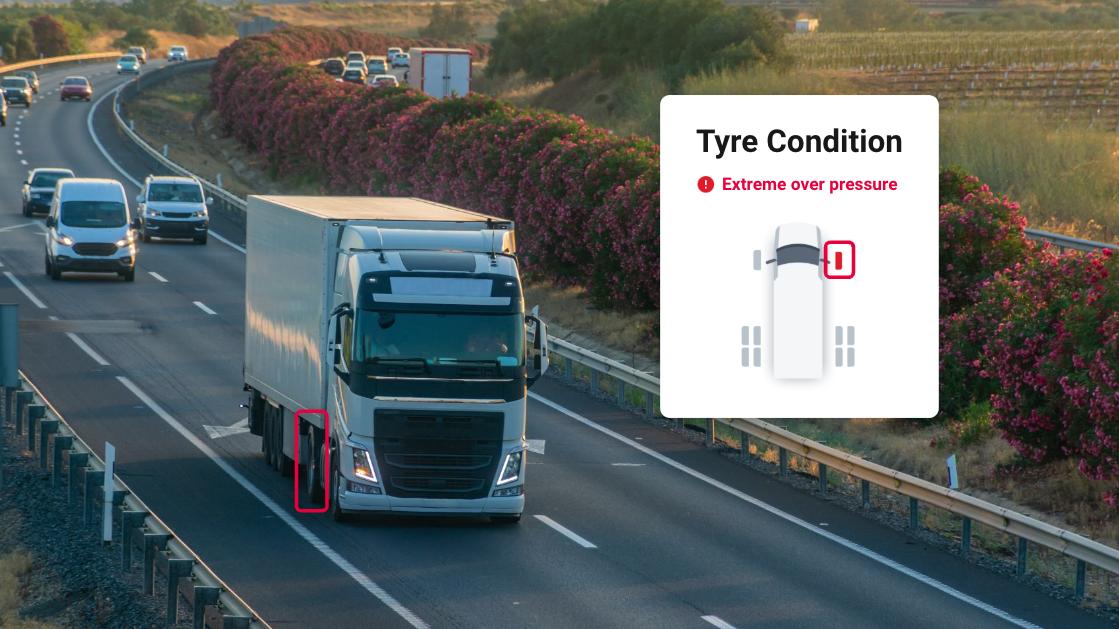
Lane departure warning and forward collision warning is being added to the platform too, as well as ‘smart trailers’ real-time GPS tracking, which also monitors trailer brakes and tyre pressures. “All the data is there in a single platform,” Sekar explains, “location, maintenance, charger insights. We can integrate with the trailer manufacturer’s sensors. How do you ensure the driver has the right trailer? We can do that, but if you’re using just the data from the trailer manufacturer you wouldn’t know that.”

Good Drivers Prevail

The ‘virtual coach’ shows the driver camera footage of all alert issues. This is powerful and is used as positive feedback and constructive advice to them. Only 20 per cent of drivers need extra help. 80 per cent are good drivers, but need to avoid any bad habits developing. ‘Connected training’ uses AI to write and create driving courses.

Samsara’s IoT and AI tech is well-suited to be used on electric vehicles as transport firms continue to switch from diesel and petrol commercial vehicles as the challenge of operations is greater with EVs. “Most of our customers are still using ICE trucks and vans,” says Sekar. “EV conversion is a business case, as is saving on fuel. Demand for EVs differs across locations. Safe driving is also more sustainable, of course.”

The platform provides data on everything from severity of speeding, idling to fuel usage and time-on-site, producing a trip summary for managers, who can select advanced custom reports, using up to 9 data points, on things like scope 3 emissions. Samsara aims to have an impact on customer outcomes – running and insurance costs, accidents, emissions and more.

League Table

Paul Duncalf, Director of Safety for Sysco (which owns Brakes food distribution) talked about the roll-out of Samara in its CV fleet. “You need a compelling story to persuade the team to adopt technology. Ours was to reduce serious traffic accidents. Do you want to work for a company that doesn’t want to do that and have that on your conscience?”

What about getting driver buy-in for the introduction of cameras? Sysco had an amnesty for driver misbehaviour for the first few months, except for phone usage. Sysco managers use the tech themselves. “We showed drivers how it works and some footage so they knew why we were introducing it.” Best driver competitions and incentives, all data driven, help with acceptance. “League tables work well psychologically,” he points out. “Start with the alert settings bar set high, rather than for everything. Then lower it to make things tougher,” he advises.

Boardroom Decision

Fraikin’s Chief Digital Officer, Edward Breedveld, describes working with Samara as a ‘partnership’. “It’s open, collaborative and transparent,” he says. “We’re pushy to break boundaries and get things solved and we wanted to get it right first time.” Fraikin has 60,000 commercial vehicles in 10 countries in Europe, providing a full-service rental fleet to its customers, from delivery to maintenance and replacement. The company is still retrofitting its entire fleet with Samsara tech and deploying it on all new vehicles. A boardroom-level decision, with what Breedveld describes as almost ‘military level planning’.

“We need the driver to be happy and they’re in short supply, so we want feedback,” Breedveld states. “Information is key. We show people in real time how Samsara works. Data is needed because decarbonisation is coming.” As fleets switch over the financing and usages of EVs brings concerns around charging, battery degradation and resistance to change. Data from Samsara’s platform provides actionable information to improve user experience and reduce the environmental impact of road freight transport.

France is a challenging market to deploy Samara in Fraikin vehicles. There are legal obstacles around privacy so union backing is required. ”Each market is different,” Breedveld informs. “But in Europe the journey to net zero in road transport and to zero emissions in urban areas is irreversible.”

Samsara’s customers like the fact that the platform keeps moving forward, offering more for them to use it for and learn from. “When one of Fraikin’s fleet customers understand what data can be provided they see the potential,” Breedveld concludes. “The system tells the customer what they didn’t know before. Customers use Samsara for positive reasons, not for ‘big brother’ negative ones. It helps everyone, for example with plummeting mobile phone use. Companies using Samsara can benchmark themselves verses their competitors, favourably.”

similar news

Samsara Launches Sustainable Fleet Management Solution


Subscribe

Get notified about New Episodes of our Podcast, New Magazine Issues and stay updated with our Weekly Newsletter.