Medical Supplies Storage Solution

A tailor-made META-Lagertechnik Austria storage solution in Vienna has recently been handed over and successfully put into operation to its customer VIVISOL. The logistics centre for medical supplies is yet another example of the expertise and benefits that META offers its customers under the name META-ILS (Innovative Logistic Solutions).


VIVISOL is among the leading medical technology service providers in the field of homecare services, offering comprehensive nursing care and medical technology support both in the home environment and in specialised facilities. This includes core areas such as oxygen and sleep apnoea therapy, ventilation therapy and monitoring/diagnostics. Today, VIVISOL cares for more than 750,000 patients across Europe. So-called VIVISOL AtemCenters store and provide therapy equipment for homecare, e.g. in Vienna, where META-Lagertechnik Austria has now implemented a custom-designed storage solution.


Since as early as 1972, META-Lagertechnik Ges.m.b.H has been an expert partner for the Austrian market and has become a leading supplier of innovative storage solutions and state-of-the-art technology for efficient warehouse management and logistics.

Perfect combination


META offers customised solutions for complex tasks in the field of warehouse automation with conveyor technology under the name META-ILS. Customers worldwide benefit from the full package of efficient conveyor technology combined with premium warehouse technology. It is this very expertise and the perfect combination that took centre stage in the realisation at the VIVISOL AtemCenter in Vienna. META was awarded the contract for this project not least due to its many successful references in this field and its META-ILS expertise.

The result: considerably more efficient order picking


At the heart of the system are META MULTILINE order picking racks with integrated flow lanes, providing storage capacity for approx. 2,800 containers on the lower levels of several META MULTIPAL pallet racking rows. Comprehensive consulting and analysis has paved the way for significantly shorter and more efficient picking routes. The result of combining static racking technology and conveyor technology is indeed impressive: a significant time saving of 45% has been achieved, as measured and documented by the customer VIVISOL.

Using roller and vertical conveyors across all storage levels, automated goods/container transport is carried out with maximum efficiency, including the entire logistics chain from goods receipt to goods issue.


Separate area for returned goods


Another result of the process: returned goods are consistently separated from regular stock so that contaminated devices are stored strictly apart from non-contaminated goods.


A vertical conveyor now transports the returned devices to the first floor, where they are then thoroughly cleaned and decontaminated. This area is located in a separate fire protection section, which required the integration of a fire-protection door. Here, the fire door has been connected and synchronised with the conveyor technology in operation – a real technical challenge that was successfully mastered.
Once the goods receipt and decontamination processes are complete, the devices are returned to the warehouse and put back into circulation by means of a second vertical conveyor.

Further storage areas and storage solutions


Additionally, further storage areas have been created involving the optimum use of META storage systems. META CLIP shelving and hazardous materials racks are used to create individually adaptable storage spaces for hazardous materials requiring special storage conditions. Further storage levels have been created using a steel platform equipped with an emergency ladder to ensure an escape route.
Microshifting: a Logistics Game-changer

Mounting pressure on fulfilment and a shrinking talent pipeline across warehousing and transport means flexible shift design is key to keeping supply chains moving.

With the average HGV driver now aged 51 and more than a third of UK employees over 50 years-old, workforce management expert Ned Gammel (pictured, below) says microshifting – shorter, more flexible shift models – could be the key to securing the sector’s future.

Gammell, VP of Sales at workforce management provider Quinyx, warns that without urgent change, the sector risks running out of talent.

He explains:

“Logistics leaders know the workforce is ageing fast, but the solution isn’t just hiring more people – it’s modernising how we schedule work. The next generation expects flexibility, autonomy and balance. Microshifting delivers all three – and could be the difference between a full team and an empty depot.”

Data from the Road Haulage Association reports nearly half (47%) of HGV drivers are aged over 50, while only 1% are under 25. Insights from Quinyx’s State of the Frontline Workforce Report reveal a sharp generational divide across logistics roles:

• 74% of logistics workers aged 54+ are satisfied with their jobs – 10% higher than their 18 to 24-year old colleagues
• 86% of over-54s feel appreciated at work
• Almost half (46%) of over-54s report no work-related stress

In contrast, younger logistics employees cite depression (51%), burnout (36%), stress (55%) and lack of scheduling flexibility (20%) as key frustrations at work – underlining the need for new shift structures that fit modern lifestyles.

Already gaining traction in retail and manufacturing, microshifting allows frontline roles to be divided into smaller, stackable blocks that can be swapped or selected by staff.

Gammell continues:

“You can’t always divide a long-haul route in two, but many warehouse, picking and dispatch roles are perfect for modular scheduling. With smart technology, businesses can match cover to demand peaks, while offering workers greater control over their hours.”

With intelligent, AI-driven scheduling tools, logistics operators can:
• Attract younger talent with flexible, lifestyle-friendly shifts
• Retain older workers through phased or reduced-hour options
• Reduce burnout and absenteeism by balancing workloads
• Optimise resources around real-time demand peaks

Gammell concluded by saying that Microshifting isn’t a gimmick.

“It’s a practical fix for a growing workforce crisis. By modernising shift design, logistics leaders can build multi-generational teams that are motivated, balanced and ready for the future.”

Louisville Crash Highlights Freight Hub Resilience

The recent UPS cargo aircraft crash near Louisville Muhammad Ali International Airport — home to the carrier’s Worldport super-hub — has highlighted the critical role that major air hubs play in global logistics, as well as the importance of resilience and safety across integrated air networks.

While investigations continue, UPS acted quickly to limit operational disruption. Flights continued to move and the hub remained open, supported by established contingency plans that enable rapid rerouting and overnight schedule adjustments. Worldport typically processes around 2 million packages per day, meaning even small delays can have wide-reaching effects across global supply chains.

Louisville’s central position makes it a vital node for time-critical deliveries, with next-day e-commerce fulfilment, automotive service parts, and healthcare shipments heavily reliant on its overnight turnaround. The incident therefore renewed focus on the risks of dependence on single mega-hubs and the importance of maintaining alternative routing strategies.

The National Transportation Safety Board (NTSB) is leading the investigation, with UPS cooperating fully and prioritising support for its crew and their families. The cargo aviation sector maintains a strong safety record, but events like this reinforce the need for continual investment in training, monitoring and fleet safety programmes.

For shippers and logistics managers, the incident serves as a reminder to review network resilience, service-level diversification, and visibility tools to ensure minimal customer impacts when hub disruptions occur.

As volumes through integrated air networks continue to rise, maintaining robust hub infrastructure and contingency planning remains essential to keeping global trade and e-commerce running on schedule.

Freight Forwarders see Tech as Fundamental

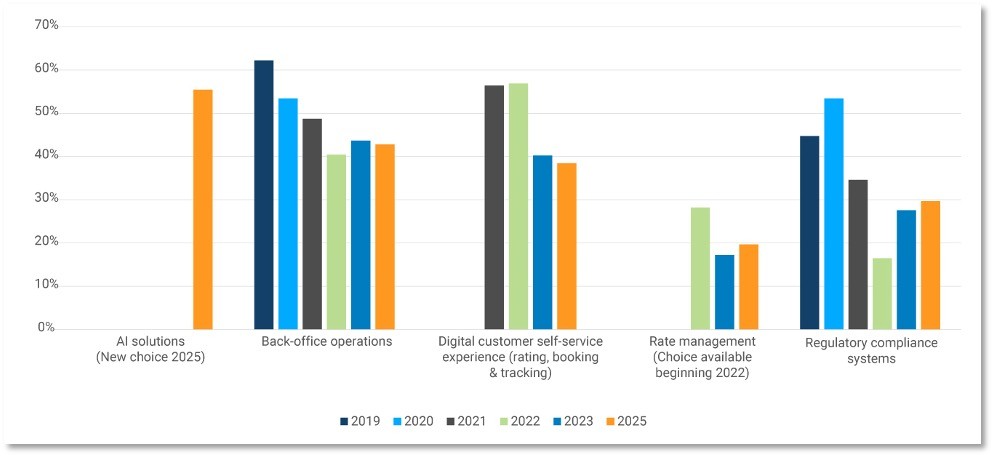
Descartes Systems Group has announced the results of its Global Forwarder/Broker Benchmark Study of more than 400 companies, highlighting a logistics industry navigating global uncertainty and technological opportunity. According to the study, global instability (60%), tariff changes (42%) and customer pricing pressure (61%) are among the most significant challenges freight forwarders and customs brokers expect to face over the next five years. In the face of these headwinds, however, 67% of respondents viewed technology as fundamental or highly important to growth, and an overwhelming 55% cited implementing new technologies as the top strategy to grow over competitors.

Respondents viewed the ability to leverage automation and artificial intelligence (AI) as vital to achieving long-term efficiency, compliance agility and profitability. AI (65%) was cited as the technology expected to deliver the greatest value to organizations over the next two years. While many traditional technologies experienced a decline in perceived value, both rate management (20%) and regulatory compliance systems (30%) showed gains in 2025. Rate management solutions have grown in importance for the ability to deliver automated, self-service rating and quoting capabilities to customers, while the value of regulatory compliance systems has increased given the complexities of meeting quickly evolving regulatory demands.

Other key findings include:

  • Manual processes hinder growth: 25% cited manual workflows as the top inhibitor to growth, with smaller companies especially constrained by limited access to capital (27%).
  • AI dominates technology investment: 55% of respondents plan to prioritize AI investment over the next two years.
  • Competitive edge shifting: Tailored services (33%) overtook high service (31%) as the top competitive advantage, signaling a move toward more customized and data-driven customer experiences.
  • Importance of technology diverges by company size: While 60% of large companies view technology as fundamental to growth, only 27% of small companies share that view.

“Over the nine editions of the study, the role of technology has changed significantly for freight forwarders and customs brokers—from streamlining back-office operations, to enabling digital customer engagement, to harnessing intelligent automation,”

said Scott Sangster (pictured above), General Manager, Logistics Services Providers at Descartes.

“This shift is mirrored in the industry’s IT investment priorities, which have evolved in step with technological maturity: from technology for efficiency in 2019–2020, digitization in 2021–2022 and now intelligence and automation through 2025. While forwarders and brokers are facing unprecedented global trade volatility today, many organizations remain optimistic about technology’s potential to help redefine their future.”

Subscribe

Get notified about New Episodes of our Podcast, New Magazine Issues and stay updated with our Weekly Newsletter.