Smart Compliance for EU and UK Fleets

Samsara has launched an industry-first dynamic Smart Compliance solution for fleets across the EU and UK. The platform enables a proactive approach to tachograph (tacho) compliance, helping organisations manage critical elements of driver safety and regulatory workflows in one place.

Designed for compliance managers and safety leaders across industries, Samsara’s Smart Compliance integrates prevention, management, and coaching into a single, open platform.

Traditional compliance often requires managing multiple, disconnected systems for tacho downloads and telematics. This creates administrative burdens and increases the risk of legal fines. With 60% to 80% of EU fleets operating across borders, managing these complexities is a daily challenge.

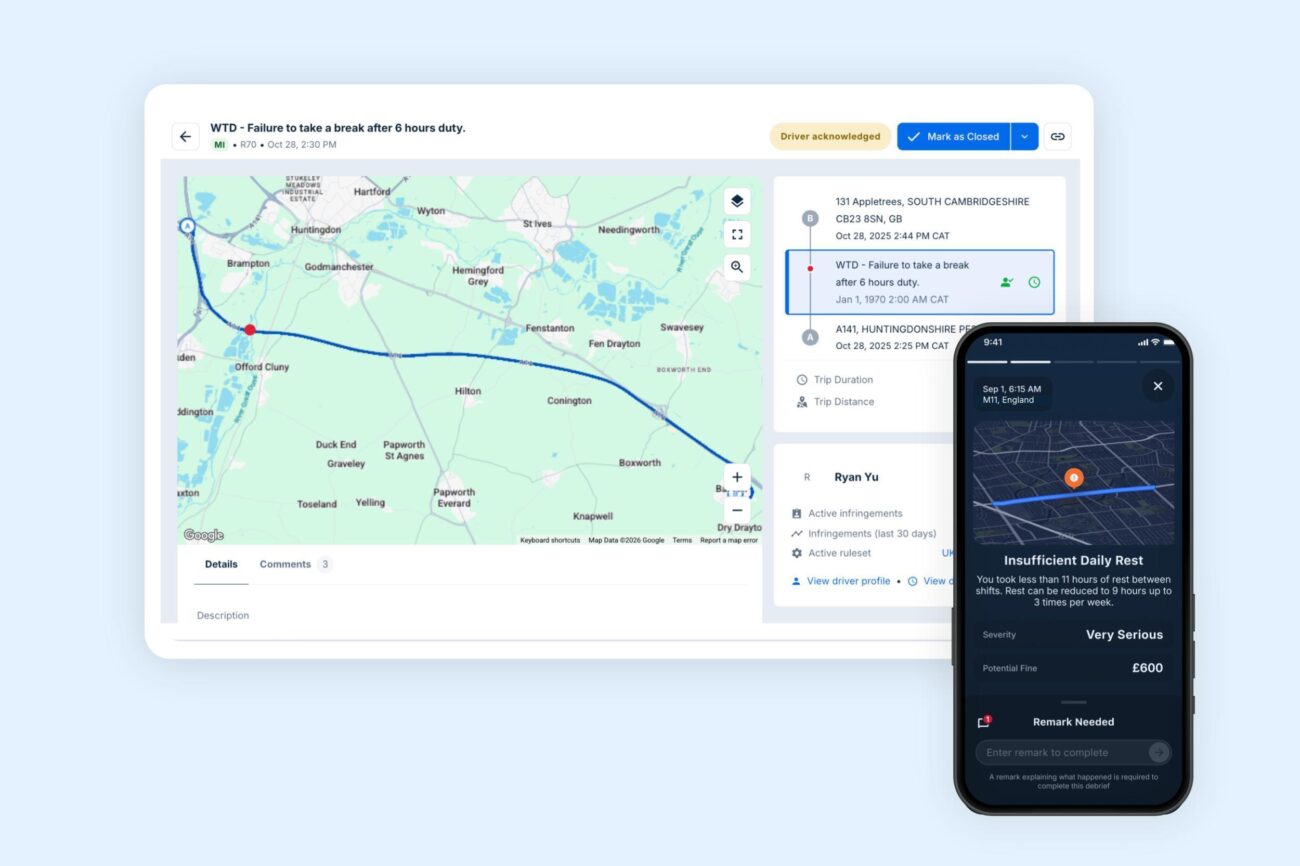
Samsara claims to be the first platform that eliminates the need for fragmented, legacy systems by seamlessly consolidating AI-based safety, telematics, and comprehensive compliance into a single experience. As one of the first in the industry to offer proactive pre-infringement audio alerts, it aims empower drivers to correct errors in real time before they result in infringements.

While other solutions offer a patchwork of tools, Samsara provides a one-stop shop with advanced rulesets for 17 European countries. This unified approach gives organisations the accurate insights they need to scale cross-border operations while keeping their people safe and their supply chains resilient.
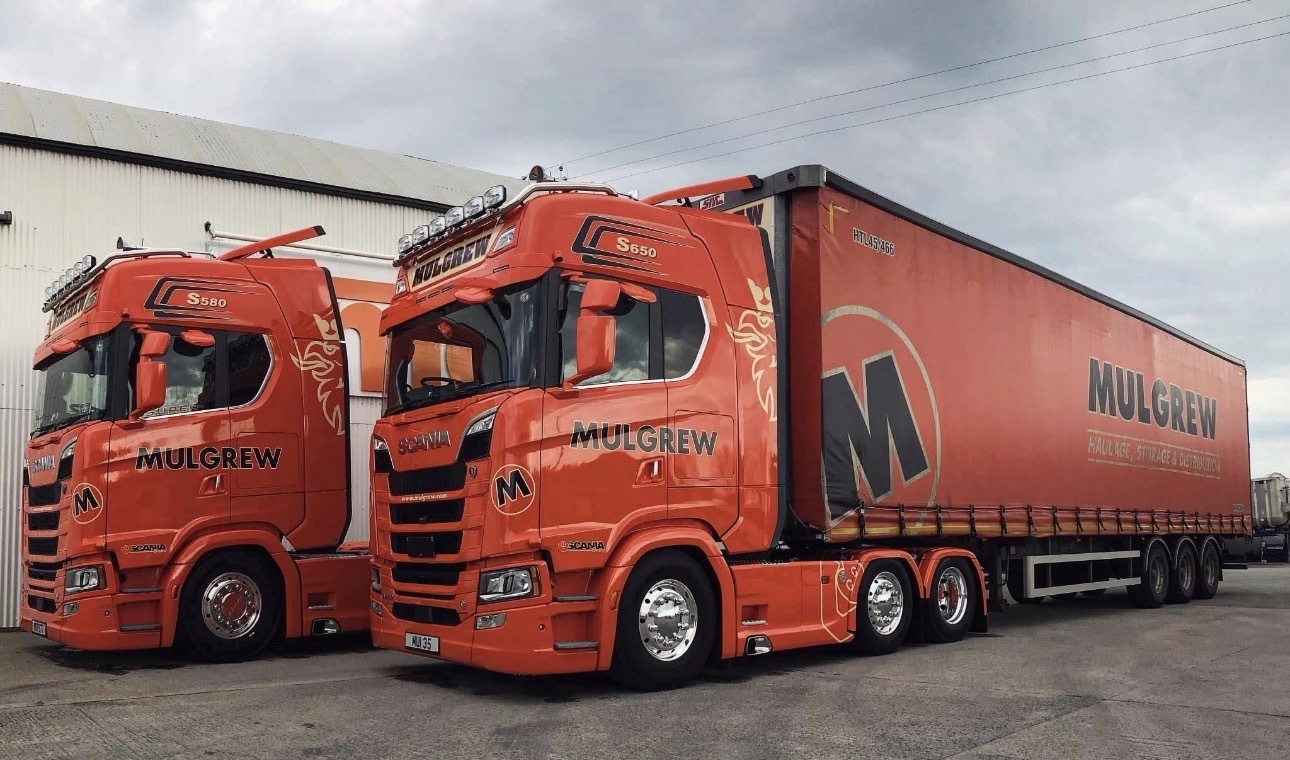
“Previously, we would wait for the infringement report and deal with everything in bulk, which could take most of the day,” said Matt Crossland, UK Area Manager at Mulgrew Haulage Ltd, one of the first customers to trial Smart Compliance. “Now everything is in one place—the infringement, manager response, and driver acknowledgement — and it takes about two minutes per infringement with Smart Compliance. Instead of looking back at last month’s infringements, we review yesterday’s, deal with them immediately, and send them straight to the driver digitally to fully understand what happened. This reduces what previously took a day, to a matter of minutes.”

Key innovations for smarter operations

  • In-cab alerts: Real-time warnings help drivers avoid errors and stay safe before an incident occurs.
  • Centralised dashboard: Organisations can manage everything from tacho downloads to infringement resolution in one central location, increasing speed and accuracy.
  • VDO-powered European rulesets: Leveraging industry-leading infringement analysis from VDO across 17+ countries, with ongoing updates to support evolving EU regulations.
  • Digital coaching workflows: Integrated tools for driver debriefs and self-acknowledgment turns data into meaningful, actionable coaching.
  • Compliance KPIs: High-level dashboards allow managers to track improvements and identify trends at a glance.

The stakes for maintaining compliance have never been higher. In 2024, tachograph offenses accounted for 58% of all DVSA HGV prosecutions, and the regulatory landscape continues to evolve. Starting in July 2026, these requirements will extend to cross-border LCVs over 2.5 tonnes, putting additional pressure on international fleets. For many organisations, the risk of non-compliance goes beyond financial penalties; it can lead to the loss of their operator’s licence, making a unified, reliable compliance platform an essential part of their long-term resilience.

By moving to an integrated, data-driven system, fleets can reduce administrative costs and significantly cut down on fines. With costs of up to £5,000 per infringement and the risk of suspension or loss of an Operator’s License, proactive compliance is critical for fleet operations. This approach also boosts driver retention by replacing punitive measures with helpful, respectful coaching.

“Our customers’ operations in Europe are some of the most complex in the world, and there is a huge opportunity to use AI to spot risks and avoid infringements,” said Praveen Murugesan, VP of Engineering EMEA. “Smart Compliance takes the guesswork out of compliance by automating the toil that office teams grapple with every day. We’re super excited to provide the technology that keeps these essential supply chains moving safely.”

Forklifts with Permanently Integrated Lithium-ion

Integrated lithium-ion batteries provide design engineers with a range of opportunities to enhance vehicle ergonomics. Linde Material Handling (MH) leverages this benefit in its new Linde Ei model series of electric counterbalance forklifts. The three- and four-wheeled models, which are available with load capacities ranging from 1.4 to 2.0 tons, are technically based on the standard Linde E electric forklifts with a classic replaceable battery system. However, the new Ei models offer significant added comfort and safety thanks to their innovative energy concept, which utilizes an integrated lithium-ion battery.

The new Linde Ei14 – Ei20 electric forklifts are designed for light to medium-duty applications in single- or two-shift operations at temperatures as low as minus 20 degrees Celsius. This makes the Linde Ei models a cost-effective yet highly ergonomic alternative for companies that have previously used electric forklifts with lead-acid batteries for their intralogistics material flow operations. Unlike lead-acid batteries, which require overnight charging, forklifts equipped with (integrated) lithium-ion batteries can be recharged during operation, such as during breaks. Lithium-ion batteries are maintenance-free and do not release battery gases during charging, eliminating the need for a separate, ventilated charging room. This frees up space that can be used for other purposes. The need for constant monitoring of the battery acid level and topping off water is eliminated as well. The optional onboard charger further increases operational flexibility, as it can be used with any standard outlet.

Ergonomics reimagined

The major advantage of the integrated lithium-ion battery is the additional cabin space it provides. Eliminating the traditional battery compartment has increased the driver’s legroom by 35 percent, significantly surpassing the industry average. This allows for a more relaxed seating position during the workday, increasing the driver’s well-being, motivation and long-term health. At the same time, the entry step is only 40 centimeters above the ground, making it very comfortable to get in and out.

“This low yet wide entry design leads the entire vehicle class,” says Richard Bozem, Senior Strategy and Portfolio Manager at Linde Material Handling. “The design provides exceptional comfort in daily use, and it enhances safety as well. Beyond that it is especially advantageous in this payload class, where drivers frequently leave their vehicle to perform other logistical tasks.”

High-level performance

Similar to the Linde E14 – E20 electric forklifts with replaceable batteries, models with integrated batteries feature a 48-volt drive system and maintenance-free asynchronous motors. This provides sufficient power for their full range of tasks. Thanks to swivel steering on the three-wheeled version or the Linde combi steering axle on the four-wheeled version and their compact dimensions, these forklifts achieve high handling performance, even in tight spaces.

Safety first

As with all Linde vehicles, the safety features of these models represent a key part of the brand’s DNA. The slim mast design offers excellent all-around visibility, while integrated standard assistance systems provide additional stability. For example, the Linde Curve Assist automatically adjusts driving speed in curves based on the steering angle, while the Linde Load Assist uses pressure sensors and a lifting height indicator to control tilting, lifting, and traveling functions to prevent tipping accidents. Optional assistance systems such as the Linde Speed Assist (automatic speed adjustment when entering warehouses), Linde Safety Pilot (load monitoring) and Linde Safety Guard (warning zones) provide additional safety.

Fully connected upon request

The Linde Ei14 to Ei20 models are part of the Linde 12XX forklift generation. These models have been developed from the ground up and feature an electric/electronic system architecture and comprehensive sensor technology. This enables a wide range of digital functions. With the optional data transmission unit, operating hours and error codes can be wirelessly and securely transmitted to fleet management or service applications. System updates and additional vehicle functions can be activated via over-the-air software updates.

Multimodal Corridors Gain Ground

As ongoing disruption across key global shipping corridors continues to impact trade flows, logistics service providers are helping customers maintain cargo flows by integrating sea, rail and road networks that are increasingly critical to supply chain resilience.

As cargo owners navigate geopolitical uncertainty, port congestion and climate-related pressures, the ability to move goods seamlessly across connected transport modes is becoming a growing competitive advantage. Industry projections show the global multimodal transport market is expected to grow to nearly $160 billion by 2032, representing a $60.7 billion growth opportunity driven by demand for more agile, visible and reliable supply chains.

This includes coastal and feeder shipping services that connect regional ports, alongside rail and road solutions that extend cargo moves inland, enabling more integrated, end-to-end logistics across key trade corridors.

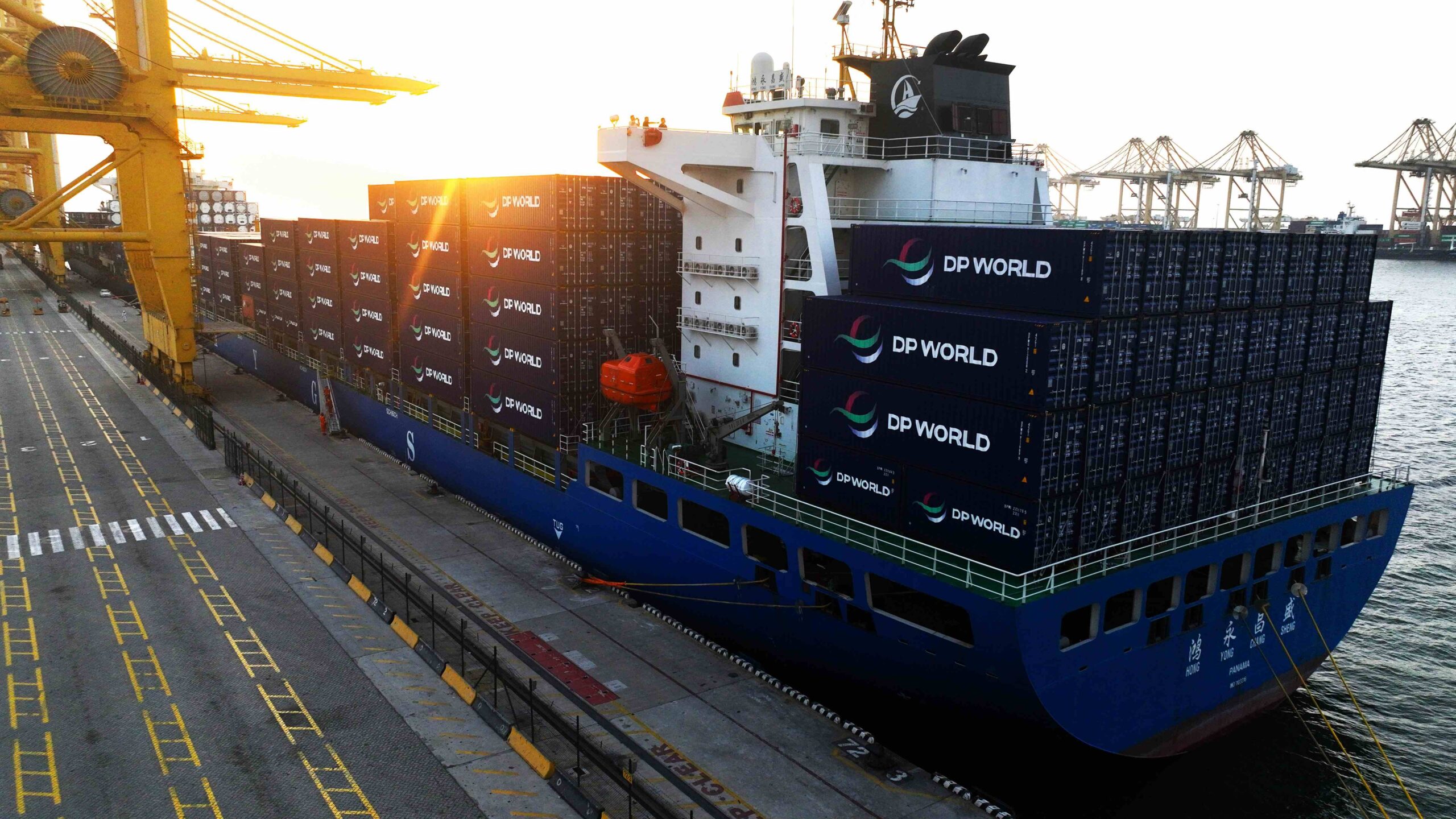
For DP World, this is not just a future trend. It is already being operationalised across the company’s global network. Through its Marine Services business, DP World connects more than 200 ports worldwide and supports 23,500+ sailings annually, with its Shipping Solutions business handling approximately 6 million TEU, creating the coastal and feeder connectivity that underpins global trade flows. These services are increasingly integrated with inland logistics capabilities, including rail and road, helping customers move cargo more efficiently across key trade corridors.

This corridor-based approach is becoming more important as supply chains evolve from linear, point-to-point models into more connected regional networks. As trading patterns become increasingly shaped by resilience, regionalisation and speed to market, businesses need transport systems that can flex across multiple modes while maintaining reliability and visibility from origin to destination.

DP World is responding by strengthening the links between ports, marine services and inland logistics to create more joined-up supply chain solutions. This includes expanding coastal and feeder connectivity beyond major hubs, improving inland access through rail and road integration, and enabling greater coordination across the end-to-end cargo journey.

These capabilities position DP World to support customers as trade becomes increasingly corridor-driven and operational resilience becomes a defining requirement.

Ganesh Raj (pictured, above), Global COO, Marine Services, DP World, said:

“As supply chains face increasing disruption, the ability to connect ports, marine services, rail and road into integrated trade corridors is becoming essential. DP World is helping customers maintain reliability and efficiency by enabling more flexible, connected cargo flows across these networks.”

DP World explores these trends further in its new whitepaper, A $60.7 Billion Opportunity: Multimodal Transport and the Future of Global Trade, which examines how integrated transport networks are redefining the movement of goods across regional and global markets. Download the whitepaper here

New Operating Concept for Multidirectional Forklifts

Hubtex is taking the ergonomics and user-friendliness of its multidirectional forklifts to the next level with a new operating and control concept. Developed on the basis of extensive real-world customer feedback and the growing integration of advanced assistance systems, the new concept brings these elements together in a unified, intuitive user interface.

At the heart of the new concept are the latest generation of the Information Terminal (HIT4), a newly developed joystick with extended functionality, and a display controller. Together, they form an operating system specifically designed around the needs of multidirectional forklift operators. Beginning in the second quarter of 2026, the system will be introduced as a standard feature in various configurations across Hubtex’s multidirectional forklift product lines.

Central Info Hub

The Information Terminal (HIT4) serves as the operator’s central source of information, clearly displaying all relevant truck data, including wheel position, travel speed, and battery status, along with information from integrated driver assistance systems. The aim is to create a more standardised operating experience while making vehicle control even more intuitive for operators.

The central display consolidates machine, energy, and safety information in a clear and structured way. Icons, colour coding, and plain-language messages are aligned for quick comprehension. Alerts, warnings, and fault messages are prioritised so operators can immediately identify the most critical information in any situation. This helps reduce training time, simplifies transitions within mixed fleets, and improves process reliability in narrow aisles as well as indoor and outdoor applications.

As the direct successor to the HIT3, the HIT4 builds on a familiar operating logic while advancing it significantly. The display features standard touchscreen functionality and, in the PHOENIX series, can also be operated via a display controller with clearly arranged function keys – even when wearing gloves. Adaptive brightness control automatically responds to changing lighting conditions, while manual adjustment options ensure the screen remains easy to read, even from angled viewing positions.

Ergonomics Refined: The New Joystick

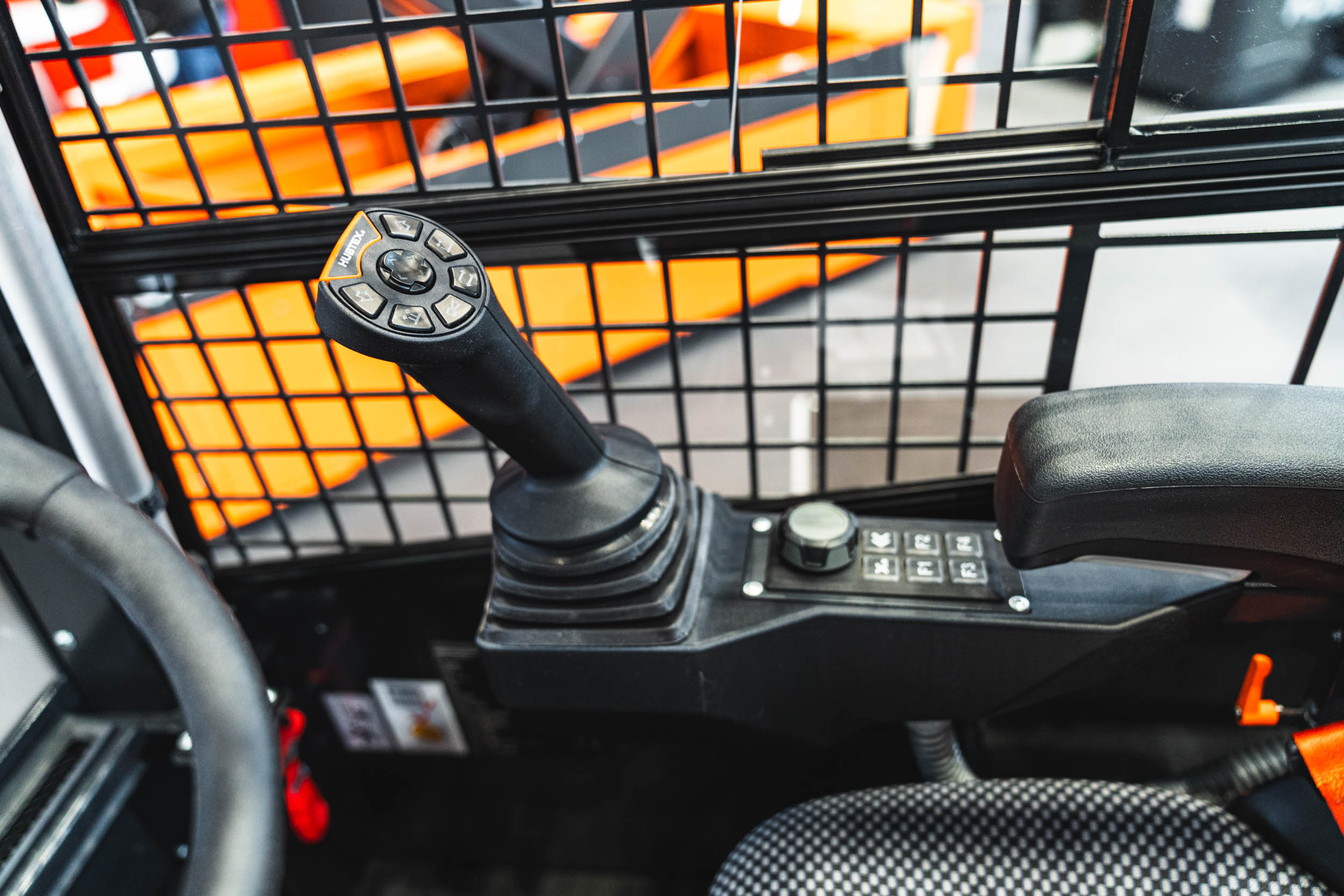
Hubtex has also comprehensively redesigned the joystick. The development objective was clear: to preserve the functions operators already know and trust, make the transition easy for existing customers, and deliver a noticeable improvement in ergonomics.

The new joystick stands out with its redesigned grip and enhanced tactile and visual layout. Features such as a newly shaped thumb rest and added functionality support greater comfort during long shifts. All controls are positioned for easy thumb access, while tactilely distinct, illuminated buttons enable safe, intuitive operation even in low-light environments. A centrally positioned directional rocker further supports frequent changes in travel direction and contributes to more ergonomic, lower-fatigue operation.

Display Controller Designed for Rugged Industrial Use

Another key element of the new operating concept was developed specifically for the PHOENIX series, where a wide range of assistance systems – particularly for narrow-aisle applications – are often integrated. The combination of the HIT4 display and the display controller makes these systems much easier to operate.

Typical assistance-system prompts shown on the display, such as guidance on ideal racking position or appropriate travel speed, help operators maintain smooth, focused driving without obstructing visibility of the load or travel path with additional monitors. With the new display controller, Hubtex is reinforcing its focus on rugged, industrial-grade usability. Designed specifically for demanding working environments, the controller enables safe, intuitive operation – even with gloves.

At the same time, it reduces the need for operators to reach towards the display and speeds up repetitive tasks. In combination with the HIT4, it creates a clear and ergonomic separation between travel and work functions, helping operators work more efficiently and safely.

Greater Transparency in Operation

The new system also offers clear advantages for service and maintenance. Structured diagnostic paths, clearly labelled parameters, a detailed event history, and optional remote access enable faster troubleshooting and help reduce downtime. Its modular architecture also makes it easy to integrate future functions without changing the familiar operating logic – an important foundation for upcoming assistance and safety features.

Overall, the combination of touchscreen, controller, and joystick reduces hand movement, speeds up repetitive actions, and enables precise manoeuvering in confined spaces. At the same time, it allows new assistance systems to be integrated without adding unnecessary complexity for the operator. Starting in the second quarter of 2026, the new operating and control concept will be rolled out step by step across all PHOENIX models, with additional product lines to follow.

Plastic Pallet Recycling Record Set

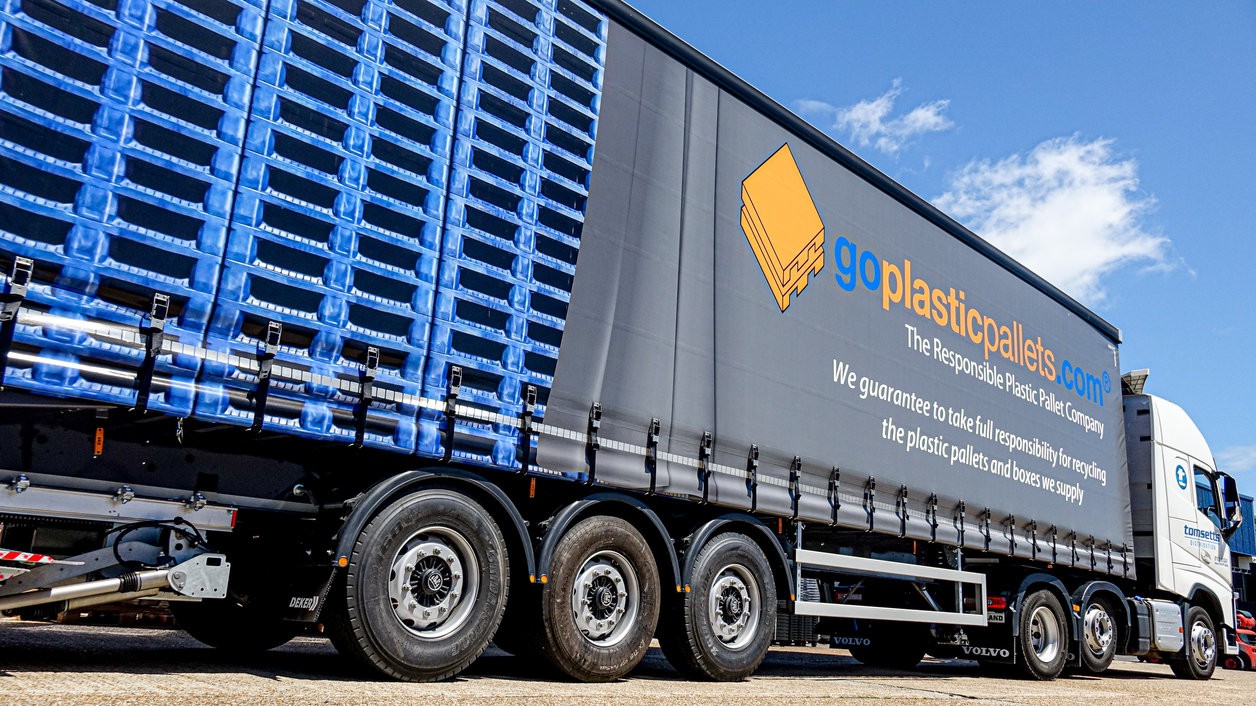
One of the UK’s leading providers of sustainable plastic pallets and boxes has smashed its monthly recycling total as the company continues its mission to create greener supply chains. During March, Go Plastic Pallets recycled a whopping 114.6 tonnes of plastic, smashing previous records.

The Eastbourne, Sussex-based company launched its recycling scheme – the first of its kind across the sector – in 2019. Since then, it has extended this commitment by guaranteeing to take full responsibility for recycling all plastic pallets and boxes it supplies. Over the last six years, goplasticpallets.com has recycled more than 2,700 tonnes of plastic, which is the equivalent of 455 truckloads.

The team collects plastic pallets that have reached the end of their working lives, before sending them to a licensed recycling facility in Belgium, where the material is cleaned, shredded and made into new products.

Earlier this week, the company calculated it had recycled 114.6 tonnes of plastic during the last month alone – comfortably beating the existing record of 105 tonnes, set in December 2025. This new milestone fell in the same month as Global Recycling Day, which took place on 18th March.

Anabel Cooper, Logistics Co-ordinator at goplasticpallets.com, plays a key role in the recycling scheme on a day-to-day basis. Commenting on the latest record, she said:

“March was a really busy period for us. As the month went on, I had a feeling we would come close to surpassing December’s record, and when we completed the final calculations we were absolutely thrilled. Our team does a fantastic job by helping major organisations across key industries – including retail, food processing, waste management, automotive and pharmaceuticals – to embed sustainable plastic pallets and boxes across their facilities and transport networks. It is also incredibly rewarding to work with these household names on recycling too, as we all look to benefit the planet by contributing to the circular economy. After learning that we set a new record, we did some research to see what else weighs around 114.6 tonnes – and apparently it is the same as an average-sized blue whale, the largest animal to have ever existed, so we must be doing something right!”

Subscribe

Get notified about New Episodes of our Podcast, New Magazine Issues and stay updated with our Weekly Newsletter.