Boost Space Efficiency

A leading manufacturer of precision plastic and fastening components for the automotive industry with a reputation for innovation and quality continually seeks smarter, more efficient ways to optimise its production and logistics operations.

At its facilities near Barcelona, ITW faced growing space constraints that limited its ability to expand storage capacity and streamline material handling. Traditional forklifts required 3.5 metre aisles and additional room for turning, which restricted storage density and efficiency.

To address this challenge, ITW reached out to their trusted local material handling dealer, Politractor, for expert guidance. After conducting a thorough site survey and a detailed analysis of ITW’s operations, it was determined that the Aisle Master from Irish material handling specialist Combilift would be the ideal solution to increase space utilisation significantly and enhance material handling processes.

This articulated forklift offered the ideal combination of versatility, compact design, and lifting performance to meet ITW’s needs.
“We needed to maximise space utilisation as much as possible,” explained Lourdes Mora, ITW’s Logistics Manager.

“Previously, we used conventional forklifts for both Euro and American palletised loads, which required wide aisles and wasted valuable space. With the Aisle Master, we reduced aisle widths to just 2,3 metres, increasing our storage capacity by 34%.”
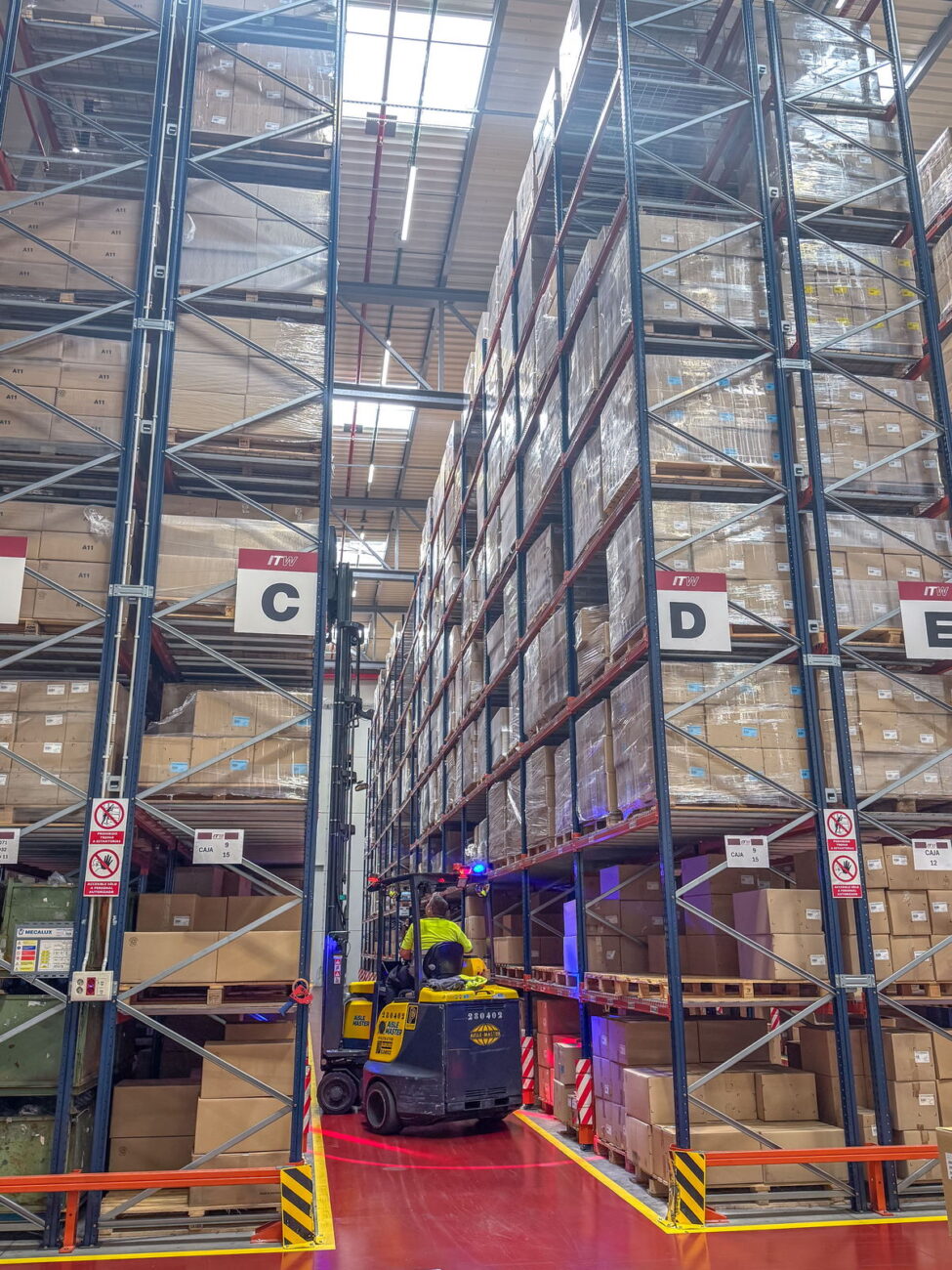
In 2018, as ITW continued its growth in the region, the company relocated to a nearby, larger facility. The new facility was initially designed for manufacturing only but was soon after adapted to include warehousing operations — a change made possible by the space and efficiency gains delivered by the acquisition of the new machines.

“Thanks to the space optimisation offered by the Aisle Master, the same facility now serves both manufacturing and warehousing functions,” said Lourdes. “This dual use has been key to maintaining operational agility while supporting business growth.”

Today, ITW operates five units with a 2-tonne capacity and lift heights of up to 10 metres. “They’re ideal for working in confined areas and efficiently moving pallets in and out of racking,” Lourdes added.

Sustainability and operator well-being were key factors in ITW’s decision. As the Aisle Masters are used indoors, all five units are electric-powered, helping to reduce emissions and noise while improving operator comfort.

As a business that has the well-being and safety of its strong workforce at the heart of its ethos, safety around equipment and in the warehouse is paramount. Each Aisle Master is equipped with additional advanced safety features such as mast-mounted cameras, blue pedestrian safety lights, and red halo safety lights. These features ensure a safer working environment for all employees, while complementing their space-saving capabilities.
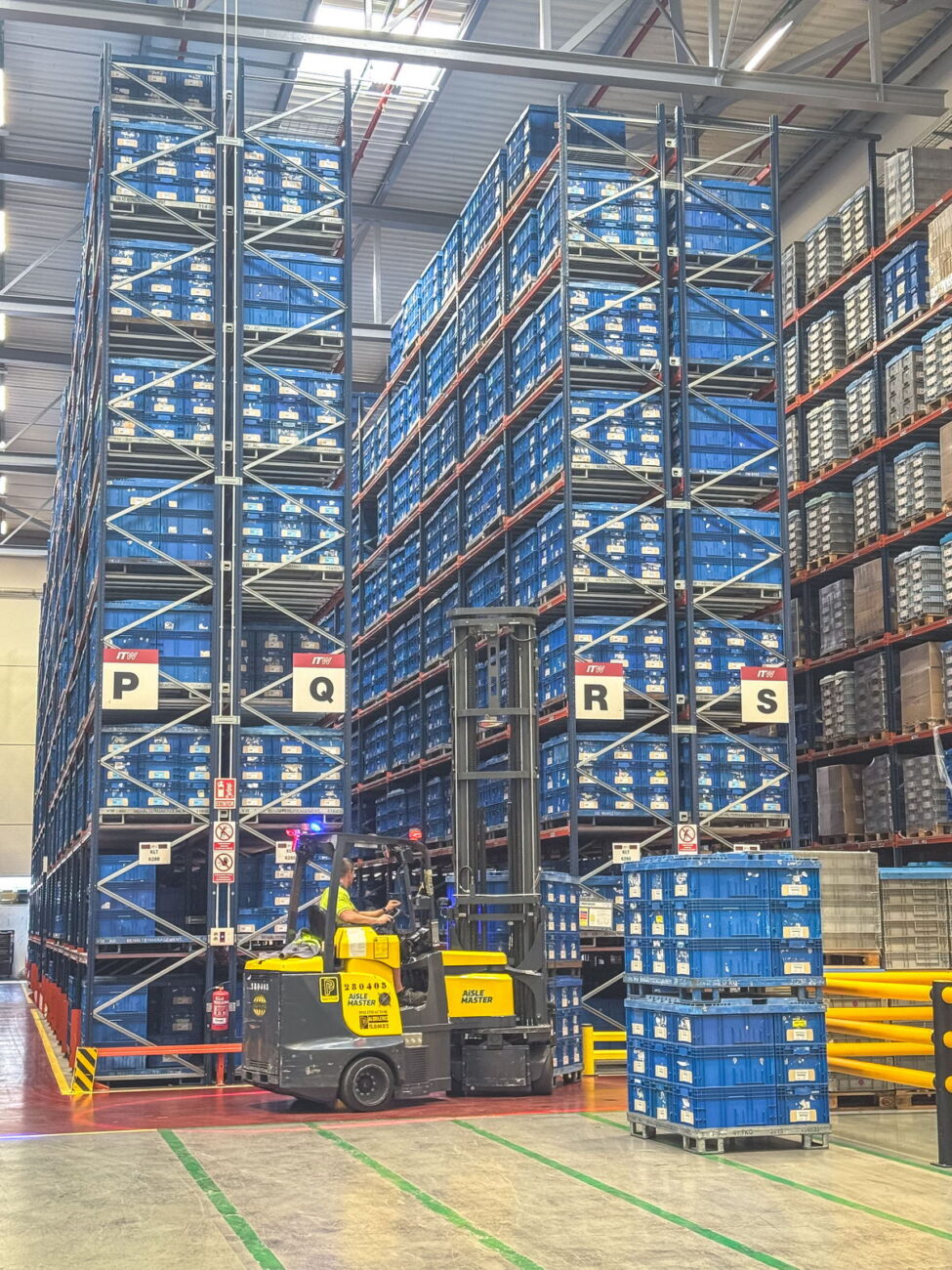
Additionally, ITW has also recently redesigned parts of its pallet-wrapping process to further improve ergonomics and operator safety, which “is the perfect combination alongside the Aisle Master,” Lourdes noted.

The use of Combilift equipment within the ITW group is not limited to Spain alone. Other subsidiaries of the company in countries such as the United States, and even Australia also use Combilift equipment.

At the company’s Spanish facility in Barcelona, Aisle Master has transformed ITW’s material handling operations — solving critical space challenges while enhancing efficiency, sustainability, and safety.

By reducing aisle widths, increasing storage capacity, and integrating advanced safety technologies, ITW has successfully expanded its warehousing capabilities without requiring additional space.

This long-term collaboration between ITW, Politractor, and Combilift stands as a powerful example of how the right material handling equipment, backed by expert support, can drive operational excellence and long-term business growth.


New Manchester Hub Unlocks Potential

Autodoc SE, an online retailer of automotive spare parts and accessories, opened its first UK warehouse in late May, in partnership with logistics service provider Radial, which is becoming part of newly formed third-party logistics (3PL) leader Paxon. With the addition of this 7,200 m² Manchester facility, Autodoc now operates five distribution centres across Europe, serving customers in 27 countries.

“The opening of our Manchester facility marks Autodoc’s evolution from a global webshop to a local powerhouse”, says Dmitri Zadorojnii, CEO of Autodoc. “By establishing this ‘local heartbeat’ in the UK, we are combining our massive scale with the speed and reliability of a domestic partner to serve our UK customers even better in the future.”

Keeping the British drivers moving in a changing market

As one of Europe’s largest automotive aftermarkets, the UK sector is also undergoing a massive transformation. With 42.5 million aging vehicles on the road and rising cost-of-living pressures, more British drivers are turning to DIY maintenance. The economic pressure is accelerating the shift toward online shopping, while growing EV adoption creates a new demand for specific, trustworthy components. Autodoc’s new Manchester facility meets these evolving needs by bridging the digital and local world.

“Our goal is to match the trust and convenience of local household brands, ensuring the right part is delivered with the seamless service British drivers expect”, says Zadorojnii.

A flying start: 1,000 orders in 48 hours

How smoothly this new setup works in practice was demonstrated from day one by the very first live order: At 08:13 on a Tuesday morning, a customer ordered safety-critical brake discs and pads bound for Liverpool. The same day, the order was dispatched from the Manchester hub, and it was delivered by 14:42 on Wednesday — less than 31 hours after the click.

“With 41,000 SKUs already in stock in the UK, everyday orders can be processed and dispatched domestically, making the process faster and more reliable than ever”, says Sebastian Bleser, Senior Vice President Supply Chain at Autodoc. “Manchester is the perfect central location with direct motorway access to every corner of England, Scotland and Wales. Partnering with Radial and leveraging their sophisticated fulfilment infrastructure allows us to bypass the complexities of cross-border logistics and ensure a seamless, highly efficient flow of goods directly to our customers.”

Built for high throughput and future growth

Radial, becoming part of Paxon, manages the logistics at the Manchester site. “We are proud to support Autodoc’s UK expansion by providing warehousing, fulfilment and transportation services that meet customer demand for readily available automotive parts, which can be delivered quickly and efficiently”, says Wayne Chapman, UK CEO of Paxon. “To seamlessly back Autodoc’s massive online catalogue of over 7.8 million parts, we’ve strategically planned inventory management, undertaking extensive data analysis to plan the warehouse set-up, fulfilment throughputs and transport. This ensures we can optimise the storage of high-demand inventory in the UK. During the first 48 hours of operation alone, we successfully processed around 1,000 orders at the new warehouse.”

“The partnership with Autodoc is a brilliant example of how businesses selling high-volumes of SKUs can scale quickly in a new country to satisfy customer demand for speed and convenience.”

The new facility holds a capacity for up to 75,000 SKUs, leaving significant room for development. To guarantee high efficiency, the facility utilises modern warehouse design and semi-automation.

Ultimately, for Autodoc, the Manchester hub is more than just a logistical upgrade — it is the cornerstone of its long-term growth strategy in the UK. Against the backdrop of a transforming market, Europe’s leading online retailer of automotive spare parts and accessories is directly responding to shifting customer habits. By establishing this local infrastructure, Autodoc strengthens its UK market position and expands its European leadership.

The Shift to Supplier Consolidation in Logistics – PODCAST

The logistics industry is undergoing a transformation, driven by supplier consolidation and technological advancements. This shift is reshaping how businesses operate, offering new efficiencies and competitive advantages.

Supplier consolidation simplifies procurement and enhances supply chain control. By working with a single provider, companies can streamline operations, reduce costs, and minimize risks. This approach also improves customer experience by offering a one-stop solution for installation, maintenance, and upgrades.

The future of logistics is heavily influenced by digitalization. Remote diagnostics and AI are revolutionizing maintenance, allowing issues to be identified and resolved without on-site visits. This not only saves time but also reduces downtime and costs.AI-driven routing and automation are further enhancing efficiency. With smart scheduling and route optimization, logistics providers can meet demanding KPIs and improve service delivery.

Industry leaders predict continued consolidation and increased use of AI and connectivity. This will lead to more integrated services and smarter, more efficient products. Sustainability will also play a crucial role, with innovations focusing on eco-friendly materials and energy-efficient solutions.

Embracing these changes is essential for staying competitive. Whether you’re planning new developments or managing existing facilities, understanding these trends will help you make informed decisions and secure long-term success.

Explore these insights further by tuning into our full discussion with industry experts.

Protecting Fleets on Roads Under Pressure

Transport networks are under major strain. In fact, the Asphalt Industry Alliance predicts that the UK now faces a record £18.62 billion backlog of road repairs that would take roughly 12 years to clear. For anyone working in logistics, this is a grave concern.

The RAC estimates that drivers contend with at least one million potholes on UK roads each year, with around six potholes per mile on council-controlled roads in England and Wales. It also says that repairs for damage more serious than a puncture can cost up to £590. For logistics businesses, this means trouble. When poor road conditions occur, it increases the risk of damaged tyres, distorted wheels, broken suspension, delayed deliveries, vehicle downtime, and avoidable administrative work. Chris Quin, Vice President, ROW Sales, Trimble Commercial Mapping & Routing, believes that when these costs land in an industry already managing tight margins, it has the potential to derail an entire operation.

For carriers, Trimble believes smart commercial-grade mapping tools can help address key challenges such as rising operating costs, driver shortages, and increasing customer expectations.

Why infrastructure risk belongs in transport planning

The UK’s road freight market is very exposed to local infrastructure. Road freight accounts for more than 80% of domestic cargo movements in the UK, while congestion, maintenance challenges and pressure around urban areas and key ports continue to affect freight efficiency.

For transport companies operating on already slim margins, a pothole-related incident is rarely an isolated cost. A damaged wheel can take a vehicle out of service. A delayed delivery can affect a warehouse slot, customer promise or onward connection. A driver forced into an unsuitable diversion may face low bridges, narrow lanes, weak roads, height restrictions or access constraints. In high-value or specialist logistics, the risk extends to the load itself. This is where commercial-grade mapping technologies can help. While technology cannot fill a pothole, it can, however, help businesses reduce exposure to avoidable damage, guide drivers along safer routes and create better visibility when conditions change at the last minute.

Routing technology helps reduce guesswork

Many transport teams still depend on a combination of local knowledge, driver experience, and consumer navigation tools. However, this approach can fall short, particularly when onboarding new drivers, operating in unfamiliar regions, or managing loads with specific requirements.

But, businesses using specialised cloud-based mappings systems have a way to turn operational knowledge into a repeatable standard. The best route is not always the shortest route. It is the route that balances road conditions, mileage, journey time, vehicle type, load profile, road restrictions, depot access, known hazards and service commitments.

The point is not to remove driver judgment. Drivers must always be able to respond to live safety risks. But using the technology to set out routing gives them a safer baseline. If a route has already accounted for vehicle height, load sensitivity, preferred roads, access points and recurring risk areas, the driver has less need to improvise under pressure.

For example, say an operator transporting high-value vehicle loads needed to reduce the risk of damage from low trees, bridges, narrow roads and unsuitable access routes. By configuring routing around load profiles and known restrictions, the business gave drivers clearer instructions and reduced reliance on ad hoc mobile-phone routing. It also helped newer drivers who did not yet have the same local road knowledge as long-serving colleagues.

The same principle applies to potholes. Pothole data is not always complete or consistent, but businesses can still build a more informed risk picture. This is because road-condition data is often fragmented across different councils meaning that fleets cannot always rely on one complete external source of truth. Instead, internal damage reports, driver feedback, telematics data, council information, traffic patterns and maintenance histories can all help planners identify roads that regularly create problems. This gives transport teams a practical way to spot recurring infrastructure defects, understand which roads are linked to repeated vehicle damage or delays, and adjust planning decisions accordingly. Over time, that insight can shape route selection, driver guidance and fleet-maintenance planning, which in turn means operators can start to map their way around the risks they see most often, rather than treating each pothole-related incident as a one-off event.

Visibility helps teams act before small issues become expensive ones

Having access to route planning technology is only one part of the answer. Once a vehicle is on the road, logistics teams need to know whether it is following the planned route, whether delays are building and whether a diversion is likely to create new risks.
Having access to commercial-grade mapping, routing, traffic data, site opening times, and precise location planning helps logistics teams better align vehicles, people, and volumes from the very start of the day. This goes far beyond treating a location as a simple point of interest, using detailed digital geofences and layered site-specific attributes to create a more accurate and operationally intelligent view of every destination.

These systems also allow operators to account for problematic areas in real time, whether that’s flooded fords, high-crime zones, local ordinances, or restricted access routes, while embedding local driver knowledge directly into routing decisions. With improved visibility, transport teams can identify route deviations earlier, understand whether they were justified, and refine future planning based on evidence rather than assumptions. This also enables more proactive driver support when diversions introduce height, weight, access, or road condition risks.

Routing Around Risk

Poor road conditions will remain a challenge for UK logistics operators for the foreseeable future, but better planning can help operators reduce the costs they can control. Logistics businesses cannot wait for every road to be resurfaced before improving how they plan, (re-)route and monitor transport. They need practical steps that protect margins, support drivers, and keep freight moving.

A shorter route that looks better because it saves miles may cost more if it increases the risk of damage, delays or failed delivery slots. Commercial-grade Mapping technology gives logistics teams a stronger foundation for those decisions.

Subscribe

Get notified about New Episodes of our Podcast, New Magazine Issues and stay updated with our Weekly Newsletter.