
Logistics City MK Makes Cold Chain Integrity Key

A major new Grade A logistics development at Logistics City Milton Keynes has been completed in late 2025, delivering a future-ready distribution facility designed to meet the growing demands of modern supply chains.

Developed by Kier Property, with IC King Associates as architect and Harmonix as main contractor, the scheme forms part of the wider Logistics City concept – a high-specification environment combining operational efficiency and strategic connectivity. Located just 1.9 miles from Junction 14 of the M1, the site provides outstanding access to national distribution networks, placing 87% of the UK population within a 4.5-hour drive time.

Designed with security at the forefront

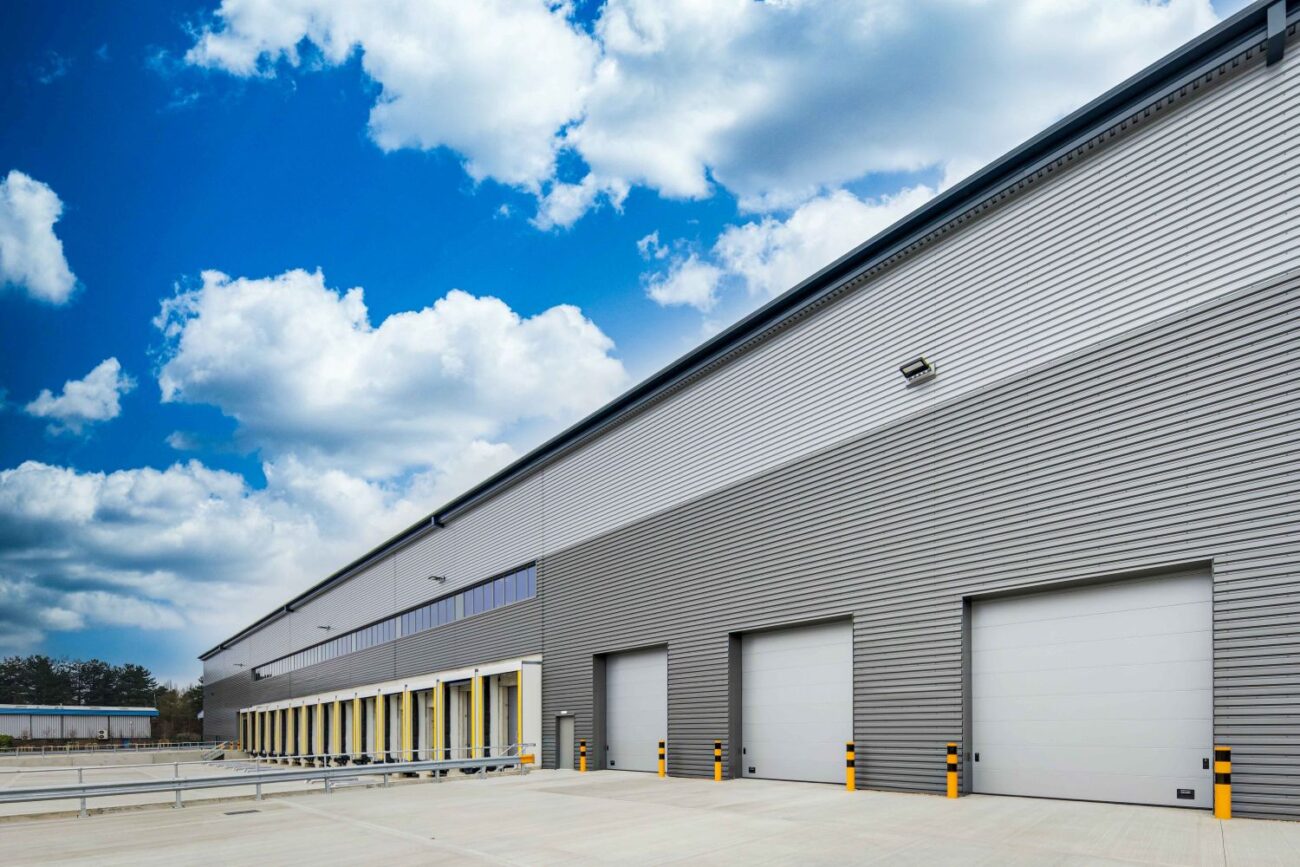
Security has been a key driver in the design of the facility, reflecting increased demand for robust, high-performance building envelopes within the logistics sector. ASSA ABLOY Entrance Systems supplied and installed four Crawford OH1042P Secured by Design level access sectional doors, delivering enhanced protection without compromising operational efficiency. Each door exceeds four metres in width and is fitted with dual cylinder locks, offering additional resistance against unauthorised access. The lock system is key-operated and installed internally, allowing controlled access from inside only, or from both the inside and outside where required. The doors are also equipped with simple deadman down operation, ensuring precise and safe control during closing while maintaining a high level of security.
Integrated loading solutions for modern logistics

The facility incorporates 14 loading bays, comprising 10 standard and four tall bays, each engineered to support high-intensity logistics operations.

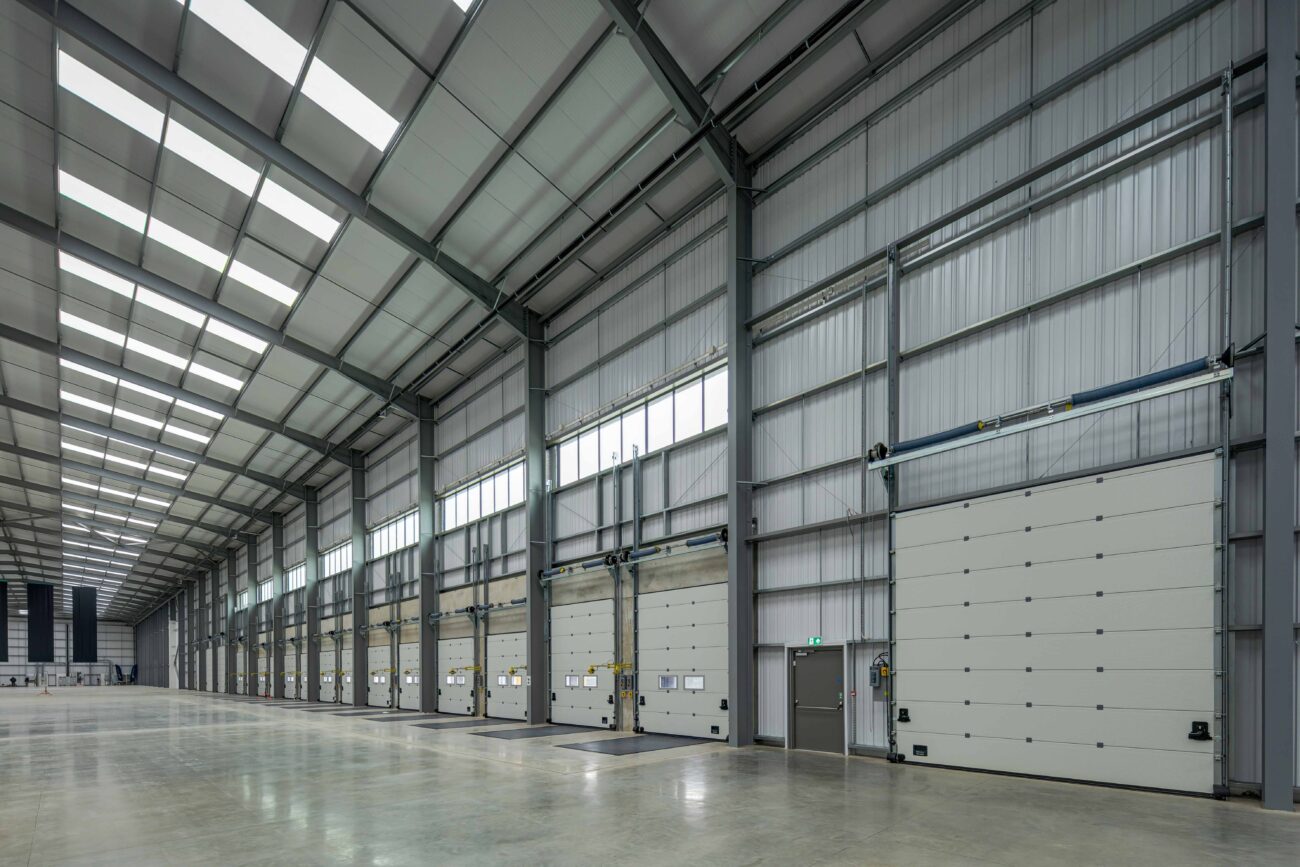
Every loading bay is fitted with a Crawford OH1042P Secured by Design dock door, incorporating aluminium rectangular certified burglar-proof windows that combine visibility with high security performance. These doors form part of a fully integrated loading solution, which includes ASSA ABLOY DL6220T telescopic lip dock levellers, along with dock buffers and wheel guides to support safe and accurate vehicle positioning. External traffic lights and internal dock lighting ensure clear communication and visibility throughout the loading process, helping to maintain operational efficiency within a fast-moving logistics environment.

Supporting the cold chain

A defining feature of the development is its focus on cold chain integrity, recognising the growing importance of temperature-controlled logistics across sectors such as food, pharmaceuticals and e-commerce. To support this, all loading bays are equipped with the ASSA ABLOY DS6070R inflatable dock shelter, designed to create a tight seal between the building and docked vehicles. This significantly reduces thermal exchange during loading and unloading, helping to maintain internal temperature stability and protect sensitive goods.
The inflatable shelter inflates around the docked vehicle to provide complete sealing and continuous weather protection throughout operations. Its roller-top design automatically adapts to accommodate both low and high vehicles, while also following any vertical movement during loading to ensure consistent tightness. The system delivers a level of sealing performance that exceeds standard operational requirements, making it particularly suited to applications where maintaining the cold chain is critical.

When not in use, the shelter retracts fully behind the side structures, allowing drivers to utilise the full width of the loading bay when reversing into position. Yellow front line indicators support precise docking, while robust collision protection at ramp height helps minimise damage and reduce maintenance requirements over time.

The shelter is installed within a frame construction featuring insulated top and side panels, providing additional thermal performance and contributing to the overall efficiency of the building envelope.

A benchmark for future logistics developments

The completion of Logistics City Milton Keynes highlights how modern logistics hubs are evolving beyond simple warehousing to become highly engineered environments.

By integrating advanced security solutions with cold chain-ready loading infrastructure, the development sets a new benchmark for resilience, operational performance and asset protection. ASSA ABLOY Entrance Systems’ contribution demonstrates the critical role of specialist entrance and loading technologies in enabling logistics operators to maintain product integrity, protect assets and optimise efficiency at every stage of the supply chain.


ATEX: Explosive Atmospheres in Warehousing

Where does ATEX (from the French term ATmosphères EXplosibles) come into play in logistics? Gido van Tienhoven, Technical Director at Ex-Machinery, specialists in explosion protection and hazardous-area equipment, discusses the issues.

In July 2016 two workers at a waste-handling warehouse near Bedford (UK) were caught in a fireball. They had been tipping drums of discarded aerosol cans into an industrial shredder when a spark from their forklift ignited the cloud of flammable gas the cans had released. One of the men spent ten days in an induced coma with severe burns, and the company was later prosecuted under the regulations covering explosive atmospheres.

It is the sort of incident most people associate with refineries and chemical plants rather than a warehouse. Yet the conditions behind it, a flammable substance, air and a source of ignition, occur across a good deal of ordinary logistics. The rules that govern them are known as ATEX, and a warehouse manager is more likely to meet them than the term’s heavy-industry reputation suggests.

Where explosive atmospheres occur

An explosive atmosphere is simply a flammable substance mixed with air in a concentration that can ignite. In logistics it tends to take one of two forms: flammable gases and vapours, or combustible dust.

Gases and vapours are easy to overlook. Aerosols are a common source, since a damaged can releases flammable propellant and a large distribution centre may hold many thousands of them. Stored paints and solvents give off vapour in the same way. So does the forklift charging bay, where traditional lead-acid batteries release hydrogen as they charge. Hydrogen ignites readily and, being lighter than air, collects near the ceiling, which is why HSE guidance treats the space immediately around a battery on charge as a hazardous area in its own right.

Dust is the second form, and it appears wherever powders are handled in bulk. Flour, sugar, milk powder and animal feed all throw off fine dust that settles on beams and machinery, and once it is disturbed into a cloud it can ignite with considerable force. The explosion that destroyed a wood flour mill at Bosley in Cheshire in 2015, killing four people, is the best-known British example of how serious a dust explosion can be.

What provides the ignition

A flammable atmosphere on its own is not enough; it needs something to set it off, and in a busy warehouse the candidates are everywhere. A spark from a forklift, a hot motor or exhaust, electrical equipment, a build-up of static, or hot work such as grinding and welding can all do it. The Bedford fire began with nothing more than a spark from a truck going about its ordinary work. This is why controlling sources of ignition sits at the heart of explosive-atmosphere safety, and why the equipment used in a risk area matters so much.

How ATEX zones work

Where a genuine risk exists, the area around it is divided into zones according to how often, and for how long, an explosive atmosphere is likely to be present. Gases and vapours are graded as zones 0, 1 and 2; dusts as zones 20, 21 and 22, with the lowest number marking the most persistent hazard.

The zone is not a paperwork exercise. It sets the standard that every piece of equipment in that space has to meet, from lighting and ventilation fans to the forklift itself, all of which must be built so they cannot become a source of ignition. A food producer, a third-party logistics operator, a recycler or a busy charging room can each contain a zoned area, and the equipment within it has to be rated to match. The work is methodical rather than mysterious: establish where an explosive atmosphere can form, ventilate and control it, and use equipment certified for the zone. Handled that way, it becomes one more familiar part of running a safe site.

When IT Fails the Whole Supply Chain Pays

Supply chain resilience increasingly depends on how effectively manufacturers connect the digital systems behind production, service, logistics and support into everyday operational work, writes Simon Hayward, General Manager & VP of Sales, International at Freshworks.

When a retailer’s systems go down, the impact is usually measured through lost sales and reputational pressure, whereas a manufacturer’s outage can move quickly into production schedules, shipment windows, spare parts availability and the ability of customers to keep their own operations moving.

The result is a clear shift in how manufacturers need to think about IT service management, because the systems used to manage incidents, service requests, assets, access and change now sit directly inside the wider supply chain.

Where digital friction enters the supply chain

Many manufacturers are still operating with technology environments shaped by years of expansion, acquisition and local decision-making, leaving different sites and teams dependent on separate platforms, manual ticket routing, spreadsheets and workarounds that were once practical but now slow the business down.

This complexity creates operational drag that is quickly felt beyond the IT department, particularly when a service request is routed to the wrong team, when a system change interrupts planning or production workflows, or when weak asset visibility delays the response to a problem affecting equipment, software or infrastructure. In logistics terms, these issues become visible through missed handovers, slower decisions, delayed shipments and customers waiting for equipment, parts or service that should already be moving through the chain.

For manufacturers, improving resilience often starts with simplifying the environment already in place, consolidating service systems, reducing overlap and creating a clearer operating model that allows people to move through workflows with greater speed and confidence. This kind of foundation gives AI and automation a practical role, because connected workflows allow intelligent tools to route requests, deflect common issues and surface information that would otherwise take agents time to find.

Turning service management into operational infrastructure

The manufacturers seeing the greatest value are treating ITSM as part of operational infrastructure, with the same focus on visibility, consistency and speed that already shapes wider supply chain planning. At Vermeer, automated routing and AI-assisted support helped reduce resolution time by nearly 50%, giving employees and production teams faster support in an environment where equipment uptime and customer responsiveness are closely linked.

Structured change management carries equal importance, because system updates, access changes and platform migrations all need clear ownership, approval and visibility when the consequences of disruption can move quickly from a local IT issue into a major production one. For supply chain leaders, the principle is familiar because resilient operations depend on shared information, predictable processes and the ability to respond quickly when conditions change.

Modern ITSM gives manufacturers a clearer path to sustainable performance by reducing manual effort, improving service visibility and helping teams address small issues before they create wider disruption across production, logistics and customer operations. When the digital workflows behind manufacturing are simplified and better connected, the business is better placed to protect uptime, keep shipments moving and meet the commitments that downstream customers depend on.

What Execution AI Actually Does in The Warehouse

In the latest episode of “Logistics Business Conversations,” industry expert Scott Kramer dives into the transformative power of AI in warehouse operations. If you’re in the logistics field, this episode is a must-listen. Kramer breaks down complex AI concepts into actionable insights, showing how AI can enhance efficiency, decision-making, and safety in your warehouse.

Listeners will learn how AI tools like predictive analytics and autonomous decision-making are not just buzzwords but practical solutions that can forecast demand, optimize workflows, and reduce errors. Kramer shares real-world examples of AI in action, illustrating its impact on everything from staffing adjustments during peak times to rerouting deliveries for maximum efficiency.

This episode is perfect for anyone looking to stay ahead in the rapidly evolving logistics industry. By tuning in, you’ll gain valuable knowledge on starting small with AI-powered solutions and expanding as you see results. Don’t miss out on the opportunity to transform your warehouse operations with AI—listen now and lead your team into the future of warehousing.

Key Takeaways
  • AI in warehousing is best understood by focusing on outcomes like speed, efficiency, and safety.
  • Embedding AI directly into warehouse management systems enhances responsiveness and decision-making.
  • Trust builds over time through gradual implementation, recommendations, and continuous learning.
  • High-quality data and process design are critical for AI to succeed.
  • Future shifts will empower managers to focus on strategy while AI handles routine tasks.

Subscribe

Get notified about New Episodes of our Podcast, New Magazine Issues and stay updated with our Weekly Newsletter.