Jungheinrich Acquires Majority Stake in ISI Automation

Jungheinrich is to acquire ISI Automation of Lemgo, Germany. The move will see the turnkey automation solution specialist become part of the forklift giant, which describes itself as one of the world’s leading providers of intralogistics solutions. The company’s ISIPlus® and ISIPro® products will expand the Group’s portfolio in the area between ERP and the shop floor.

Dr. Rosenbach, Member of the Board of Management Logistics Systems at Jungheinrich, explains, “We plan to strengthen ISI Automation and its plants in Lemgo and Extertal, and we have set ourselves the clear objective of further expanding the business with all existing and future customers in this important field of digitalization.”

The current managing directors of ISI Automation, Frank Marek and Volker Sasse, will continue to lead the company under the new Jungheinrich majority ownership, thereby ensuring continuity. Marek explains, “In a market that offers opportunities to compete on the international stage, this investment represents an important step in the strategic development of ISI Automation here in East Westphalia-Lippe.”

Steve Richmond, Director – Logistics Systems, Jungheinrich UK, comments: “The acquisition of ISI Automation is another great opportunity for Jungheinrich to expand its portfolio in the area of automated and networked intralogistics solutions. In a highly competitive market landscape, the acquisition enables Jungheinrich to further strengthen its end-to-end offering to customers and tailor the exact solution for each individual business.”

DP World Snaps up P&O Ferries and Ferrymasters in £322M Deal

DP World has bought P&O Ferries and P&O Ferrymasters (together P&O Ferries) for a purchase consideration of GBP322mn (USD421mn), implying a 2017 Enterprise Value/EBITDA valuation multiple of 6.1x.

P&O Ferries is a pan-European integrated logistics business consisting of a market leading roll-on roll-off (Ro-Ro) ferries operation and a European transportation and logistics solutions provider, P&O Ferrymasters. P&O Ferries operates a fleet of 21 vessels on the Short Sea, North Sea and Irish Sea sectors across 11 ports whilst P&O Ferrymasters provides supply chain solutions in 19 European locations. P&O Ferries handles over 2.5mn freight units per year which accounts for approximately 75% of group revenues. P&O Ferries reported FY2017 revenues of GBP1.1bn (USD1.4bn) and EBITDA of GBP100mn (USD131mn).

The transaction is subject to customary completion conditions and is expected to close in the first half of 2019.

Sultan Ahmed Bin Sulayem, Group Chairman and CEO, DP World, said: “We are pleased to announce the return of P&O Ferries back into the DP World family. P&O Ferries is a strong, recognisable brand and adds a best-in-class integrated logistics provider into our global portfolio. Importantly, P&O Ferries provides efficient European freight connectivity building on last year’s acquisition of Unifeeder. This transaction is in line with our strategy to grow in complementary sectors, strengthen our product offering and play a wider role in the global supply chain as a trade enabler.


Popular Europe-wide Trade-in Scheme Restarted by Printronix Auto ID

Printing expert Printronix Auto ID has just announced the re-introduction of its popular scrappage scheme across Europe. It is inviting companies running its old, discontinued T5000 machines and other industrial thermal barcode printers to trade them in and trade up to T8000 devices and enjoy discounts of up to 7%.

“Following the success of the ‘trade in/trade up’ scheme we launched in Spring 2018, we have re-introduced it by popular demand this year,” says Neil Baker, Printronix Auto ID’s Sales Manager UK, Ireland, Benelux & South Africa. “It enables firms to enjoy the improved performance of our newer printers at a discounted price as well as ensuring their traded in devices are disposed of safely and responsibly.”

“Mindful of our WEEE responsibilities, we are working with a professional Europe-wide waste management company with an excellent reputation. It will collect the old devices and dispose of them in line with EU standards,” adds Neil.

The trade in/trade up offer is open to any European company. To participate in the scheme, businesses need to supply the printer model and serial number of the device(s) they are trading in. They can either do this by contacting their local reseller, or by applying for the scheme via the web link printronixautoid.com/trade-in

Under the scheme, firms in the EU can trade in/trade up as little as one device. For European companies outside the EU, the minimum number of old industrial printers to be traded in and traded up is five.

“By trading in their old T5000 for a new T8000, businesses would notice a real difference in performance and build,” suggests Jon Trippett, Printronix Auto ID’s Sales Manager UK & Ireland. “The T8000 is rugged and feature-rich,” he says. “It offers 40% faster print speed, eight times more standard memory, full colour 3.4” display panel, a quick change memory card (QMQC) and the industry’s most extensive library of printer emulations including PostScript/PDF printing.”

Companies interested in participating in this sustainable scrappage scheme should first register their interest at printonixautoid.com/trade-in and complete the online trade-in form. Once firms have had their trade-in accepted and the purchase order (PO) placed, the new T8000 will be delivered.

No later than 10 days after the new printer has been received, the traded in T5000(s) have to be ready for collection by the scrapping company otherwise the discount can’t be awarded. This offer cannot be used in conjunction with any other promotions and terms and conditions apply.

Descartes Route Software Used by GEFCO in Optimization Studies

Automotive logistics specialist GEFCO has deployed route optimization software from Descartes Systems Group to respond to calls for tenders and to support its regional businesses with optimization studies.

With a presence across 47 countries, GEFCO manages several million shipments a year on behalf of its customers. The automotive logistics company has chosen Descartes’ route optimization software for the planning of its European transport activity. However, rather than using it to schedule and plan actual operational routes – the usual function of the software – GEFCO has deployed the software to better respond to calls for tenders and carry out internal studies.

“Descartes route optimization software was originally conceived and designed to be deployed in an operational capacity within our regional businesses to manage collection and distribution rounds. We, however, have now adopted it for internal use at a corporate level, to respond to calls for tenders and support our regional business units by undertaking centralised optimization studies,” explains Charles Fouche, GEFCO’s Engineering & Optimization Manager.

Within the tender process, Descartes route optimization software functionality allows GEFCO to take into account the unique constraints of each customer, helping GEFCO to run route simulations and to formulate proposals which are much more precise and relevant, ultimately offering more value to customers. “Thanks to Descartes, we have won tenders,” adds Fouche.
I

Industry View: Putting the WOW in the Checkout Experience

Craig Summers, UK Managing Director, Manhattan Associates, on the retail Wow factor and the role of logistics providers.

Embracing technology is a prerequisite for success in the modern retail environment. There are many ways in which retailers can deliver a new in-store experience – and while some retailers will undoubtedly look to emulate the human touch free Amazon Go model, for many others, human interaction is the primary and fundamental component of a positive bricks and mortar experience. From hiking boots to party shoes, it is still the shared experience of the Store Associate and customer that will remain an essential component of the in-store engagement for many.

Each retailer will need to understand the optimal model for its customer base, offering the best mix of touch free interaction and empowered Store Associate. With cloud-based mPOS, there is no technology barrier to delivering a new and positive retail experience – the challenge is to envisage the right customer model. The checkout of the future must be whatever the customer wants it to be, at any time. Released from the shackles of legacy technology, retailers now have enormous opportunities to rethink and reconsider the in-store experience and reimagine the customer journey.

Getting the basics right
The checkout is the point of sale – but it is not a standalone function; it needs to be embedded within the overall service proposition. Customers don’t want to wait in line; nor are they willing to undertake multiple separate transactions to fulfil in-store needs. They want one, simple and frictionless transaction that covers an in-store purchase, a click & collect order, a product return, even ordering another item that is not in store but can be sent from another location either to that store or to the customer’s preferred address.
An effective and efficient checkout process also needs to automatically and effectively handle coupons, apply the correct promotional pricing, capture loyalty information and so on. But it will also be integrated directly with core operational systems to provide Store Associates with real-time inventory information and customer history.
The question for retailers is how and where to deliver that point of sale. Should be it the fast, touch-free approach enabled by kiosks or self-service? Or should it be provided by a Store Associate? And if the latter, how and where within the store should that interaction occur?

Man versus Machine
Clearly for many retailers, an Amazon Go approach appeals. It maximises technology to minimise costly Store Associates and provides customers with a fast, frictionless experience: the checkout is achieved simply by walking out of the store with automatically scanned items and payment taken from the pre-authorised account.

This is not, of course, a model that has generic appeal – aside from the fact that it is massively unprofitable today and unachievable for the majority of organisations. Forget tagging technology and customer identification solutions, right now many retailers can’t even provide their Store Associates with a single view of available inventory!

But there are undoubtedly aspects of this frictionless experience that should be embedded within every retail model – and a core component of this process will be the checkout. Whether a customer is looking for speed or experience – or both – the checkout is key. Retailers have spent over a decade optimising the ‘buy button’ online, and the checkout is effectively that ‘buy button’ moment in store. The challenge for retailers is to create a checkout in store that effectively masks the growing complexity of the retail model from both the customer and Store Associate. Mobile Point of Sale (mPOS) is an obvious solution, providing Store Associates with the ability to close the deal with customers anywhere in store, yet, just 42% of retailers have mPOS in place.

Retail as a Service
Retailers have been massively constrained by the incredibly outdated legacy solutions deployed in-store. Hard wired, monolithic systems based on fixed telephone lines for payment, these solutions are both over specified and under delivering. The latest generation of cloud-based technology supports deployments anywhere – in store, on traditional Windows terminals or on mobile iOS and Android devices, delivers real-time access to global network availability and ensures that high-speed checkout is available even if the network connection is disrupted.

A Store Associate armed with a mobile device that provides real time access to inventory across the organisation and ensures the aisle is always endless – and the ability to order those products – can embark upon a meaningful customer dialogue anywhere within the store. Critically, with a mobile solution that seamlessly supports the checkout process whenever the customer is ready and through whatever payment format the customer prefers, the store ‘buy button’ is optimised. Whether a traditional ‘card present’ payment process or a customer’s own mobile payment app, there should be no break in the engagement to achieve the seamless in-store check-out that consumers crave.

Conclusion
It is only now, thanks to the power of the cloud, of the mobile app, of rich POS solution functionality that is seamlessly integrated with other store and enterprise systems, that retailers have the chance to break away from the constraints of their legacy technology and reconsider the entire store concept. Does the retailer even need a static desk anymore or can all Store Associates be mobile? Will the customer base respond well to this model – or does the retailer have a core demographic that wants a choice of both traditional and new? With confidence in the technology and an ability to deliver diverse customer services within the store, a retailer can begin to rethink the experience, to experiment with new models for customer engagement and truly offer an efficient and personalised service with a bit of ‘wow’ thrown in.

UK Safety Barrier Specialist Climbs Export League Table

Safety barrier manufacturer and exporter A-SAFE has made the HSBC International Track 200 league table for the second year running. After achieving 68% average international sales growth over two years, the safety barrier expert achieved place 78, outranking their previous position of 82.

The International Track 200 ranks mid-market companies with the fastest-growing international sales. A-SAFE has been recognised by the Sunday Times for export excellence five years in a row, making the Export Track 100 for SME’s in 2017, 2016 and 2015.

The 200 selected companies include a host of renowned British businesses such as Charlotte Tilbury Beauty, BrewDog and Bulk Powers.

A-SAFE’s position in the league table comes at an exciting time for the company, who have recently achieved the Queen’s Award for Enterprise in the International Trade Category. The award recognises A-SAFE’s outstanding achievement in export and is due to be formally presented to the company in March.


Innovative Container Unloading System in Action at LogiMAT

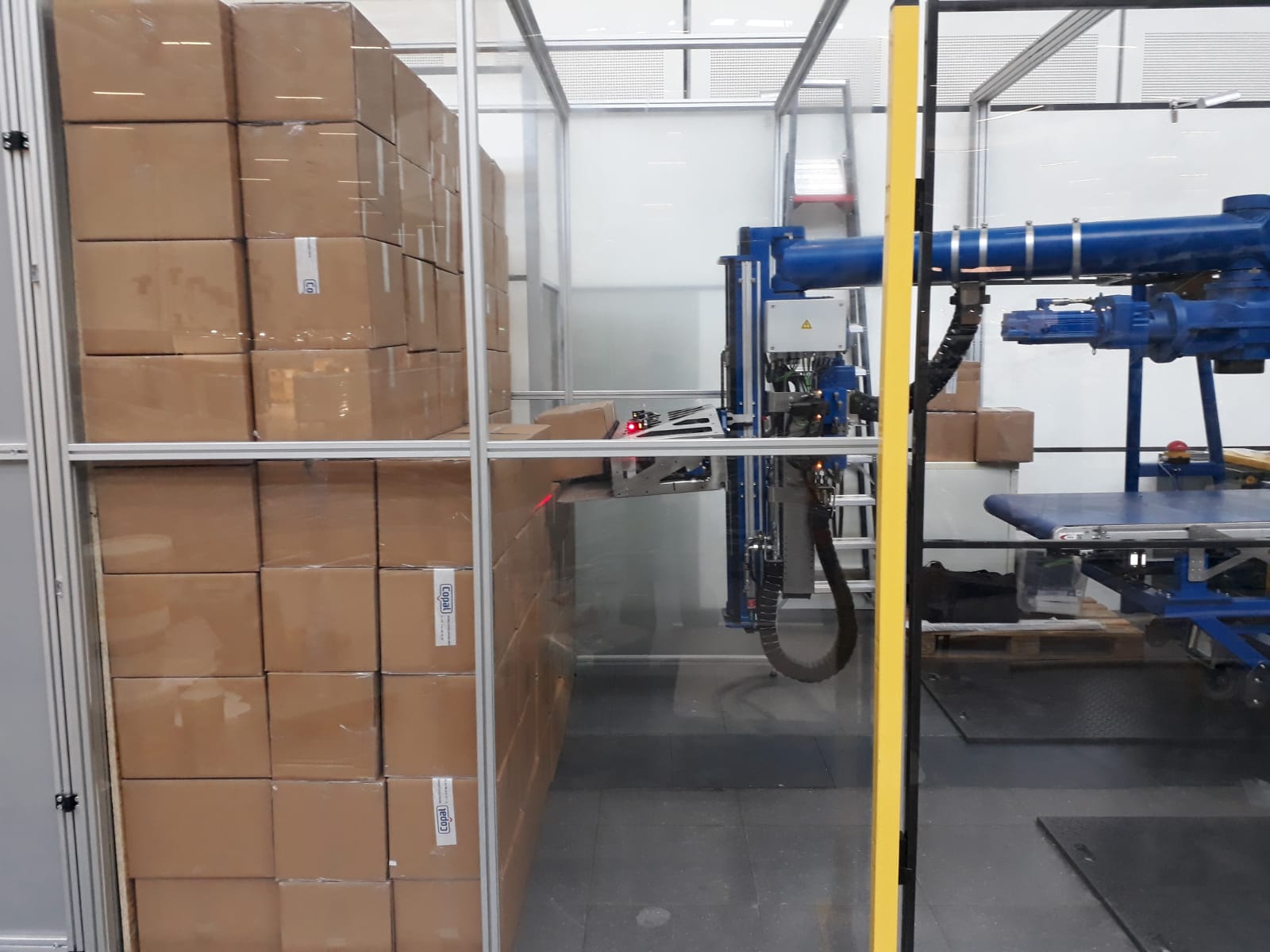
Dutch innovator Copal Handling Systems has developed a new generation container unloading system. Starting from tomorrow at LogiMAT, Stuttgart, the company will show live how carton boxes are fully automatically unloaded.

There is a significant labour shortage in the logistics industry. This situation will even get worse in the next few years. Finding and retaining employees is a daily challenge, and at peak times, continuity, efficiency and precision of incoming goods are under pressure. Inbound workflow forecasts become difficult with fluctuating work capacity, which leads to high costs and delays. Companies in the logistics chain must provide exceptional services to gain market share and build brand loyalty. This can only be achieved by optimizing logistics processes.

In addition to labour shortages, there is an increased focus on reducing heavy or repetitive physical work related to manual material handling. Legislation is becoming stricter and authorities are investing in monitoring compliance with these regulations. Logistics partners and their customers attach great value to healthy jobs and improved physical working conditions.
These reasons make the automation of warehousing processes indispensable for future oriented companies in order to maintain their position in a challenging environment.

The machine is equipped with scanning software, 3D vision technology, laser sensors and cameras that recognize the entire process at one glance. The software guarantees an efficient gripping movement and sequence. The Copal gripper ensures that all products are unloaded quickly and efficiently. The load can then be automatically palletized or directed for storage. The system can be moved between the docks.

Copal container unloading systems can be used in any logistics centre where standard and high-cube containers are unloaded. This fully automatic unloading process is unique in the world, according to the company.

Visit Copal at Hall 2 Stand B040.

Integrated Logistics Arm Helps Drive Growth for Agility

Gulf-based global logistics player Agility today reported 2018 net profit of KD 81.1 million, or 56.06 fils per share, an increase of 18.4% from 2017. Revenue for the year reached KD 1,550.2 million, and EBITDA was KD 154.8 million, increases of 10.2% and 14.5%, respectively.

For the fourth quarter 2018, Agility reported a net profit of KD 22.2 million, or 15.35 fils per share, an increase of 15.1% over Q4 2017. EBITDA for Q4 2018 was KD 40.8 million, an increase of 8.4%.

“Agility has improved profitability for shareholders for 10 consecutive quarters. In 2018, Agility posted double-digit EBITDA growth for the third year in a row,” said Agility Vice Chairman and CEO Tarek Sultan.

Sultan said the company continues to invest in its future by building more than 1 million sqm of new warehousing and industrial facilities across the Middle East and Africa; building, through one its subsidiaries, the $1.2 billion Reem Mall mega project in Abu Dhabi; and investing more than $100 million in Shipa, its digital logistics platform.

Agility Global Integrated Logistics (GIL) revenue grew 8.6% to KD 1,153.1 million in 2018, driven by strong growth across core products. Net revenue also grew by 4.9% year-over-year, with 22.9% net revenue margins, as a result of better air freight yields and stable ocean freight yields. Full year EBIDTA rose 6.3% to KD 35.9 million, attributable to strength in freight forwarding and contract logistics, consistent execution of GIL’s commercial strategy, and management’s focus on efficiency.

On core products: contract logistics grew 8.7% its revenue, and GIL outperformed the market in both air and ocean volumes. GIL air freight tonnage increased 9.2% and ocean freight TEUs grew 6.7% vs. global market air freight volume growth of 4.5% and global ocean freight volume growth of 3.5%.

Imperial Logistics International Names New COO

Imperial Logistics International has named Juergen Mues Chief Operating Officer (COO). He takes up his position on 15 March.

Reporting to CEO Hakan Bicil, Mues (above) will assume overall responsibility for all operational aspects of the business, which employs some 9000 staff at 170 locations in 20 countries throughout Europe, South America and China.

Mues joins Imperial Logistics from SBB (Swiss Railways) Cargo, where he spent 13 of his total of 30 years in logistics, in a variety of senior posts – most recently as its Head of Production, and an Executive Board member. Prior to that, he was Director of Logistics and Informatics at Roche Consumer Health, and Supply Chain Manager at SANOFI, based in Paris and Cologne. He holds degrees from the University of St. Gallen and Cologne University of Applied Sciences.

The appointment of Mues as COO at Imperial Logistics International is part of a rationalization of the business, which is currently geographically diversified and comprises many subsidiaries that are highly-specialized: for example, in hazardous materials warehousing, automotive logistics, chemicals road transportation and inland waterways barge operations.

Explains CEO Hakan Bicil: “Imperial Logistics International is composed of many very strong operators with unparalleled capabilities and track records in their own fields; but few of these currently exploit their potential across all available geographies. In order to realise Imperial Logistics’ ambitious growth plans, we need to take these highly-successful businesses, and create a framework that will support their expansion into new locations. The creation of this new COO position is a key component in facilitating this lateral growth of our businesses.”


Ex-Doosan Head Waples Named New FLTA CEO

Former Doosan executive Tim Waples has been named the new Chief Executive of the Fork Lift Truck Association (FLTA).

His appointment, which kicks off on March 1, comes at a time when the recruiting and development of engineers within the fork truck sector has reached near-crisis point. In recruiting Waples, whom it describes as a true “fork-trucker” the FLTA will draw upon a lifetime of practical and strategic experience. Having begun his career as an apprentice, he rose rapidly through the ranks, working in both service and sales roles, ultimately becoming head of Doosan where he prioritised engineer training and dealer development.

As a key member of the BITA Board – where he achieved the rare distinction of serving a second term as President – he was influential in the creation of F-TEC, the forklift industry’s dedicated engineering training centre, created in conjunction with the FLTA itself. One of his most pressing challenges will be working with F-TEC and BITA to drive the recruitment of apprentices and encourage ever-greater upskilling.


Subscribe

Get notified about New Episodes of our Podcast, New Magazine Issues and stay updated with our Weekly Newsletter.