Pan-European Logistics Joint Venture Launched

The European logistics property market continues to attract strong investment interest, with demand for high-quality warehouse developments rising across key industrial hubs. In response, La Caisse, a global investment group, and Prologis have announced an agreement to launch Prologis Logistics Investment Venture Europe (PLIVE), a new pan-European joint venture dedicated to acquiring, developing, and operating prime logistics properties.

La Caisse and Prologis will hold 70% and 30% interests, respectively, with governance rights shared between the partners. Prologis will provide specialised asset management and development expertise as the operating partner of the platform.

The PLIVE launch portfolio will provide immediate scale in Europe’s key logistics corridors and a strong foundation for demand-led, long-term growth. This venture builds on an established relationship between the two firms dating back to 2019, when they formed a logistics joint venture in Brazil.

With approximately EUR 1 billion in seed assets (CAD 1.6 billion), the platform will initially combine income-generating properties and development sites contributed by both partners. This will include approximately 844,000 square metres of Class A logistics space across France, Germany, the Netherlands, Sweden and the United Kingdom.

We have seen Prologis’ best-in-class capabilities to drive returns firsthand through our partnership in Brazil, and we are building on our combined strengths to create a truly consolidated pan-European platform. This joint venture brings together Prologis’ deep hands-on operational expertise and our vision to actively transform assets to enhance long-term value… Together, we will gain greater exposure to the European logistics sector, strengthen execution, and maximize the performance and scale of our logistics portfolio.

said Rana Ghorayeb, Executive Vice-President and Head of Real Estate at La Caisse.

Our partnership with La Caisse is built on years of working together and delivering results… Together, we’re expanding that success in Europe, combining long-term capital with our operating platform to scale high-quality logistics assets across key markets.

said Ted Eliopoulos, Managing Director, Strategic Capital, Prologis.

The partners plan to expand the platform through acquisitions and development across key European logistics corridors, leveraging Prologis’ sourcing, development and operating platform.

While the PLIVE platform will benefit from a shared pipeline of opportunities, Prologis will manage the properties, including accelerating leasing and development, with major strategic and financial decisions made jointly. The joint venture reflects the companies’ confidence in the long-term fundamentals of the European logistics sector, as companies reshape supply chains, move production closer to home and continue to invest in e-commerce.
Electric Empty Container Handlers Deployed

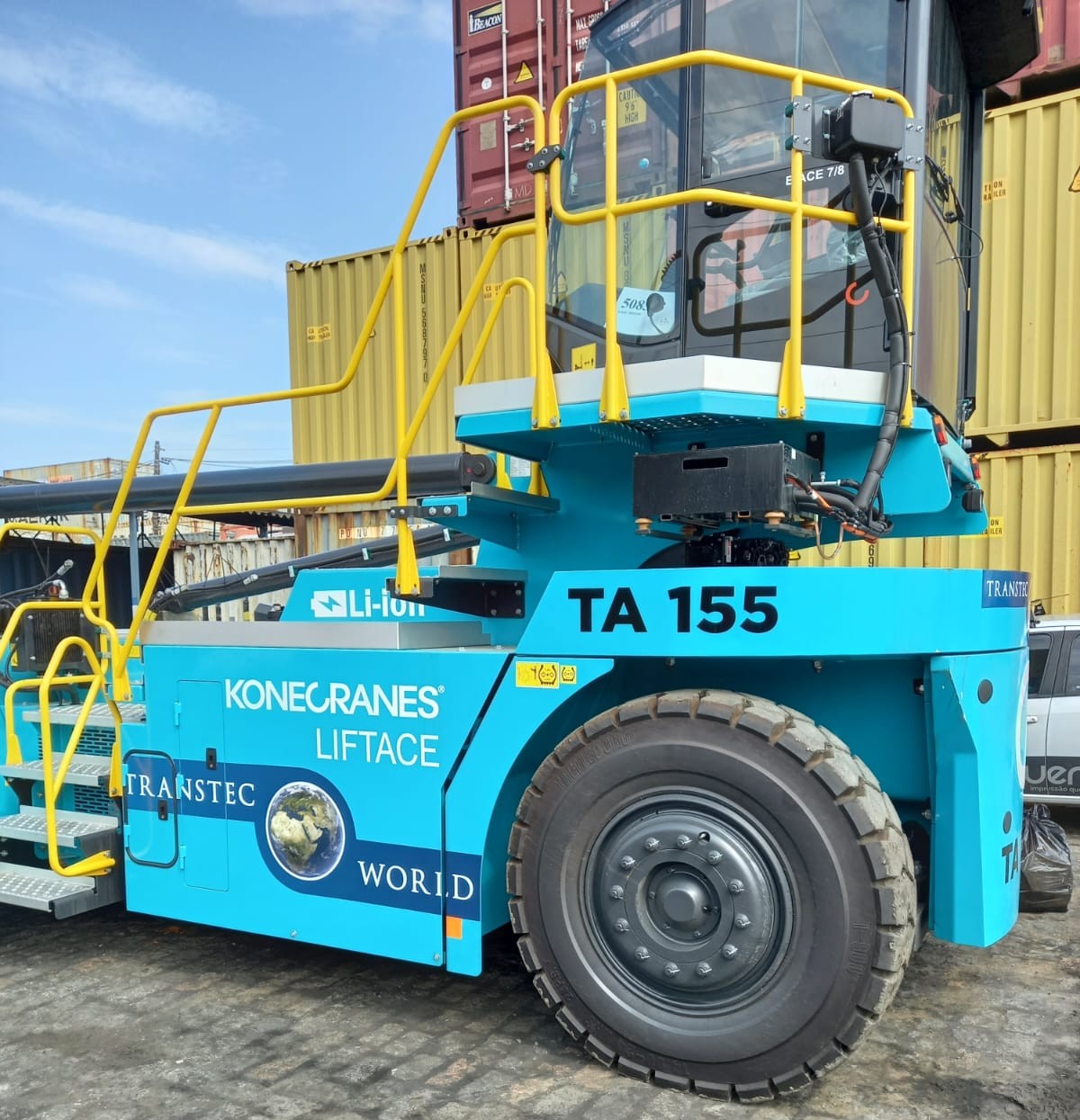
Transtec World has become the first operator in the Americas to adopt Konecranes’ electric empty container handlers.

Two E-ACE 7/8 ECC 90 electric empty container handlers will operate across Transtec World’s container depot at the Port of Santos in Brazil, marking the first deployment of Konecranes electric empty container handlers in the Americas. The order was placed In Q4 2025, with delivery planned during Q2 2026.

Transtec World is one of the largest container depot operators at the Port of Santos, managing eight container yards and handling more than 710,000 containers annually. The two Konecranes E-ACE 7/8 ECC 90 electric empty container handlers will support daily stacking and repositioning operations across the depot.

“Konecranes stood out for the quality of its brand, as well as the strong local support provided through distributor Equiport. We’re proud to be the first customer in the Americas using these fully electric empty container handlers. They will help us to improve efficiency and further reduce our operational CO2 emissions in line with the expectations of our customers,” says Rogério Oliveira, Operational Director at Transtec World.

Designed for intensive container handling, the high voltage electric models deliver strong lifting performance without local tailpipe emissions. Their electric drive system reduces noise, improves energy efficiency and lowers overall operating costs compared with diesel powered equipment. The new lift trucks combine high performance with strong safety and ergonomic standards, ensuring a comfortable and efficient operator environment. They are also equipped with TRUCONNECT® Remote Monitoring, providing real time insights to support preventive maintenance and maximize equipment uptime.

“Introducing high voltage electric empty container handlers into a major depot operation like Transtec World shows how Konecranes electric solutions can meet the performance demands of day to day container handling. This step reflects a broader shift in the Americas as operators look for ways to boost efficiency, reduce emissions and align with the expectations of global supply chains,” says Andres Ramirez, Regional Sales Development Manager, Konecranes Lift Trucks.

The contract marks another proof point for Ecolifting, Konecranes‘ comprehensive step-by-step roadmap to zero tailpipe emissions that supports the decarbonization of port operations. Our solutions range from renewable diesel-powered drives, to hybrid and fully-electrified fleets, and emerging options like hydrogen, all designed to meet the needs of each customer today and for the future.

A strong focus on customers and commitment to business growth and continuous improvement make Konecranes one of the material handling industry’s leaders. This is underpinned by investments in digitalization and technology, plus our work to make material flows more efficient with solutions that support the decarbonization of the economy and advance circularity and safety.

Throughput Doubled with Warehouse Management

A growing consumer products company has scaled operations without added labour, achieving 98.5% accuracy and zero audit errors. Durham Brands (DBA Gimme Beauty®), a hair accessory company, has transformed its warehouse operations with Infios Warehouse Management (WM) – enabling the company to improve accuracy and deliver record-breaking peak season performance.

Following the implementation of Infios WM, Durham Brands exceeded its December peak forecast by 170% while nearly doubling throughput from 10,000 to 19,000 cases per FTE, without adding labour. The company also achieved 98.5% inventory accuracy and recorded zero audit errors for the first time ever.

“This strategic move was more than a system upgrade, it was a meaningful shift in how we operate. We scaled through our biggest volume surge in company history without adding labour, and we improved accuracy and created opportunities to promote from within. The impact continues to compound across the business,” said Jeff Durham, CEO of Durham Brands.

Durham Brands has experienced more than 30% year-over-year growth for several consecutive years, supplying major retailers including Target, Walmart, Kroger and Ulta. As order volumes, SKU complexity and warehouse footprint expanded, the company outgrew its legacy warehouse management system, which relied heavily on manual processes and disconnected workflows across picking, packing and shipping.

Through Infios WM, Durham Brands introduced system-directed workflows across picking, license plating, lot control, and scanning – within a unified fulfillment environment. These capabilities eliminated manual steps, reduced mis-ship risk and improved real-time visibility across operations.

The system’s intuitive workflows and NetSuite integration have empowered employees across the operation – including a hearing-impaired, Spanish-speaking team member who now independently manages e-commerce fulfillment.

Durham Brands also strengthened inventory control and financial performance by moving to continuous cycle counting and improving lot visibility, enabling more strategic sourcing decisions and generating hundreds of thousands of dollars in tariff savings.

“Durham Brands’ results demonstrate how intelligent supply chain execution can unlock new levels of performance at scale,” said Tim Moylan, Chief Growth Officer, Infios. “The team is now completing a full week of work in just three days while maintaining exceptional accuracy and throughput. This is exactly the kind of continuous optimization and agility modern supply chains require to keep pace with growth.”

With a scalable, modern warehouse management platform in place, Durham Brands is now positioned to sustain its rapid growth while maintaining high service levels, operational efficiency and workforce productivity. The company plans to continue investing in automation, data visibility and scalable infrastructure to support its next phase of growth.

New Warehouses: Human-Optional/Robot-Centric

By 2030, 50% of new warehouses in developed markets will be designed as ‘robot-centric’ facilities, with humans being optional, according to Gartner.

As warehouse workers become less keen to perform manual tasks, many organizations will be challenged to sustain operations through hiring alone, as labour costs and supply remain under significant pressure for most of the year. In response, chief supply chain officers (CSCOs) are accelerating adoption of intralogistics smart robotics (ISRs) to scale operations as manual labour warehouse models become increasingly obsolete.

“AI continuously optimizes warehouse environments in real-time, shifting them from static structures into agile systems that adapt as demand changes,” said Abdil Tunca, Senior Principal Analyst in Gartner’s Supply Chain practice. “This changes how CSCOs think about designing warehouses for scalability, from settings that primarily rely on human labor to environments that maximize the ability to orchestrate robotic fleets.”

The ISR market is highly fragmented and will require most companies to adopt more than one type of robot and a multiagent orchestration platform to coordinate heterogenous fleets of robots. As robot adoption accelerates, organizations are moving beyond retrofitting traditional facilities with automation to designing new warehouse environments. In these modern warehouses, human labour is required only for exception handling, rather than serving as the foundation of daily operations.

Workforce and Cost Pressures Are Driving a Shift to AI Orchestrated Operations

Warehouse designs will increasingly prioritize flexibility, efficiency and adaptability to support automation-led, human-aided workflows. Workstations, storage of goods and fulfillment workflows can be adjusted instantly based on changes in demand patterns or labour availability, allowing facilities to respond without costly physical redesigns.

Over time, fixed warehouse infrastructure will give way to more software managed environments that continuously self optimize. For example, re-routing robotic pickers to higher priority orders during peak demand or reallocating tasks between humans and machines when staffing levels fluctuate.

This shift enables organizations to scale operations more efficiently. Autonomous facilities can operate with reduced lighting and climate requirements and reconfigure workflows without physical infrastructure changes. While there will be upfront capital costs, automation offers structural cost advantages that can help organizations handle higher order volumes with lower costs.

Gartner recommends CSCOs take the following steps when designing robot centric warehouse environments:

● Adopt digital twin and simulation models early to validate layouts and optimize robotic performance prior to construction.
● Favour scalable, software defined robotics platforms over single purpose automation to improve adaptability and reduce obsolescence risk.
● Establish long term vendor ecosystem partnerships to support future integration, flexibility and expansion.

Complexity Defining Challenge in Vehicle Logistics

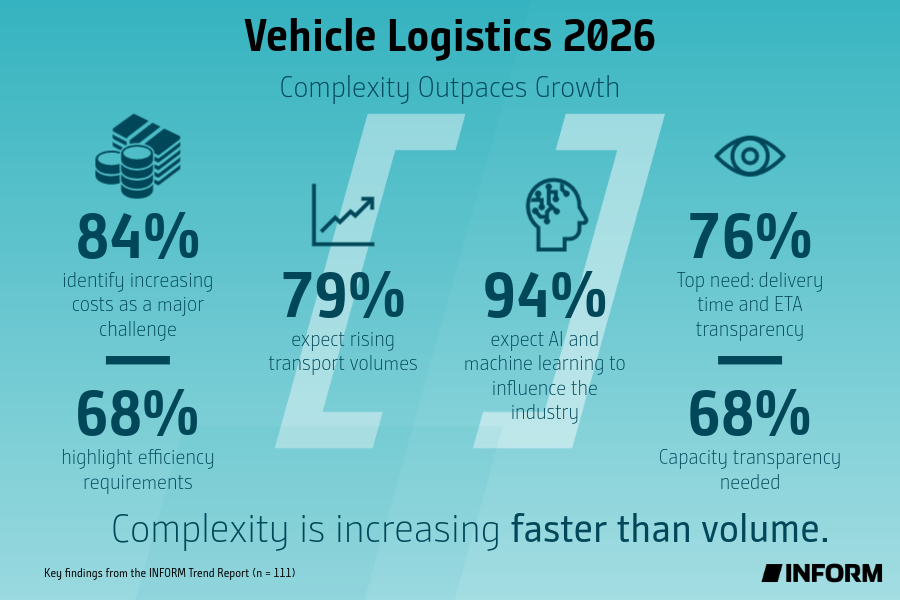
Vehicle logistics is entering a new phase defined less by growth alone and more by the challenge of managing increasing operational complexity. This is the central finding of the INFORM Trend Report 2026: IT in Vehicle Logistics, based on a survey of 111 industry professionals.

While 79% of respondents expect vehicle transport volumes (rather than overall production volumes) to increase over the next five years, a large majority simultaneously report continuously rising operational pressure. 84% identify increasing costs as the dominant challenge, followed by growing efficiency requirements (68%) and fluctuating volumes (52%).

Cost pressure remains the dominant operational challenge and has intensified compared to previous surveys. At the same time, limited transparency and increasing network complexity continue to impact planning quality and execution reliability. In many organizations, fragmented information still leads to reactive rather than proactive decision-making.

Management Summary: Growth Continues – Complexity Accelerates

The study highlights a structural shift in vehicle logistics:
• Most respondents expect transport volumes to grow.
• Operational pressure is intensifying across networks.
• Complexity is increasing faster than volume.
As a result, vehicle logistics is evolving into a decision-making challenge under cost and coordination constraints. Limited transparency remains a key barrier to efficient operations:
• 76% report insufficient visibility of delivery times and ETA.
• 68% see gaps in capacity transparency.
• 66% highlight missing transport status visibility.

At the same time, companies see a growing gap between operational requirements and existing IT capabilities. While 95% expect IT systems to improve operational efficiency, many organizations still struggle with fragmented data, limited integration, and insufficient decision support.

From Visibility to Decision Intelligence


Vehicle logistics networks involve multiple independent actors — from OEMs to carriers, terminals, ports, and dealers — each operating with their own systems and planning processes. As networks grow more interconnected, coordination becomes significantly more complex. Thus, the results indicate a clear shift in priorities: “Transparency alone is not the final objective. The real challenge is turning operational data into better decisions across the logistics network,” said Dennis Feddern, Senior Vice President Vehicle Logistics at INFORM.

Artificial Intelligence (AI) is widely expected to play a key role in addressing these challenges. 94% of respondents believe AI and machine learning will significantly impact the industry. It is expected to support the evaluation of complex scenarios and improve decision-making, with its primary role seen in augmenting human expertise rather than replacing it. However, the study also shows that immediate priorities remain more fundamental: better system integration, real-time visibility, and flexible planning capabilities.

A Long-Term Structural Trend

The INFORM study series (2013–2026) reveals a consistent pattern: vehicle transport volumes are expected to grow, while operational environments become more complex and volatile. Hartmut Haubrich, also Senior Vice President Vehicle Logistics at INFORM, added:

“While many companies still expect growth, what we currently observe in the market is a more differentiated picture across regions. Regardless of short-term developments, the need to improve planning capabilities and decision-making remains unchanged.”

The study is based on a survey conducted between December 2025 and January 2026, with 111 professionals and managers from the global vehicle logistics industry. Participants include representatives from: automotive manufacturers (37%), logistics service providers (46%), as well as carriers, terminal operators, and port authorities.

The majority of respondents are based in Europe (62%), followed by North America (18%), with additional participants from South America, Asia, and Africa. Most participating companies operate in finished vehicle logistics, with 98% handling new vehicles, 50% handling used vehicles, and 30% involved in high and heavy transport. The survey was conducted anonymously using a structured online questionnaire consisting of 25 questions.

Pre-retail Logistics needs to walk, before running

Paving the way for AI in supply chains requires foundational levels of digitalisation and connectivity, which are often lacking during pre-retail logistics. This needs addressing first, if businesses are to even get close to creating AI-assisted supply chains in the near future, writes Stuart Greenfield (pictured, below), UK and European Sales Director, for Advanced Supply Chain.

Embracing AI

There’s a growing consensus that AI is a strategic priority for transforming supply chains. Deloitte’s 2026 Retail Industry Global Outlook pinpoints AI as a key enabler for smarter, faster and more resilient supply chains, with 68% expecting agentic AI adoption in the next 12 to 24 months.

Data from Gartner suggests three quarters (74%) of supply chain practitioners identify AI as the primary driver of supply chain transformation in the coming years, while KPMG predicts supply chains this year will start embedding AI in planning and risk management.

Supply chain management and strategies are approaching a turning point, where the possibilities of AI are becoming more of a reality, rather than an aspiration. New opportunities are emerging to optimise stock inventory management, improve demand forecasting and strengthen scenario modelling to better manage supply chain shocks. However, realising such benefits will hinge on the flow of available, reliable data, and pre-retail processes could prove the weakest link.

Walking before running

Many pre-retail operations are still overly reliant on manual processes, often because warehouse operatives are constantly on the move. Paper stock logs and hand-written labels are typically commonplace during the stages of getting products ‘retail ready’ for sale. This causes a huge disconnect, which slows the flow of information and risks errors.

Stock inventory data is often inputted into a system at the end of a shift, meaning a lag of several hours between the processing and movement of goods, and the communication of data. By the time information is shared, it’s already likely to be outdated and unreliable, and possibly incorrect.

Illegible handwriting on labels can lead to mistakes, causing orders to be rejected and rerouted or held up in a distribution centre. The data lag stops real-time or near-time updates, limiting visibility and insight that can negatively impact the whole supply chain. Attempting to apply AI in such operating conditions is like trying to run before you can walk.

Creating connectivity

Manual processes during pre-retail logistics can be quickly replaced and enhanced by mobile, touchscreen kiosks and label printers, which enable automation and digitalisation. Connecting kiosks to a web-based supply chain management solution enriches the flow and accuracy of stock inventory data. Visibility and insight can be created, which, combined with the right IT capabilities and transport management systems, can be used to support end-to-end communication throughout supply chains.

From the moment labels are printed and scanned, information can be communicated to support supply chain optimisation. For example, it’s possible to maximise vehicle loads during both inbound and outbound logistics, while also scheduling vehicle movements to cut dwell time at warehouses and fulfilment centres. Mileage in supply chains and the number of vehicles in transit can be reduced to save carbon emissions and fuel costs. Just-in-time inventory management can also be better planned, minimising stockpiling and the associated energy consumption and costs of warehousing excessive inventory.

Replacing manual processes during pre-retail logistics can enhance efficiencies to help cut lead times and significantly boost speed to market. It’s a step that can yield many advantages from a relatively low investment, and a step that can get pre-retail logistics future-ready for the possibilities of AI.

Simulator Predicts Warehouse Performance

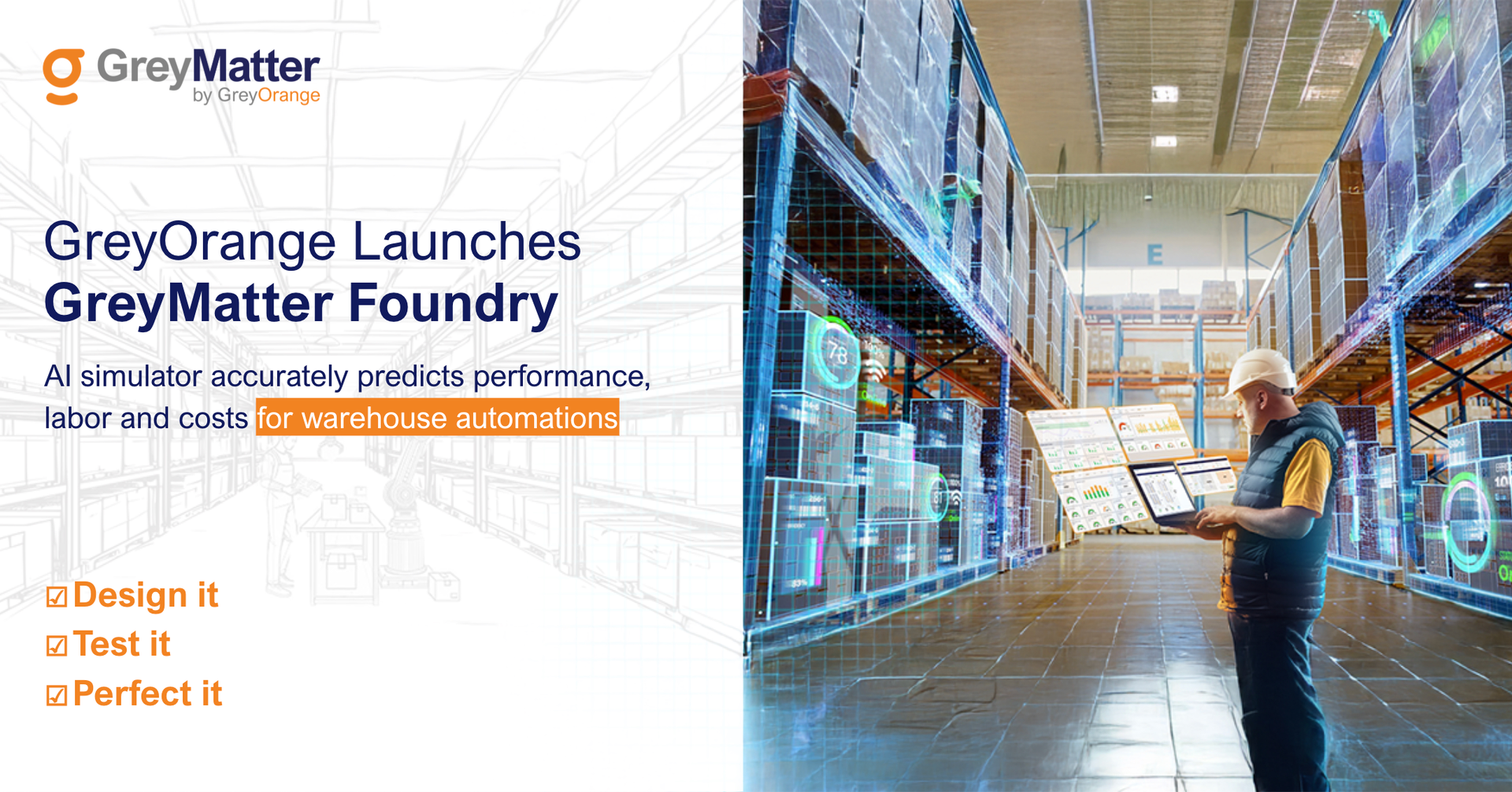
GreyOrange, supplier of AI-powered multi-agent warehouse orchestration and execution and store inventory software, has announced the launch of ‘GreyMatter Foundry’, an immersive AI simulator designed to unify warehouse flow design, technology sizing, and layout planning into a single, high-fidelity environment.

With GreyMatter Foundry, customers, systems integrators and in-house fulfillment teams can model complex automation scenarios to predict total system performance, estimate build-out costs, and visualize harmonious wall-to-wall orchestration before deploying a single dollar of capital.

Bridging the Gap Between Design and Reality

GreyMatter Foundry meets the growing need for AI tools that can manage complex, heterogeneous warehouse environments comprising fleets of robots from different vendors, other forms of automation as well as human associates. It is already deployed across thousands of warehouses. It is the ‘brain’ orchestrating a collective fleet of over 130,000 agents from GreyOrange’s Certified Ranger Network, making 250,000 trips per day and over 1 million optimizations per minute. With the addition of Foundry, supply chain leaders can now harness this unparalleled dataset to generate high-quality, accurate, wall-to-wall simulations for any design permutation in a matter of hours rather than weeks.

Key Features:
● Unlimited Heterogeneous Simulations: Unlike traditional toolsets, Foundry allows users to model unlimited robotic agent types and human-led processes simultaneously. Users can custom-specify robotic agents already in their fleet or those currently in production.
● AI-Powered Design Copilot: Using a simple conversational prompt or pre-set templates, users can intuitively guide the simulation. The AI Copilot helps tailor recommendations to specific throughput requirements without bias toward any specific robotic hardware.
● The CRN Advantage: While Foundry is vendor-agnostic, it delivers the highest-fidelity accuracy when simulating agents within the GreyOrange Certified Ranger Network (CRN). By drawing from over 1 million optimizations per minute performed by the CRN, Foundry provides unparalleled predictive reliability.
● Future-Proofing for 5- and 10-Year Horizons: Foundry comes equipped with pre-set scenarios for future growth, analyzing which combination of robotic agents and labor will meet demand cycles five to ten years down the road.

Foundry can be used to:
● Simulate the impact of labour challenges, plan staffing, or adapt day-to-day operations for any peak periods such as Black Friday
● Predict storage requirements and adapt workflows for seasonal SKU additions
● Model different layouts and flows to achieve specific throughput goals or financial efficiencies
● See 3D visualizations, walkthroughs, and ROI calculations for the entire warehouse
● Run multiple simulations in parallel, exploring thousands of potential outcomes to predict performance and costs with 95% accuracy or greater, even in the most complex heterogeneous automation environments both with the current rate of material flow and as the business expands

“Warehouse automation should not be a leap of faith,” said Saurabh Gupta, CTO for GreyOrange. “By putting the intelligence of our live, global GreyMatter network behind every simulation, we give distributors, 3PL’s, retailers and integrators a crystal ball grounded in real-world data. Whether you’re designing from a greenfield scenario or rethinking an existing operation, Foundry lets you test thousands of scenarios, stress-test for peak demand, and arrive at deployment day with confidence.”

PODCAST: Fulfilment at Speed and Scale

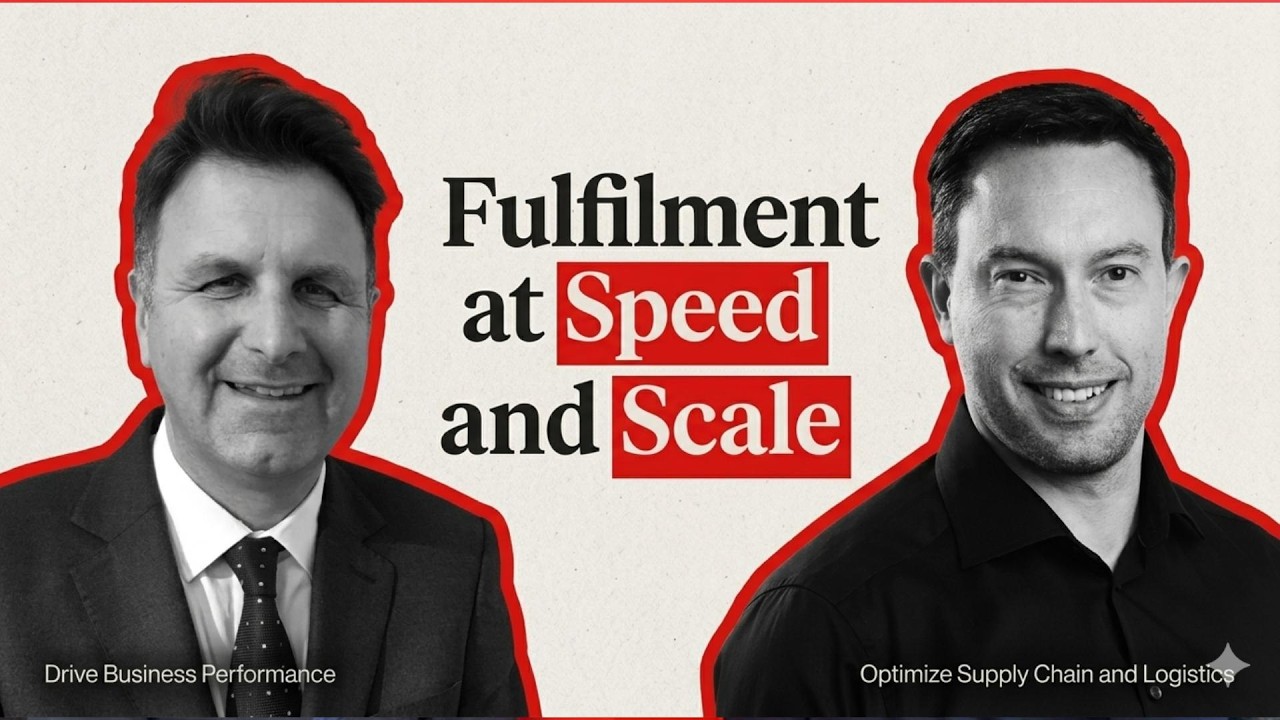
In the latest Logistics Business Conversations, host Paul Hamblin sits down with Russell Holmes of AutoStore to explore one of the biggest challenges facing modern logistics: how to achieve higher throughput without expanding your warehouse footprint.

From e-commerce fulfilment to grocery micro-fulfilment, the conversation reveals what “high throughput” really looks like in practice-think 10,000+ line presentations per hour, and in some advanced operations, far beyond that. Holmes explains how automation can deliver 5x productivity gains over manual picking, while also improving efficiency, accuracy and operator experience.

The episode also dives into the realities of investment decisions in uncertain times. Why are more businesses moving away from long-term, high-risk automation projects in favour of phased, scalable approaches? And how can software innovation-rather than new hardware—unlock significant performance gains, including faster pick times and increased output?

There’s also a look ahead at what’s next for warehouse automation, from AI-driven optimisation to increasingly hybrid, interconnected systems.

If you’re looking to increase capacity, maximise space, and future-proof your operation, this episode is packed with insight.

Listen now via the embedded player below.

Multimodal Services in the Spotlight

As global supply chains face mounting pressure from geopolitical uncertainty, shifting trade flows and rising customer expectations, logistics providers are increasingly being called upon to deliver more integrated, flexible solutions. The ability to combine multiple transport modes under a single, coordinated strategy is becoming a key differentiator, particularly for businesses moving complex or time-sensitive cargo across international markets.

Against this backdrop, multimodal logistics and 4PL models are gaining traction, enabling companies to streamline operations, improve visibility and reduce inefficiencies across the end-to-end supply chain. For operators with both global reach and in-house capabilities, this approach offers a way to balance control with adaptability.

Logistics Business spoke with a spokesperson from Spain-based logistics operator and shipowner Suardiaz Group to understand how the company is evolving its multimodal capabilities to meet these changing demands.

With more than 75 years in the industry, Suardiaz has grown into a global operator offering a wide range of services across maritime, air, rail and road transport, alongside customs, project cargo, warehousing and chartering. Backed by more than 1,000 employees and over over 30 offices across Europe, Africa and the Americas (Spain, France, UK, Morocco, Mexico, Peru, Dominican Republic), the company supports international operations through a combination of in-house expertise and a worldwide partner network.

A key focus for the group is door-to-door multimodal transport. As the spokesperson explained, this model places responsibility for the entire shipment, from origin to final destination, under a single operator, even when multiple transport modes are involved. By coordinating road, sea, air and rail movements within one contract, the company is able to offer customers greater visibility and control. “We provide this service globally,” they said.

coordinating international networks and partners to ensure seamless, efficient, and fully integrated transport solutions worldwide.

Suardiaz has also developed its role as a fourth-party logistics provider, combining brokerage with owned assets. While ocean and air freight are managed through strategic partnerships, the company retains direct control over its road fleet and a substantial warehousing footprint of more than 150,000 square metres. This hybrid approach allows it to balance flexibility with operational oversight across the supply chain.

The discussion also highlighted the group’s experience in project cargo, particularly in the renewable energy sector. Handling large, heavy components such as power transformers requires careful planning at every stage. According to the spokesperson, a detailed understanding of dimensions, weight distribution and handling requirements is essential, with transport drawings playing a critical role in ensuring safe loading, movement and installation, especially where the centre of gravity is offset.

Suardiaz works across a broad mix of industries, supporting businesses ranging from smaller enterprises to global manufacturers. Automotive, food and perishables, retail and renewable energy stand out as key sectors, although the company is equally active in infrastructure and industrial projects where tailored logistics solutions are essential. Flexibility, the spokesperson noted, is central to meeting these varied demands while maintaining efficiency and reliability.

When it comes to route planning, the company takes a consultative approach. While international sea and air corridors are well established, the emphasis is on selecting the right partners and combining transport modes in the most effective way. By doing so, Suardiaz aims to optimise both cost and transit time, ensuring each logistics operation is completed as efficiently as possible.

As supply chains continue to evolve, the company’s integrated model reflects a broader industry shift towards end-to-end logistics solutions that prioritise resilience, efficiency and global connectivity.

Fleet Standardisation at MODEX 2026

Autonomous navigation and fleet management leader BlueBotics will highlight fleet manager standardisation, obstacle avoidance, and vehicle navigation at MODEX 2026, taking place April 13–16 in Atlanta, Georgia, through on-stand educational sessions, expert discussions, and a joint seminar with Kohler focused on unified fleet management.

At booth C13394, BlueBotics will present its ANT navigation and fleet management technology, including SmartPass, a new innovation that enables automated guided vehicles (AGVs) and autonomous mobile robots (AMRs) to overcome path obstructions efficiently while maintaining the structured, predictable behavior required in industrial environments.

“Industrial users don’t just need autonomous vehicles — they need systems that remain predictable, coordinated, and scalable as operations grow,” said Dr. Nicola Tomatis, CEO of BlueBotics. “At MODEX, we look forward to discussing how bounded autonomy allows fleets to handle obstacles more intelligently while maintaining smooth, predictable operations.”

Fleet manager standardisation seminar with Kohler

BlueBotics will place fleet manager standardisation at the center of its MODEX presence through a joint seminar with kitchen and bath leader Kohler titled The Power of One: Unlocking AGV/AMR Efficiency Through Unified Fleet Management. The session will take place on Tuesday, April 14, from 12:30 PM to 1:15 PM at the Supply Chain Resiliency Theater.

During the session, BlueBotics CEO Dr. Nicola Tomatis and Brian Gruzdis, Senior Staff Engineer – Warehouse Automation Lead at Kohler, will discuss the benefits of standardising an AGV/AMR fleet manager, the potential risks involved, and best practices for selecting a fleet manager partner and deploying fleet management enterprise-wide.

Drawing on real-world experience, Gruzdis will explain how standardising Kohler’s AGV software platform has supported the company’s global AGV and AMR operations by accelerating deployments, reducing integration risk, and enabling greater flexibility in deploying different vehicle types across multiple production sites.

On-stand expertise and live knowledge sharing

Throughout the show, BlueBotics’ experts will host short on-stand educational sessions, offering visitors practical insights into key automation challenges and solutions. Topics will include the pros and cons of obstacle avoidance, mobile robot interoperability, fleet manager standardisation, and best practices for integrating automated vehicles into complex industrial environments.

Visitors will also have the opportunity to discuss their specific automation projects with the BlueBotics team, from vehicle development to system integration and fleet manager standardisation.

Driving efficient, scalable fleet operations

By combining structured navigation with controlled obstacle avoidance, BlueBotics enables fleets to maintain efficient material flow while minimizing disruption and reducing the risk of deadlocks. Its ecosystem of “ANT driven” vehicles spans a wide range of vehicle types, all of which can be managed through a unified fleet management platform based on BlueBotics’ ANT server fleet manager.

This approach reflects a growing industry focus on system-level performance, where predictability, interoperability and centralized control are essential to scaling automation successfully across sites and applications.

Subscribe

Get notified about New Episodes of our Podcast, New Magazine Issues and stay updated with our Weekly Newsletter.