Viking Partnership Extended

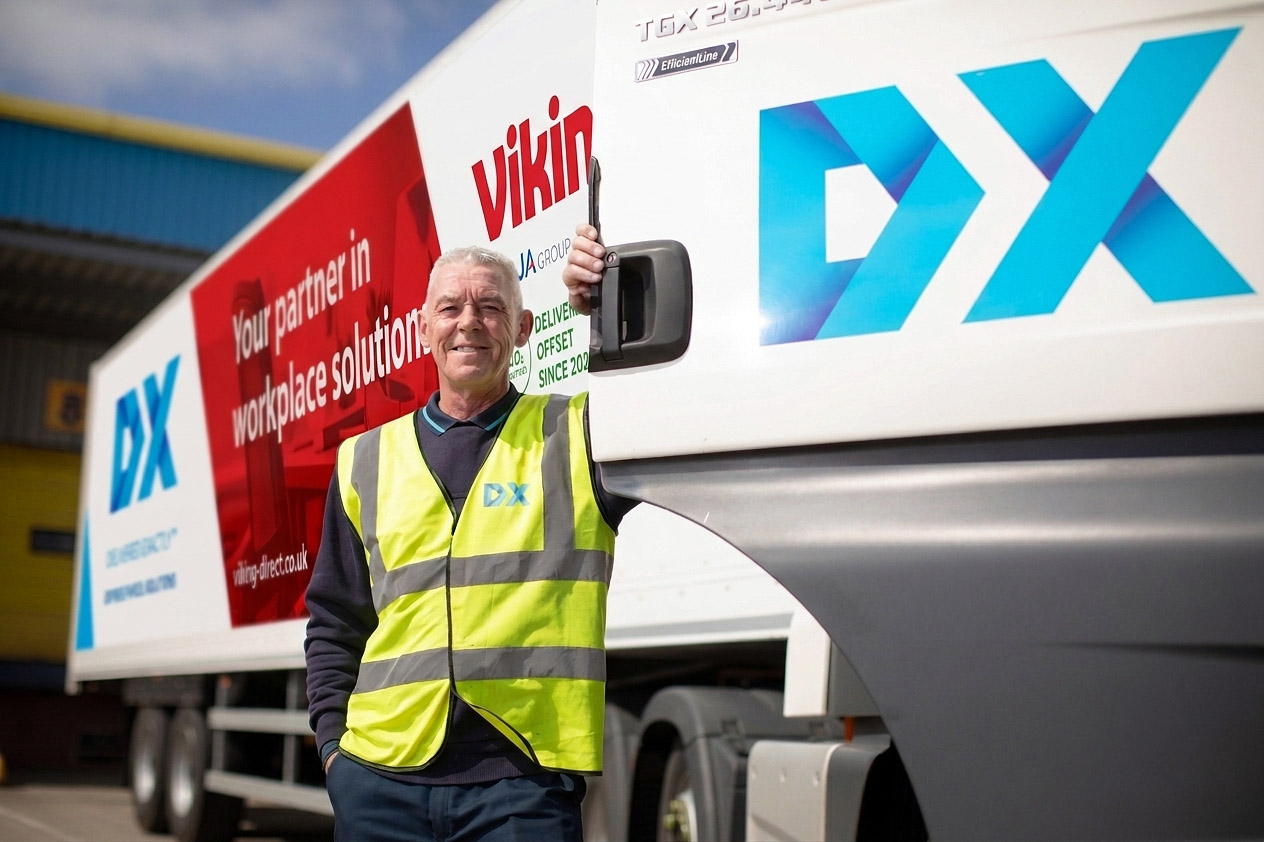
DX has announced the expansion of its strategic partnership with Viking Direct UK, a large distributor of workplace supplies and equipment, in a new, multi-year contract. The contract builds on the highly successful and close relationship the two businesses have already established.

Under the terms of the new contract, DX, which was awarded ‘Trusted Partnership Status’ by Viking in 2025, will be responsible for the next-day delivery, across the UK, of the hundreds of thousands of Viking customer orders placed each year. Both sides have committed significant investment into the partnership over the past few years. This has been across dedicated facilities and dedicated personnel, including embedded DX teams within Viking’s operations.

Even more significantly, DX and Viking have established very close communications between the two organisations. This close level of engagement has helped to create a culture that has promoted and rewarded problem-solving, innovation, and greater efficiencies. The net result has been increased performance levels, record customer satisfaction for Viking, and a reduction in operational costs.

Andy Renshaw, Logistics Director at Viking, commented:

“DX feels like a true partner to Viking rather than simply another supplier. What sets DX apart is not just service performance, but the way the relationship works when there is an issue to solve or an opportunity to improve. There is transparency, agility and a motivation to adapt on both sides. DX’s depot managers and our own team treat each other as colleagues solving the same problem rather than two businesses managing each other. That’s not something you can impose. It has to be built, and you can see it in how impressively people on both sides actually behave.”

Ian Truesdale, Chief Executive Officer of DX, commented:

“DX and Viking have established a highly effective and close relationship, and we’re delighted to see our partnership continue to grow. It has been extremely productive because both sides take their commitment to high customer standards very seriously and are willing to engage openly and transparently with each other. We look forward to further years of successful collaboration and development.”

Viking Direct UK is a supplier of office supplies, stationery, furniture and ink and toner for businesses of every size. With over 35 years of experience, the company aims to deliver reliable products, competitive pricing and fast UK-wide delivery to keep workplaces running smoothly.


UK-India Trade Requires Resilient Freight Network

The UK and India reached the culmination of long negotiations as the new free trade agreement between the world’s 5th and 6th largest economies comes into effect. The agreement will deliver major benefits to exporters in both countries, estimated at an eventual £25bn boost in bilateral trade, by reducing or removing tariffs on almost all goods exports, writes Rashid Abdulla, DP World CEO & MD, Europe (pictured below).

“Some businesses will see sweeping reductions. The UK’s largest food and drink export, whisky, will benefit from a Indian tariff cut from 150% today to 40% over the next 10 years, while the tariff faced by UK car manufacturers’ on exports to India will fall below 10%. The majority of current UK exports to India will ultimately be tariff free. UK suppliers will also gain access to the Indian central government procurement market, worth tens of billions a year.

“For key Indian export sectors, like textiles and fishing, tariffs on the goods they send to the UK will also be cut, giving UK consumers more choice and cheaper prices on the high street. This is good news for people and businesses in both countries – trade powers economies. Reducing tariffs and freeing international trade boosts prosperity.

“Negotiating, signing and ratifying free trade agreements is the first step to boosting trade. Delivering on their potential requires reliable, resilient trade networks with capacity to spare. The logistics assets and networks that underpin the ability of economies to trade reliably and in increasing volumes are especially important when goods need to cover significant distances to reach their intended markets.

“The UK and India already trade goods and services worth £48bn a year. Boosting this trade requires innovative, ambitious businesses seeking to export to distant markets, served by the major freight handling and transport infrastructure they need to do so successfully. As a country grows the volume of its trade, so it needs more facilities, modes and routes to service that trade with the speed and reliability that cargo owners require.

“For small or medium sized enterprises, some who may be exporting into a new market for the first time, the prospect may seem daunting. However, the UK has the trade infrastructure in place, a developed network of routes, and the business expertise available to ensure the reduction of tariffs is an opportunity that is taken.

“DP World has now invested more than £6bn in our network of UK assets, as we believe in this country’s potential to continue growing as a global trading power. Our ports, logistics and marine services network is connecting UK importers and exporters with domestic and international markets.

“Enhanced trade capacity makes the UK better able to respond and adapt to trade shocks, elevates its role in connecting European trade more widely, and brings it closer to global markets. In India too DP World is a major investor that handles one quarter of the national container trade. We integrate ocean, air, road and rail transport in India with free zones, warehousing and forwarding to make trade simple and boost supply chain resilience. A container leaving the UK from London Gateway on one of the world’s largest container ships can reach our terminals in Nhava Sheva, Mundra, Chennai or Cochin in little more than three weeks. Our new container terminal at Tuna-Tekra in Gujarat is scheduled for completion next year.

“Supply chain resilience around the world is now in greater focus than perhaps ever before. When routes and networks are disrupted by global events and geopolitics, exporters need logistics expertise to adapt and ensure their goods reach the markets they are destined for, safely and on schedule.

“In a market as large and complex as India, inconsistent fulfilment can quickly erode distributor confidence and weaken customer relationships. Businesses that cannot maintain operational continuity may find themselves losing market share not because of product quality, but because of an inability to deliver reliably at scale.

“This is where integrated logistics and market access expertise become strategically important. Exporters need customs coordination, market access advisory and established operational infrastructure – regulatory expertise and end-to-end logistics execution help them reduce administrative friction, maintain supply chain visibility and secure resilient distribution networks.
India is forecast to become the world’s 3rd largest economy in the coming years.

“Increasing trade with India and with the world’s other major economies is a long-term opportunity for the UK. Investment that has been made already and is still ongoing can support the businesses who will generate rising exports and spread the benefits of growth to every part of the country.

“The start of a major free trade agreement is an exciting moment brimming with economic potential, and for businesses and employees across the UK we hope to see repeated many more times in the coming years.”

Gamification for Warehouse Performance

Intelligent Supply Chain Execution specialist Infios has announced that vaibe will join the Infios suite of solutions, advancing warehouse performance through the combined power of technology and people. vaibe, a gamification platform designed for warehouse environments, uses game mechanics to increase frontline engagement, motivation and productivity, and will strengthen the Infios portfolio with its workforce performance capabilities.

Originally developed through Körber’s internal digital innovation process, vaibe has evolved into a differentiated solution that addresses the critical human dimension of supply chain operations. Now joining Infios—a joint venture of global technology company Körber and global investment firm KKR — vaibe further strengthens the company’s ability to deliver measurable improvements in both workforce engagement and operational productivity.

“vaibe brings a highly practical dimension to how we think about performance in the warehouse,” said Eugene Amigud, Chief Innovation Officer at Infios. “It strengthens our ability to connect system intelligence with day-to-day execution, helping customers drive better outcomes not just through technology, but through how work actually happens.”

“From a technology perspective, vaibe was designed to integrate seamlessly into warehouse workflows while delivering real-time feedback that drives behavior,” said Tiago Sottomayer, Chief Technology Officer at vaibe. “Becoming part of Infios allows us to scale that architecture, embed deeper into operational ecosystems and accelerate how data translates into meaningful action on the floor.”

This integration reflects a shared commitment to purposeful innovation, leveraging technology to make supply chains more efficient, agile, and intelligent. Together, Infios and vaibe will help organisations strengthen the connection between frontline workforce engagement and measurable business outcomes across the supply chain.

“vaibe started with a clear focus — make work on the warehouse floor more engaging and impactful,” said Nick Retzmann, Chief Growth & Product Officer at vaibe. “Joining Infios gives us the opportunity to expand that mission globally and bring those benefits to many more customers.”

The announcement marks the next stage in vaibe’s evolution—from internal innovation initiative to an established solution within the Infios portfolio—further strengthening Infios’s commitment to modern, human-centered supply chain operations.

DKV Acquires Majority Stake in Tolltickets

B2B platform for on-the-road payments and solutions, DKV, is acquiring a majority stake in tolltickets GmbH, a certified provider of European toll solutions headquartered in Rosenheim, Germany. Through this acquisition, DKV Mobility expands its European toll business and gains access to Tolltickets’ platform for the European Electronic Toll Service (EETS). EETS is the Europe-wide standard that allows road tolls in many countries to be settled with a single on-board unit. DKV Mobility is acquiring the shares from Kapsch TrafficCom AG, which will retain a minority stake in the company. Tolltickets will continue to operate as an independent company.

Sebastian Klauke, CEO of DKV Mobility, says:

“Our toll business is a key building block of our integrated mobility platform. With a majority stake in Tolltickets, we are securing a strong long-term position in the European EETS market, gaining greater scope to actively shape its development, and consistently continuing our growth course.”

DKV Mobility is expanding its position as an integrated mobility platform, giving customers access to essential fleet-related services across Europe from a single source. Its toll business is one of the strategic core areas of this platform.

Georg Kapsch, CEO of Kapsch TrafficCom AG, says: “For over a decade, we have been invested in Tolltickets and watched it grow remarkably. DKV Mobility is exactly the right partner to take the company to the next level, combining Tolltickets’ technology with the scale needed to grow across Europe. We remain committed to supporting its continued success.”

Jérôme Lejeune, Managing Director at DKV Mobility responsible for Toll & Refund Services, adds: “We have been working successfully with Tolltickets as a sales partner for many years. With this strategic partnership, we are now taking the next step and deepening our collaboration in the European toll business. Our customers will benefit from this step as we will be able to provide our toll solutions across Europe even more reliably and flexibly in the future.”

Quentin Couret, Managing Director of Tolltickets, comments:

“With DKV Mobility, we are strengthening a partnership that has been built over many years – bringing together our experience in the toll business and their large, Europe-wide customer base. As an independent company, this gives us the momentum we need to keep growing and to make our technology accessible to even more customers.”

Tolltickets was founded in 2007, is headquartered in Rosenheim, Germany, and employs around 60 people. The company is one of the leading certified EETS providers. Tolltickets offers its own on-board units as well as vignettes and gives customers access to toll systems in 15 European countries through a single solution. More than 100,000 vehicles are managed via its platform. The company serves both business customers and private customers through its online shop.

The closing of transaction is subject to regulatory approval and is expected until the end of the year.

How to Scale Faster with Turnkey Warehousing – Podcast

Warehousing has become one of the fastest-evolving sectors in logistics. The growth of e-commerce, increasing customer expectations, labour shortages, automation, decarbonisation and rising energy demands are forcing businesses to rethink what a distribution centre needs to deliver—not just today, but decades into the future.

Modern warehouses are no longer simply places to store inventory. They’re becoming highly connected, energy-efficient operational hubs, designed to support robotics, AI-driven fulfilment, electric vehicle fleets and increasingly complex supply chains. At the same time, developers and occupiers face mounting pressure to improve sustainability, future-proof investments and create facilities that can adapt as technology continues to evolve.

Recorded live at Multimodal 2026, this episode of Logistics Business Conversations explores these challenges with Prologis experts Danny Bostock and James Henstock. Together, they discuss how warehouse design is changing to meet the needs of modern logistics, from reducing the time between signing a lease and receiving the first pallet, to ensuring buildings have the power capacity, flexibility and digital infrastructure to support future automation.

The conversation also examines why energy security has become one of the sector’s biggest challenges, how solar generation and EV infrastructure are reshaping warehouse developments, and why the industry’s focus now extends far beyond the building itself to include employee wellbeing, transport connectivity and long-term resilience.

Whether you’re an occupier planning your next facility, a property professional, or simply interested in where the logistics industry is heading, this episode offers valuable insight into the trends that will define the next generation of supply chains.

Listen to the full episode below to discover how today’s warehouse decisions are shaping the future of logistics.

The Shift to Cloud-Native Warehousing Accelerates

As logistics providers continue to invest in cloud computing and artificial intelligence to improve warehouse efficiency and manage increasingly complex supply chains, Kuehne+Nagel is evolving its KN SwiftLOG warehouse management system into a cloud-native platform with agentic AI capabilities.

Spanning more than 1,000 sites in close to 100 countries, the deployment represents one of the most extensive transformations of warehouse operations in the logistics industry. 

To support this transformation, the platform is built on Blue Yonder’s Warehouse Management Solution, part of the company’s Cognitive Solutions. This brings KN SwiftLOG into a unified, cloud-based environment while continuing as Kuehne+Nagel’s established warehouse management system. 

The global roll-out began in April 2026 and is being implemented in phases to ensure continuity of service. As deployment progresses, it enables scaling across operations and helps manage increasing supply chain complexity and evolving customer requirements. 

Evolving KN SwiftLOG into a cloud-native platform allows us to connect operations, data, and workflows more effectively across locations. As supply chains become more complex, improving efficiency remains a key driver for adopting cloud-based solutions. This shift supports consistent execution at scale and helps us respond more quickly to customer requirements, while maintaining reliable service delivery,

says Eduardo Razuck, Executive Vice President, Contract Logistics, Kuehne+Nagel. 

The platform lays the foundation for more efficient and coordinated operations across the network, connecting warehouse activities with data-driven insights and intelligent automation. This enables more accurate planning, clearer visibility, and faster responses to disruptions.  

For customers, this translates to consistent execution across locations while maintaining the stable operations they experience today. Moving to a single cloud-based platform supports more standardised processes across sites, helping to align operations for customers served in multiple countries. The first customer deployment is planned to go live in Asia in July 2026. 

Together, Kuehne+Nagel and its customers will benefit from AI-enabled execution and next-generation operating practices that increase productivity, speed and agility… The future of supply chain belongs to those who can standardise globally, decide faster, and adapt at the speed of disruption.

said Duncan Angove, CEO of Blue Yonder.

The rollout reflects a broader trend across the logistics industry, where warehouse operators are replacing legacy management systems with cloud-native platforms to improve visibility, standardise processes and support greater automation. As AI capabilities become increasingly embedded within warehouse management systems, logistics providers are looking to enhance productivity, improve decision-making and build more resilient supply chains capable of adapting to changing customer demands.

Investment Signals Confidence

One of the things I enjoy about reporting on the logistics industry is that every week offers another snapshot of where the market is heading. For example, this week’s news paints a good picture of an industry that continues to invest, innovate and adapt, despite the uncertain economic backdrop.

Perhaps the most encouraging theme has been the continued willingness of companies to invest in their operations. New warehouse developments, distribution facilities and technology projects continue to be announced across Europe and beyond. These are not short-term decisions; they reflect confidence in future demand and a recognition that efficient supply chains remain central to business success.

That confidence is also reflected in the pace of warehouse modernisation. Logistics Investment in Automation plays an important role, but the emphasis is increasingly on finding the right solution rather than the biggest one. Businesses are looking for systems that integrate with existing operations, improve productivity and offer clear ROI. This sensible, pragmatic approach reflects the maturity of today’s logistics market.

Another trend that stands out is the industry’s growing focus on resilience, which sits alongside efficiency as an equally important objective, as businesses recognise that supply chains need to cope with unexpected disruption as well as everyday demand.

That thinking extends beyond warehouses. Fleet operators continue to look for ways to improve vehicle utilisation, reduce operating costs and enhance safety, while shippers are placing increasing emphasis on end-to-end visibility and reliable service. None of these developments are particularly revolutionary in isolation, but together they demonstrate an industry becoming smarter and more connected.

As we move further into the second half of the year, I suspect we’ll continue to see this steady evolution rather than dramatic change. New facilities will come online, partnerships will develop, transport networks will become more efficient, and technology will continue to support better decision-making. These may not always make the biggest headlines, but they are exactly the developments that strengthen supply chains over the long term.

That’s why I enjoy keeping track of the industry’s progress. Behind every investment announcement, product launch or customer project is another example of logistics quietly becoming more capable, more efficient and better prepared for whatever comes next. And those are the stories worth following.

Why Zone Separation Could Transform Cold Chain Efficiency

The UK operates the largest cold storage market in Europe by capacity, and it is under pressure. The temperature-controlled sector contributes £14 billion in gross value added to the economy, according to the Cold Chain Federation, yet operators are absorbing sharp cost increases: the Federation reported cold-chain energy costs rose 46% in 2023 alone. For logistics operators running chilled and frozen distribution, energy is no longer a background overhead. It is a defining operational and competitive variable.

Much of the industry conversation focuses on the storage side, on refrigeration plant, insulation, and set-point management. But in a distribution centre, the bigger and more overlooked energy drain is movement. Distribution facilities are defined by constant door activity, frequent openings, and the transfer of goods between zones held at different temperatures. Ambient goods-in, chilled pick faces at up to 8°C, and frozen areas at −18°C or below often sit within the same building footprint, and every uncontrolled opening between them costs money.

Where the energy actually goes

The scale of this is not marginal. The ASHRAE Handbook of Refrigeration notes that heat gain from infiltration air can amount to more than half the total refrigeration load of distribution warehouses. That figure is specific to high-throughput, high-door-traffic facilities, which is exactly what a modern fulfilment or 3PL distribution centre is. In other words, in the buildings logistics operators actually run, air movement between zones can be the single largest driver of refrigeration demand, ahead of the storage envelope itself.

This is where physical zone separation earns its place. Temperature-separating curtain walls and PVC strip curtains reduce the uncontrolled exchange of air at openings and between zones, so each area is held only as cold as it needs to be rather than bleeding cold air into warmer neighbours or over-cooling on rebound. Peer-reviewed research has measured strip curtains in good condition reducing doorway air infiltration by around 90%, though effectiveness falls sharply when curtains are damaged, gapped, or poorly overlapped, which makes condition and maintenance part of the energy strategy, not an afterthought.

Flexibility as an operational advantage

The other reason curtain systems suit distribution rather than fixed storage is change. Fulfilment operations reconfigure constantly, with zones expanding and contracting by season, by contract, and by product mix. Warehouse curtain dividers and insulated partition systems can be repositioned as those needs shift, letting an operator create or move a chilled zone without a construction project. For 3PLs in particular, whose space requirements change with every new client, that adaptability protects both capital and continuity of operation.

It also aligns with where the sector is heading. The Cold Chain Federation’s ongoing Cold Chain Net Zero work, alongside the UK’s legally binding 2050 Net Zero target, is pushing operators toward measurable energy reductions. Reducing refrigeration load through better zone separation is one of the more straightforward interventions available, requiring no plant replacement and no operational shutdown.

Specifying responsibly

Any internal partitioning must be designed around the building’s fire strategy. Curtains must not obstruct escape routes or fire detection, and must not impede sprinkler coverage under BS EN 12845, in line with duties under the Regulatory Reform (Fire Safety) Order 2005. Fabric should be certified to BS 5867 Part 2 Type B, with a BS EN 13501-1 Euroclass rating where required, and operators should check the manufacturer’s actual test certificate rather than assume a classification. Handled properly, zone separation is a rare thing in cold-chain logistics: a meaningful energy saving that does not require rebuilding the facility to achieve it.

By Scott Fullerton, Operations Manager, AKON Curtains Limited

AI drives a new era of specialist logistics technology

The logistics industry is entering a new phase of digital transformation as artificial intelligence moves beyond visibility and analytics to automate operational decision-making. With supply chains under continued pressure to improve efficiency, resilience and customer service, logistics service providers (LSPs) are increasingly investing in AI-powered infrastructure that can streamline workflows, reduce manual processes and deliver real-time operational intelligence.

One of these such companies has announced it is separating into two focused businesses. project44 will continue serving enterprise shippers as a Decision Intelligence Platform, while LSP44 launches as a dedicated, profitable AI-native company built specifically for logistics service providers, including 3PLs, freight forwarders and brokers.

The move creates two businesses with distinct customers, go-to-market strategies and product roadmaps, while continuing to share the same underlying AI-native agent network, carrier API infrastructure and global logistics data graph.

Although launching as a standalone business, LSP44’s roots stretch back to project44’s founding in 2014, when the logistics industry still relied heavily on phone calls, faxes and EDI. The company’s first product connected carriers through real-time APIs across quoting, dispatch, visibility and documentation, with logistics service providers including Worldwide Express, BlueGrace and DSV among its earliest customers.

Today, nine of the world’s ten largest logistics service providers operate on LSP44 infrastructure. Over the past decade, project44 expanded into the enterprise shipper market, building its Decision Intelligence Platform while continuing to develop the carrier network, integrations and data foundation that underpin both businesses.

Shippers and LSPs don’t buy the same thing, so we stopped pretending one business could serve both… People often forget that project44 began by serving brokers, forwarders and 3PLs. LSP44 represents a renewed focus on those customers, giving them more than a decade of network, data and trust in the form of AI agents that don’t just observe—they act.

said Jett McCandless, Founder and CEO. “

The separation reflects the increasingly different technology requirements of shippers and logistics providers. While shippers use platforms to improve planning and execution, LSPs embed infrastructure directly into their own transportation management systems, customer portals and digital services. As AI adoption has accelerated, those differing needs have become even more pronounced.

Unlike many newer AI entrants, LSP44 combines AI with more than a decade of operational logistics context. Its platform is built on a logistics data graph spanning more than 280,000 carriers, 1.5 billion shipments and 706 million carrier events processed every day across North America, Europe, Asia-Pacific and Latin America.

The platform supports the full shipment lifecycle through APIs and AI agents, covering carrier procurement, quoting, tendering, booking, dispatch, ocean execution, appointment scheduling, carrier onboarding, real-time visibility, exception management, documentation, freight audit and settlement. By grounding AI in live operational data, LSP44 says customers can automate complex logistics workflows while improving speed, accuracy and service.

LSP44 also launches as a profitable standalone business with its own engineering, sales and leadership teams, enabling it to focus exclusively on the needs of logistics service providers while continuing to invest in AI innovation.

Industry partners welcomed the move. Michael Rabaud, Global Director of Digital, Data and Innovation at CEVA Logistics, said combining AI agents with live logistics data creates “a step-change in what we can do.” BlueGrace Logistics Founder and CEO Bobby Harris described LSP44 as “the infrastructure layer we build on”, while Worldwide Express President Joel Clum highlighted the company’s long-standing partnership with project44 and the value of AI embedded directly into logistics operations.

As AI becomes increasingly central to supply chain execution, organisations are looking beyond standalone automation tools towards connected platforms that combine trusted operational data, carrier connectivity and intelligent decision-making. With dedicated businesses serving both enterprise shippers and logistics service providers, project44 and LSP44 aim to accelerate innovation for each customer group while building on the shared infrastructure developed over the past decade.

Study Finds Small Asset Theft Behind Millions in Hidden Losses

Asset theft and equipment loss remain persistent challenges across industries including construction, transportation, utilities and field services, placing increasing pressure on organisations already managing tight margins, labour shortages and complex supply chains. While the financial impact of stolen high-value equipment is well understood, the day-to-day operational disruption caused by missing tools, smaller assets and specialist equipment is often harder to quantify. As businesses look to improve efficiency and resilience, greater visibility into asset location and utilisation has become an increasing priority.

New research from Samsara highlights the scale of this challenge. The company’s 2026 State of Connected Operations (SOCO) Asset Theft & Loss Report, Quantifying the Hidden Cost of Asset Invisibility, finds that equipment theft and loss is not just a replacement-cost problem—it’s a £9.7 million annual operational drain for mid-sized organisations (between £180 million and less than £740 million in annual revenue) without asset tracking.

The bigger surprise is which assets are driving those losses. While heavy machinery theft often makes headlines, the report found that 72% of operational costs stem from disappearing assets valued at less than £7,400, including tools, sensors, generators and specialised parts that organisations rely on every day.

The proprietary study, based on insights from 1,500 financial executives — majority mid-size operations between £180M and <£740M annual revenue —  across construction, logistics, field services, and utilities in the United States, Mexico, the United Kingdom, Ireland, France, Germany, and Canada, puts a precise number on a problem the industry has long felt but never been able to quantify. Despite 71% of operations experiencing equipment theft every quarter, and 25% of new equipment budgets going to replace what’s been stolen or lost, the hidden damage runs far deeper: project shutdowns, emergency rentals, idle labour, and contract penalties compound the direct loss into millions in operational costs.

Before deploying Samsara, a single missing piece of equipment could delay a job, idle a crew, and force emergency procurement, all without ever knowing where the asset actually was… With real-time asset visibility, we expect a 100% reduction in unreturned assets, 90% reduction in days outstanding, and our teams spending time on safety and customer service instead of searching for tools. All told, this could add up to millions in recovered operational costs.

said John Chaccour, Director of Technology at Total Safety.

Key findings include:

Equipment theft is a reality, not a rare event

  • 71% of operations without asset tracking experience equipment theft every quarter
  • 25% of new equipment budgets go to replacing stolen or lost assets
  • In the UK & Ireland, 37% of organisations report higher insurance premiums as a direct consequence of asset theft and loss

Small equipment is a hidden driver of losses

  • Operations without tracking lose an average of £9.7M annually from direct and indirect costs of missing equipment
  • 72% of those operational costs come from missing assets valued under £7.4K, like tools, sensors, and specialised parts
  • The “death by a thousand cuts” from disappearing small gear is where the real financial drain occurs

Missing assets drain productivity and halt projects

  • 98% of organisations say searching for assets is a daily or weekly occurrence
  • At more than a quarter of organisations without real-time visibility, employees spend more than 10 hours per week searching for missing equipment — equivalent to one full-time employee doing nothing but searching for three months a year
  • 77% globally (71% in the UK & Ireland) say a missing critical asset caused a significant shutdown or delay in the past 12 months
  • Without tracking, the average time to locate a missing asset is 25 days, and 54% of organisations can’t recover even half of their stolen high-value equipment

The gap between organisations with and without asset visibility is not merely operational, it’s financial. Companies investing in tracking are not only recovering assets faster, they’re preventing the secondary costs that compound long after the initial loss.

Find the full report findings here.

Subscribe

Get notified about New Episodes of our Podcast, New Magazine Issues and stay updated with our Weekly Newsletter.