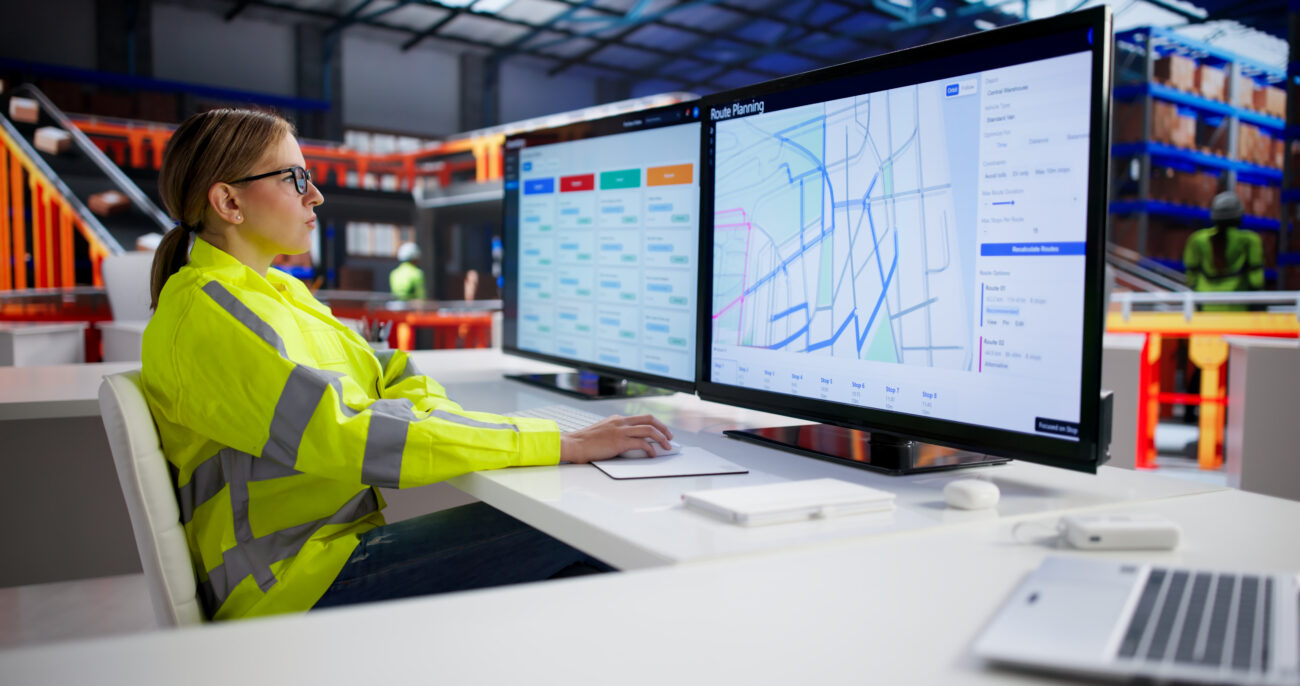
A realistic path to Artificial Intelligence in transportation and distribution can be found. Walk onto the operations floor of many transportation and distribution businesses today and you’ll still see a familiar scene: a planner with a clipboard, a whiteboard full of routes, and a team trying to stay ahead of whatever the day throws at them. This doesn’t suggest a failure to modernise, but a team trying to stay ahead of whatever the day throws at them.
It’s the reality of an industry where margins are tight and disruptions are constant. The cost of getting a decision wrong in this business can be painfully high. When every day feels like controlled chaos, few operators have the luxury of experimenting with unproven technology.
If this describes your operation, you’re not behind. You’re working within the practical constraints of transportation. And those constraints are exactly why AI adoption must be pragmatic, not revolutionary.
Artificial intelligence is beginning to earn its place on the operations floor, not through sweeping transformation, but through small, targeted wins that build trust over time. The fleets making the most meaningful progress aren’t the ones trying to reinvent their entire operation. They’re the ones choosing a single, well-defined problem and proving an AI tool can solve it reliably.
“You don’t need to rip up the clipboard to get value from AI,” says Ben Glossop (pictured, below), VP of Sales at Aptean, who spent over 14 years at routing specialist Paragon working directly with UK fleets, planners, and operators.
“The best run fleets aren’t necessarily the most digitised. They’re the ones that pick one challenge, prove an AI tool can solve it, and let success build trust before doing more. Give transport teams earlier insight and clearer visibility, and everything gets easier from there.”
The Gap Between ‘Important’ and ‘Action’
A recent study by industry-specific, vertical software provider, Aptean and independent research firm Vanson Bourne highlights a clear gap between belief in AI and actual deployment. Aptean 2026 Artificial Intelligence Research surveyed 325 transportation and distribution executives across the UK, US, Canada, Netherlands, France, and Germany, as part of a broader sample of 1,535 business leaders across five sectors.
The findings reveal a regional gap in confidence in AI versus follow-through. EMEA transport and distribution leaders are more likely than their North American counterparts to say industry-specific AI is critically important (35% vs 22%), yet less likely to have adopted it (41% vs 57%). European operators believe strongly in AI’s potential, but conviction isn’t yet translating into widespread deployment.
That hesitation aligns closely with confidence in the guardrails: fewer EMEA organisations report having regulatory and compliance reassurance in place (61% vs 74% in North America), clear procedures for handling AI errors (53% vs 65%), or ongoing monitoring of AI accuracy (59% vs 73%). In other words: belief is high, but trust in the framework around AI is still catching up.
“Operators increasingly want earlier warnings when something is going off plan, not after the fact,” Glossop adds. “They’re no longer satisfied with systems that just record what happened. They want tools that help them influence what happens next. Knowing there’s a delay on the M6 before it snowballs into three missed deliveries helps a planner consider what’s next and not just react.”
This mindset of looking for small, contained and visible wins from AI before broader rollout, is exactly what helps bridge the gap between – believing AI matters and deploying it with confidence.
What “Proof” Looks Like in Practice
“As part of the Aptean’s report, qualitative interviews were conducted alongside the survey data. One transportation provider’s story illustrates how operators are approaching AI in the real world,” says Glossop.
Rather than attempting a wholesale AI transformation, the company interviewed focused on one recurring challenge: costs arising from dispatch and route errors. They introduced AI capable of flagging not just equipment that had already failed, but equipment likely to fail soon. The system predicted that a vehicle carried a real probability of breaking down within the next 500 to 2,000 miles. Planners received early alerts when a vehicle’s failure probability crossed a threshold, allowing them to reassign loads before disruption occurred.
The impact was immediate. Error rates dropped by approximately 90%, directly reducing costly service failures and improving margins during a period of rising fuel costs. Reflecting on the rollout, the project’s sponsor admitted they wished they had moved from pilot to full deployment sooner, rather than waiting six months to see the results. This is what practical AI adoption looks like: one problem, one measurable win, and a clear path to scaling.
You’re Not as Far Behind as the Headlines Suggest
Across the full 325 strong transportation and distribution sample, 77% said the value of AI is clear, but hasn’t yet been realised in their own operation. That’s not a sign of stagnation; it’s a sign of realism. Where AI is already delivering, it is delivering in specific, practical ways. Respondents were more likely to report improvements in decision-making (47%) and reduced operating costs (44%) than in almost anything else. These are exactly the kinds of contained, measurable wins that come from picking one challenge, proving AI supports, not from a sweeping transformation.
The Metric That’s Still Stubborn: On Time Delivery
One finding stands out: transportation and distribution were the least likely of all five sectors researched to report a significant improvement in on time delivery or order fulfilment -just 12%. That’s striking, given on time performance is one of the clearest drivers of customer loyalty and repeat business in transportation.
“I don’t think that’s a sign AI doesn’t work. I think it’s a sign most organisations haven’t pointed it there yet. The gains so far have concentrated on operating cost and decision speed. That’s not a reason to wait. It’s a reason to be deliberate about which problem you tackle first.”
Be Your Own Customer Zero
Glossop’s advice to operators is simple: don’t start by asking, “How do we use AI in our business?” Start by asking, “What’s the one recurring challenge that costs us the most, be it in time, money, resources, or predictability?” It might be late running routes, empty miles or vehicle breakdown.
From there, apply the same discipline you’d use when hiring a new team member. Give it the right level of understanding and test it works within the business first. Don’t roll it out to drivers, planners, or customers until it earns your trust internally. Pilot it properly. A trial without a defined problem and a measure of success tends to drift into an interesting experiment that never took off. Be clear on who will use it and who will oversee it. Think of AI as an intern.
Once it delivers a tangible result, let that result do some persuading within the business. That’s how those interviewed as part of our research got to where they are: not through a single bold leap, but through enough small, provable wins to build business confidence. Interestingly, it’s often the point where businesses often admit they wish they’d moved faster.
One Win at a Time
The clipboard and the whiteboard are not the enemy. They are a perfectly useful way to run a transportation business – until the day a well-chosen, well scoped, AI tool proves it can do one part of that job better. At that point, the case tends to make itself.
The fleets making the most progress aren’t chasing transformation. They’re looking for one reliable win that can be scaled. In an industry built on reliability, predictability, and trust, that’s exactly the right way to start.