Good Year for Ports of Boulogne and Calais

Port Boulogne Calais has once again demonstrated its resilience both in terms of fishing and cross-Channel traffic. Both ports showed solid results for 2023.

After a very good year in 2022, the port of Boulogne-sur-Mer confirmed its dynamism in 2023. With €89.1 million in value (+ 2%), it once again, for the second consecutive year, reached its highest level for 20 years. Fish volumes are up 8% compared to 2022, and have crossed the symbolic 30 000 tonnes (30 437 t) threshold, returning to their level before the introduction of Brexit.

Reduced catches of certain species such as sole, mackerel and whiting are offset by ever-increasing volumes of cephalopods (squid and cuttlefish), red mullet and scallops, stocks of which are in excellent condition. The port of Boulogne-sur-Mer remains the leader in the ranking of French fishing ports in terms of tonnage and value.

Despite legitimate fears in the fishing industry over the implementation of Brexit, given the proximity of the port of Boulogne to the British coast, the Individual Support Plan (ISP) will ultimately have had only limited impact on fishing capacity in Boulogne. Although regrettable, a total of six units specialising in small-scale fishing and a single trawler will have benefited from this decommissioning plan, representing less than 5% of landings.

2023 was the first full year in terms of tourist traffic since the health crisis and complete lifting of travel restrictions in March 2022. The partial resumption which began in 2022 was confirmed in 2023; the port of Calais welcomed 7 263 513 passengers and nearly 1.3 million tourist vehicles, representing an increase of +41% and +33% respectively compared to 2022. This double-digit increase was driven by an excellent summer season which almost achieved a return to pre-health crisis figures of just over 2 million travellers and nearly 450 000 vehicles in July and August alone.

In terms of freight, the port of Calais is proving more important than ever. While the Channel saw a slight contraction of the freight market of 2% in 2023, the port of Calais performed well,
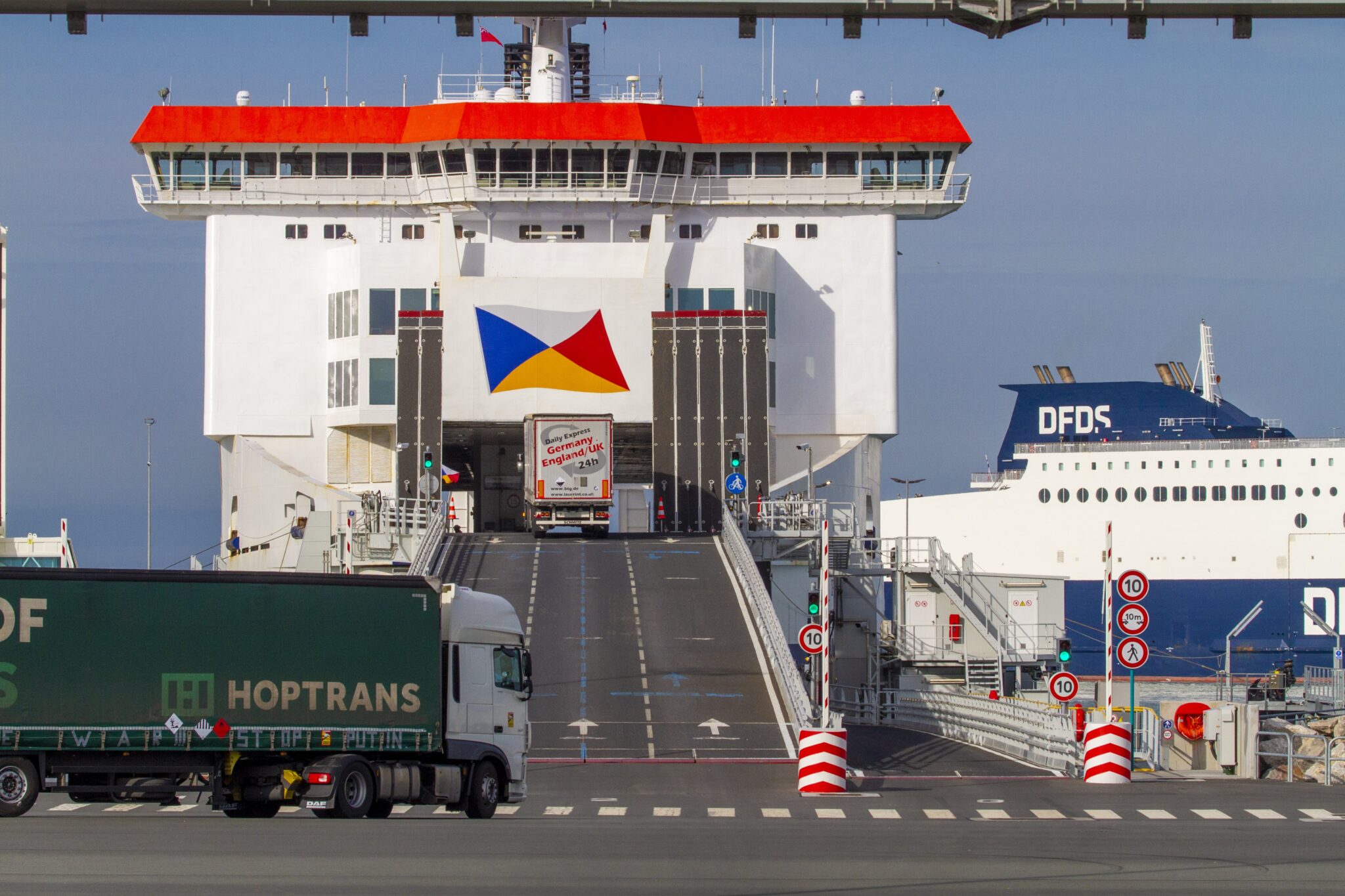
with an increase of +10% in its traffic. With 1 809 813 freight units (heavy goods vehicles and unaccompanied trailers), it returned to its pre-Brexit level and exceeded the 50% market share milestone. Hold capacity, flexibility, optimised fluidity with the new terminal and dematerialised border crossing for goods have strengthened the port of Calais’ position as a preferred crossing point for transport professionals.

After several years of strong growth, unaccompanied freight slowed down in 2023. Down 12% to 55 010 units, this traffic struggled in particular in the last quarter, mainly due to temporary availability on the market of drivers of heavy goods vehicles from Eastern Europe, which encouraged carriers to turn to accompanied mode. Furthermore, the Ro-Ro service operated by DFDS to Sheerness then rerouted, in summer, to Tilbury didn’t meet its promises; this new destination required carriers to adapt to reorganise their logistics. DFDS finally cancelled this service at the end of the year.

While combined transport at the national level is experiencing a sharp drop in activity of 20%, the rail motorway services that serve the port of Calais are holding up well and even progressing very slightly by 1% (41 641 units). A genuine achievement for the operator VIIA in a very unfavourable national situation.

Overall, activity at the Calais and Boulogne-sur-Mer general cargo terminals remained stable in 2023, with total tonnage of 1 899 633 tonnes in 2023 compared to 1 917 435 in 2022. The Boulogne terminal handled 642 501 tonnes (-2%), which breaks down into 486 042 tonnes for export and 156 460 tonnes for import. The main materials handled for export remain limestone and quicklime, mainly destined for Sweden. On import, bulk mainly covers raw materials (natural sand at 102 000 t and road salt at 24 000 t). The emergence of pellet traffic (21 000 tonnes) should also be noted.

At the Calais terminal, bulk activity also remains stable at 590 876 tonnes (-2%). Almost all bulk tonnage is intended for export and consists of limestone and pebbles for the Nordic countries (Sweden and Denmark) and sand and aggregates for the United Kingdom. For 2023, rail tonnage stands at 666 256 tonnes.

2023 was synonymous for the port of Calais with the return, in the summer, of new vehicle traffic, which had been at a standstill since 2015. The Charles André Group, the French specialist in automotive logistics, chose Calais for its know-how and the quality of its Ro-Ro and rail facilities, as well as for its special geographical position both close to the United Kingdom and the automobile production units in Hauts-de-France. For these first six months of activity, 10 400 new vehicles passed through the port. For 2024, expected traffic is more than 30 000 units.

After the dry dock at the port of Calais had seen no activity for several decades, it welcomed two ships in just a few months. SOCARENAM, a French shipbuilding flagship company based in Boulogne-sur-Mer, has been commissioned to construct six overseas patrol boats by the French Navy. The second ship to leave the shipyard was dry docked in Calais for finishing work.
Furthermore, running in parallel with a sustained workload schedule in the Boulogne-sur-Mer workshops, the company is in the process of building the first example of patrol boats intended for the Maritime Gendarmerie in Calais.

While the International Maritime Organisation (IMO) announced, last July, the objective of “zero emissions” from ships by 2050, the stakeholders of Cross-Channel – maritime and ports operators – have brought forward this plan and are already working to decarbonise maritime traffic across the Channel. On the sidelines of COP 26 in Glasgow, certain countries including France and the United Kingdom have committed, in the Clydebank declaration, to setting up “green maritime corridors”.

As early as last March, Port Boulogne Calais signed a cooperation protocol with ferry operator DFDS and the ports of Dunkirk and Dover aimed at agreeing on a joint work programme to enable the transition to electric maritime traffic across the Channel. The shared ambition is to provide a green maritime corridor (zero emissions) by 2030, which will necessarily involve the design of new-generation ships using propulsion technologies that are more environmentally friendly and, in particular, electric. The port of Calais is working with DFDS and its partners to prepare the infrastructure necessary for these future ships. At the end of 2023, DFDS confirmed its wish to order electric ships for the Calais – Dover line.

Anticipating the energy transition of all fleets, P&O Ferries put into service the very first hybrid ship operating on the Calais-Dover line last June. Specifically designed and created to operate on the Channel, the P&O Pioneer is the first ship to be equipped with a hybrid engine – diesel electric – allowing it to call into the ports of Calais and Dover without having to use its diesel engines or manoeuvre in the docking area thanks to its double-head design. All these innovations have led to a 40% reduction in CO2 emissions. The ultimate objective is to make the Calais-Dover crossing entirely electric. The P&O Pioneer will be followed by its sister ship, the P&O Liberté, which left China on 15 January and is due to arrive on the Channel in spring 2024.

For François Lavallée, Chairman of the Board of Directors: “2023 was a year of growth for Port Boulogne Calais. Calais regained its pre-crisis freight volumes and Boulogne fishing is continuing its good figures for 2022. We are already looking to the future, with major challenges ahead: the arrival of the EES arrangement (Entry & Exit System) at the port of Calais, accelerated greening of our two ports and the start of the upcoming renegotiation of fishing quotas between the EU and United Kingdom.”

Benoît Rochet, General Manager of Port Boulogne Calais, adds : “I am delighted at the resilience shown by the ports of Boulogne-sur-Mer and Calais. The good results for 2023 for both cross-Channel traffic and fishing mean we can embark on this new year with confidence. The significant investments planned and already made by our customers in new ships specifically designed to serve the Calais-Dover line demonstrate their complete confidence in our port. The return of new vehicle traffic and recommissioning of the Calais dry dock show the extent of our know-how. The port of Boulogne-sur-Mer, for its part, is doing well, and the Capécure area remains very attractive for investors.”

Synergy Logistics’ new Head of EMEA Sales

Warehouse technology innovator Synergy Logistics has appointed a highly experienced business performance lead as it looks to scale up on expansion, growth and drive change. Chris White joins as Head of Sales for Europe, Middle East & Africa (EMEA) with a dual remit of further improving client engagement and advancing the commercial arm of the business.

White has over 25 years of experience in large-scale operations, having worked with companies like Hewlett Packard, Pitney Bowes, and DHL Express. He has held senior positions in IT, supply chain, warehousing, and distribution. In his previous role as a Director for the SaaS Enterprise Division of Parcel2Go, a leading player in the fulfilment market, he achieved a growth of 300% in just seven years. As a result, the Enterprise Division now accounts for 60% of the Group’s overall business and their portfolio has expanded from three to thirty different organizations.

White, who began his career playing professional football for 14 years at Portsmouth FC, Peterborough United and Exeter City, stated: “I am thrilled to be a part of Synergy – a company that is as flexible, agile and adaptable as its software solutions. The products they offer make a real, tangible difference and I am excited to contribute to the positive trajectory of the business.

“I’ll also be working very closely with Synergy’s EMEA CEO, Tony Dobson, who has unrivalled contacts and experience within the industry and continued passion for technological advancement. I can contribute additional expertise in building strong partnerships and delivering enterprise level value.”

To bolster Synergy’s ambitious growth plans, he will be supported by Kirsten-Reece Tarpey, who has been promoted to Business Development Manager, and Dan Moss in his new role as Commercial & Operations Manager.

Synergy Logistics is a leading innovator in warehouse management technology, powering warehousing operations globally for over 50 years. Synergy’s cloud-based warehouse management system (WMS), SnapFulfil, delivers cutting edge technology and rapid return on investment using a proprietary and highly configurable workflow rules engine. With flexibility at its core, SnapFulfil is quick and easy to implement and can swiftly adapt to meet evolving fulfillment demands that ultimately improves warehouse efficiency. Synergy’s latest breakthrough technology, the award-winning SnapControl, is a multi-agent orchestration platform (MAO) that provides a device agnostic, unified approach to automation. SnapControl provides seamless and efficient orchestration of all warehouse devices and robots, with a low total cost of ownership and rapid time to value.

40 Years’ Expertise in Mobile Robotics

At LogiMAT 2024, DS Automotion will showcase the results of 40 years of expertise in developing and manufacturing mobile robots, along with providing tailored solutions for individual user needs. The Austrian company has established itself as a global expert thanks to its exclusive focus to this field and a commitment to continuous innovations in its core skills and technologies.

Since 1984, DS Automotion GmbH has been at the forefront of developing and producing driverless transport systems (AGVs) and autonomous mobile robot (AMR) solutions for internal logistics and assembly applications. With now four decades of experience, the Austrian company has established itself as a leading manufacturer in the development of autonomous, navigating vehicles and corresponding fleet management systems.

The ongoing in-house development of essential core skills and technologies solidifies DS Automotion’s position as one of the world’s leading manufacturers in this field. The extensive range of mobile robotics solutions will be showcased at LogiMAT 2024 through live operations, various animations, simulations, and personal discussions with experts across various business areas.

A wide-ranging fleet, born driverless

The variety of mobile robots from DS Automotion is truly impressive. DS Automotion has an entire fleet of standard vehicles in its portfolio for transporting containers such as KLTs, pallets, trolleys and containers. This includes the new AMR named AMY, the underride vehicles of the OSCAR family, pallet trucks, as well as the wheel-arm high lift stackers and counterbalance trucks from the LUCY, AMADEUS, and ARNY series. These vehicles are equipped for all common types of navigation and communicate seamlessly via the latest VDA5050 interface.

DS Automotion is renowned for its wide-ranging customization options for series vehicles, coupled with expertise in developing and producing bespoke, tailor-made special vehicles.
Plannable autonomy

Beyond mobile robots, DS Automotion’s software experts develop cutting-edge solutions like the NAVIOS fleet management system and the ARCOS navigation and control software. These innovations provide a transport system with predictable autonomy, combining maximum flexibility and efficiency from both AMR and AGV worlds into a single, unified transport system in just one installation. Recognized with the IFOY AWARD 2023, this pioneering technology is now progressively rolling out across the entire fleet.

You will find the DS Automotion stand and contact persons in Hall 6, Stand D05

How 5G Could Benefit Logistics Industry

PwC predicts wide-scale development of 5G communication networks will contribute an additional 1.3 trillion USD to global GDP by 2030. With logistics and transport among the primary target sectors for 5G-enabled technology, what are the key benefits 5G could bring? Here, Kristian Torode, Director and Co-founder of business broadband provider Crystaline explores.

With speeds comparable to home broadband and low latency, 5G won’t just improve our home lives, it’s set to revolutionise industry in the same way. The logistics industry, for example, has historically struggled with labour shortages, rapid changes in demand, and poor tracking information. Fortunately, the development of 5G could provide the answer to these issues and more.

Real-time tracking

Unlike older technologies such as barcodes and RFID tags, which can experience problems during scanning, 5G-enabled tracking could be the solution to better tracking of goods. A 5G-enabled device doesn’t need to be scanned and can report its location independently and in real time, allowing for more precise journey tracking with minimal effort. In fact, it’s possible to track the product right down to the shelf it is stored on, enabling more transparent and accurate tracking throughout the supply chain.

A complete network

One of the factors previously holding back the adoption of Internet of Things (IoT) devices has been capacity. A 4G cell tower, for example, can only hold around 2,000 devices at once. As a result, areas that are highly populated with people and devices often suffer with performance issues caused by the network being at capacity.

But a 5G tower can support far more — up to one million devices at any one time. This capacity boost means that businesses will be able to have far more devices on the network than ever before. Not only does this include their product inventory, but it can also include delivery vans and lorries, on-site forklifts, and other essential tools needed in day-to-day operations. More precise planning therefore becomes faster and easier, minimising unscheduled delays and maximising use of available equipment. Security is enhanced too, with a reduced risk of goods being lost or stolen.

A more comprehensive view

Alongside being able to track more devices, we’ll also be able to gather much more comprehensive information for each one. Where you might previously only receive location information, developments in sensor technology mean that far more parameters can be measured quickly and cost-effectively.

Temperature and humidity sensors and live video feeds are just a few possibilities. Ultimately, these sensors will allow logistics companies to guarantee the quality of their service. This is particularly relevant for transporting perishables such as medicines or chemicals, which can be easily damaged by inadequate storage conditions.

Overcoming staff shortages

Lastly, the development of 5G-enabled autonomous vehicles could be advantageous to tackling skill shortages. With too few qualified drivers available, others have had to take on the pressure. Often, this can lead to drivers working for longer hours than they should or without taking proper breaks.

A vehicle using 5G-enabled technology could drive autonomously for certain periods, such as on the motorway, giving the driver more time to rest without losing any time on the road. It’s even possible that future drivers won’t be in the cab at all. Instead, they could be driving the lorry remotely either from the office or the comfort of their own home, thanks to the low latencies offered by 5G.

It’s clear that 5G isn’t just a gimmick — it can offer serious real benefits for logistics companies of all shapes and sizes. Offering improved visibility in real-time across all levels of logistics operations, 5G could be the missing piece in achieving a truly robust and joined-up supply chain.

Retail Supply Chain & Logistics Expo

Retail Supply Chain & Logistics Expo is back. Customers want faster delivery times and an easier return system. In order to deliver this, retailers need to adapt their supply chain, and have a seamless warehousing and distribution system.

The Retail Supply Chain & Logistics Expo provides a hub to help businesses meet these expectations and stay ahead in this demanding industry.

Organisers Fortem have partnered up with us and together we are helping you to improve seamless customer experience. Join us at the UK’s leading retail focused supply chain & logistics event this year at ExCeL, London, on the 27th & 28th February 2024.

For a FREE ticket you will gain access to hundreds of retailers where you can network with the leaders of the supply chain and logistics sector, grow profitable partnerships and create limitless opportunities. Discover industry innovations, implement investment-worthy solutions within the industry, and many more more.

At Retail Supply Chain & Logistics you can listen and learn from the world’s best keynote speakers and stay up to date with the pace of innovation in the industry. Discover a keynote speech from DHL Supply Chain who will be delivering an inspirational talk about Human/ Automation Performance Management to adapt to changes and challenges within the industry.

Do not miss out, secure your FREE ticket here.

17 Innovations in IFOY Final

The IFOY organization has announced the nominations for the IFOY AWARD 2024 and once again made a hard selection. From a field of 35 companies entering, 15 intralogistics providers from six countries qualified for the final with a total of 17 devices and solutions, including four start-ups.

The intralogistics specialists AGILOX, Crown, GLOBE Fuel Cell Systems, HWArobotics, Innok Robotics, Jungheinrich, MEYSENS, RAVAS, SAFELOG, SSI SCHÄFER and STILL can win one of the internationally coveted trophies.

BOX ID Systems, Brightpick, CIP Mobility and CYBRID are in the final of the “IFOY Start-up of the Year” spin-off award.

“The nomination round was exceptionally tough. More than half of the applicants did not make it to the final round,” says Anita Würmser, Chairperson of the IFOY jury. “All the more clearly, the finalists reflect the megatrends of our time. Starting with increasingly sophisticated warehouse technology and extending to the meanwhile impressive range of applications of mobile robotics and AI through to highly innovative components and increasingly complex customer projects. Efficiency, scalability, and future readiness are in demand and the IFOY Audit will show who has the edge.”

Würmser expects a tough debate in the jury, which includes Logistics Business Editor Peter MacLeod, sessions to decide the six winning trophies, which will be awarded in June in Baden near Vienna in Lower Austria.

Safeguard Systems from Cybercrime

Cybercriminals are targeting supply chains more and more every year, taking advantage of vulnerabilities within third parties to gain access to key data, writes Alistair Binns (pictured), Commercial Director at TMX Transform.

Reports of cyberattacks on hospitals, medtech manufacturers and other players across healthcare supply chains increased again in 2023. Ransomware attacks can be especially devastating, crippling essential systems until ransoms are paid. In July, a cyber-attack on an NHS supplier left two ambulance trusts serving millions of people without access to electronic patient records.

Even beyond outright cyber theft and extortion, subtler data breaches empower counterfeiting schemes and put patients at risk. Fake or adulterated drugs and devices become much easier to produce using stolen proprietary data and distribution plans. Maintaining confidentiality is a vital part of the relationship between healthcare professionals and patients, as people trust that their privacy will be maintained by healthcare professionals, whether in a healthcare setting or online.

To deal with this emerging threat, companies need to implement robust data management systems that ensure data confidentiality and integrity. Setting up a seamless, decentralised data platform that can record, track, and manage information securely and digitally is vital, while blockchain technology and artificial intelligence can provide a better overview of network weaknesses before they can be exploited. As healthcare cyberattacks grow more prevalent globally, organisations along the supply chain need to prioritise modern security solutions and staff education to protect patient wellbeing.

Lessons learned from crises

The pandemic exposed vulnerabilities in supply chains worldwide, necessitating major changes to their operations and strategy. In the initial phase of the pandemic, health networks were swamped by the first wave of cases and the required health equipment and medication. The sector worked hard to repurpose therapies and adapt to provide relief to patients suffering severe symptoms, but continued disruptions to the supply chain were inevitable amid Europe-wide surges in demand.

For the most part, Europe managed to prevent the major disruption of emergency and essential medicine supplies – an effort that showcased resilience, agility and the importance of collaboration between stakeholders across the pharmaceutical and healthcare supply chains. Once again, we need that sort of resiliency to overcome the lingering threat of cybercrime. The supply chain industry needs to prioritise more secure networks because the stakes of human health are too high to not learn from past shortcomings.

Businesses are better prepared for cybercrime, but will need to continue to invest in their supply chain security by:
• Conduct regular cybersecurity audits and vulnerability assessments across the entire supply chain network. Identify any gaps or risks and remediate them.
• Implement robust identity and access management protections using multi-factor authentication, role-based access controls, and monitoring for suspicious access attempts.
• Provide comprehensive cybersecurity training to healthcare supply chain employees to spot potential phishing attempts, unsafe browsing, or other risky behaviour.
• Install advanced cybersecurity tools like AI-powered threat detection, anomaly detection systems, firewalls, and antivirus software to establish in-depth defences.
• Have an incident response plan ready with disaster recovery protocols, backup systems, executive support, and public communications strategy.
• Foster collaborations on cyber intelligence sharing and collective vigilance across healthcare organisations, IT services firms, cybersecurity agencies, and throughout the healthcare ecosystem.

Reengineering For Resilience

Today’s healthcare supply chain leaders understand that eventual disruptions are inevitable in increasingly complex global networks. Modern supply chain infrastructure makes transparency and collaboration priority one. Information sharing across the healthcare ecosystem grants all parties situational awareness to troubleshoot issues collectively and in real-time. The overnight success of vaccines shined a spotlight on what focused partnerships can achieve – rather than reverting to old comfortable strategies, healthcare supply chain organisations now must carry lessons learned into a stronger future for global health.

Collaboration and Data Key to Timber Industry

Collaboration between different sector organisations is increasingly important to achieving shared targets for the timber industry, according to John Dye, President of the Timber Packaging & Pallet Confederation (TIMCON).

At the general meeting of TIMCON members, held in Manchester in January, Dye said strong relationships with international and domestic associations including European Federation of Pallet & Packaging Manufacturers (FEFPEB), National Wooden Pallet & Container Association (NWPCA), National Association of Pallet Distributors (NAPD), Timber Development UK (TDUK), Wood Panel Industries Federation (WPIF), and the Wood Recyclers Association (WRA) – which were all represented at the event – are vital to progressing the interests of timber-based businesses. This included cooperating on policy matters affecting the industry such as the PPWR and working together to source high quality data to inform better decision making for the business.

NWPCA Vice President of Public Affairs Jason Ortega, echoed the theme of international partnerships as he presented an update on his organisation’s activities. This includes a new carbon calculator it has developed and from which it will share learnings as TIMCON embarks on a similar initiative to help its membership meet increasing sustainability obligations.

Marcus Kirschner of the German Wood Packaging Federation (HPE) and FEFPEB’s PPWR Committee said working with national organisations across Europe is a central part in lobbying EU
policymakers. This includes ensuring they understand that the wooden packaging and pallet industry is naturally sustainable and should be at the heart of its circular economy principles, and helping achieve acceptable results on PPWR.

Dye said: “Over the past decade, TIMCON has fostered close productive partnerships with our pallet and packaging industry counterparts across the world and related wood-based sectors. These relationships help us establish and communicate shared positions and achieve mutually beneficial outcomes. At a time of significant international tensions, this spirit of solidarity, cooperation, and friendship helps strengthen us all, as individual businesses, as associations, and as a timber industry overall.”

He added that with TIMCON representing the UK and Ireland, its remit included members both inside and outside the EU, again highlighting the significance of working towards international solutions that benefitted all. The need for quality data on the business from within the industry was also highlighted by Guy Watt of John Clegg Consulting, who presented the findings of the UK Wood Pallets & Packaging Market in 2022. The latest edition of this annual report, which is jointly commissioned by TIMCON and Forest Research (the research arm of the Forestry Commission), showed a 7 per cent drop in production of new pallets, to 45.3million, representing a fall of approximately 3.4m pallets.

This follows the 8.3 per cent increase in pallet manufacture shown in last year’s report – and may be followed by a larger decrease for 2023. Pallet repairs, meanwhile, have risen to 48.9m, an increase of 1.7 per cent on 2021. Watt said surveys for the market report’s next edition would be issued to the membership much earlier, during February this year. This, said Dye, will allow it to be published earlier, reducing uncertainty around volumes, and helping inform discussions with Defra and other government departments.

The TIMCON meeting also featured presentations by Charlie Law, Sustainability Director for TDUK, and Nick Boulton, TDUK Head of Technical and Trade Policy. Law gave an update on the UK timber industry’s net zero action plan and the specific ways in which the pallet and packaging sector can support it. Boulton presented latest UK market industry trends, including timber imports, demand, and forecasts.

Winners of BIFA Freight Service Awards

Suzi Perry hosted a crowd of over 550 at the British International Freight Association’s 2023 Freight Service Awards, which took place at the Brewery in London. The ‘Queen of the Pit Lane’ revealed nine winning companies and two winning individuals in the 11 categories of the awards, which celebrated its 35th anniversary this year.

In the Air Cargo Services category, which was sponsored by IAG Cargo, deugro (UK) Ltd triumphed over fellow finalists cargo-partner Ltd, Hogg Global Logistics Ltd, and Killick Martin & Company Ltd.

Winner of the Ocean Services Award, sponsored by Port Express, was Woodland Global, which overcame strong challenges from fellow finalists F.S. Mackenzie Ltd, Hemisphere Freight Services Ltd, and World Cargo Logistics Ltd.

Hemisphere Freight Services took first place in the Project Forwarding category, sponsored by Macbeth Insurance Brokers, ahead of fellow finalists Brunel Shipping & Liner Services Ltd, Peters & May Limited, and Ucargo LLP, which was highly commended by the judges.

In the Specialist Services category, sponsored by Thyme IT, the winner was Seafast Logistics Ltd, whilst the other finalists included Cardinal Global Logistics, Metro Shipping Ltd, and Ucargo LLP.

Kerry Logistics (UK) Ltd was revealed as the winner of the Supply Chain Management category, sponsored by BoxTop Technologies, seeing off strong competition from fellow finalists Atlantic Pacific Global Logistics Ltd, Ligentia UK Ltd, Noatum Logistics UK Ltd, and Uniserve Holdings Limited.

Scooping first place in the brand new Sustainable Logistics & the Environment Award category, sponsored by American Airlines Cargo was Woodland Group Ltd, which overcame excellent entries from fellow finalists, Maersk Logistics and Services UK Ltd (which was highly commended by the judges), Metro Shipping Ltd, DHL Global Forwarding, and Geodis FF United Kingdom Ltd.

Hogg Global Logistics Ltd took the category name quite literally to win the Extra Mile Award, sponsored by Descartes, ahead of the entries from fellow finalists Cardinal Global Logistics, Cargo Overseas Limited, and Kranlee Logistics Ltd.

Victorious against fellow finalists DHL Global Forwarding, Kranlee Logistics Ltd, Uniserve Holdings Limited, and Unsworth UK, OIA Global Ltd triumphed in the Staff Development category, which was sponsored by Albacore Systems.

In the European Logistics category, which was sponsored by TT Club, the winner was Atlantic Pacific Global Logistics Ltd, with the other finalists being Baxter Freight Ltd, Brunel European Ltd, Espace Europe Ltd, and Uniserve Holdings Limited.

Winner of the Apprentice of the Year category, which was sponsored for the first time by Menzies LLP was Cameron Smith (Ligentia), who beat off strong competition from Jacob Swift (Avocet Clearance) who was highly commended by the judges; Samuel Barrett (Charles Kendall Freight); Leanne Read (Neon Freight); Kieran Elkin (Dachser); and Richard Smith (Ziegler UK).

Meanwhile, Christopher Carter from Peterson (United Kingdom) Ltd impressed the judges with his commitment to the industry to win the Young Freight Forwarder of the Year category, which is sponsored by Virgin Atlantic Cargo. Fellow finalists were Amelia Mulhern (Kuehne+Nagel); Emily Howard (Westbound Logistics); Georgia Gibson (cargo-partner), who was highly commended by the judges; Michael Shiels (DHL Global Forwarding) and Nicola Hall (Edge Worldwide Logistics).

Whilst congratulating all the companies and individuals that won each category, BIFA Director General, Steve Parker acknowledged all 29 freight forwarding companies that made the finalists shortlist in the nine service categories, as well as the 12 people who were finalists for the two individual categories.

Parker said: “Once again, BIFA was delighted with the number and range of entries received and it was great to meet in person to celebrate excellence across the freight forwarding industry, with awards that are now in their 35th year, and justifiably regarded as the most prestigious in the sector. I would also like to recognise the support and contribution of all the sponsors to the running of the competition this year. Representatives from the category sponsors gave their time to carry out judging and the selection of winners for each award.”

New Brand Layout, Innovative Storage

META will be presenting several innovations at LogiMAT 2024. The new brand layout of the storage technology specialist headquartered at Arnsberg, Germany will be on display in Stuttgart. Visitors can also gain an overview of the company’s innovative shelving systems. The focus is on storage solutions in conjunction with conveyor technology and picking robots, as well as the tried-and-tested standard shelving systems.

New brand layout

META is presenting itself in a new way. With the start of LogiMAT 2024 the warehouse technology specialist will underline the brand’s core values such as quality and innovation with a new brand layout. The new design will be globally rolled out at the leading trade fair in Stuttgart to further strengthen the positioning of the proven quality brand. That’s something to look forward to.

Shelving solutions for picking robots

META has developed an own racking solution based on its META MULTIFLOOR system to meet the special requirements arising from the use of order picking robots. This system, adaptable to the requirements of the picking robot, will be on display at this year’s LogiMAT.

Conveyor technology – META-ILS solutions

Under the name META-ILS (ILS = Innovative Logistic Solutions), META has been offering individual customer solutions for complex tasks within the field of warehouse automation with conveyor technology for two years now. The combination of efficient conveyor technology and premium storage technology means lasting benefits fpr customers worldwide.

Innovative and proven

Visitors will be able to see for themselves the extensive world of META presented in a new design across more than 130 square metres in Hall 1, Stands H01 and H05. The team of warehouse technology experts will be happy to answer any questions about innovations as well as the company’s tried-and-tested solutions such as storage technology, steel construction, operating equipment, services and the META Calc online configurator.

Subscribe

Get notified about New Episodes of our Podcast, New Magazine Issues and stay updated with our Weekly Newsletter.