

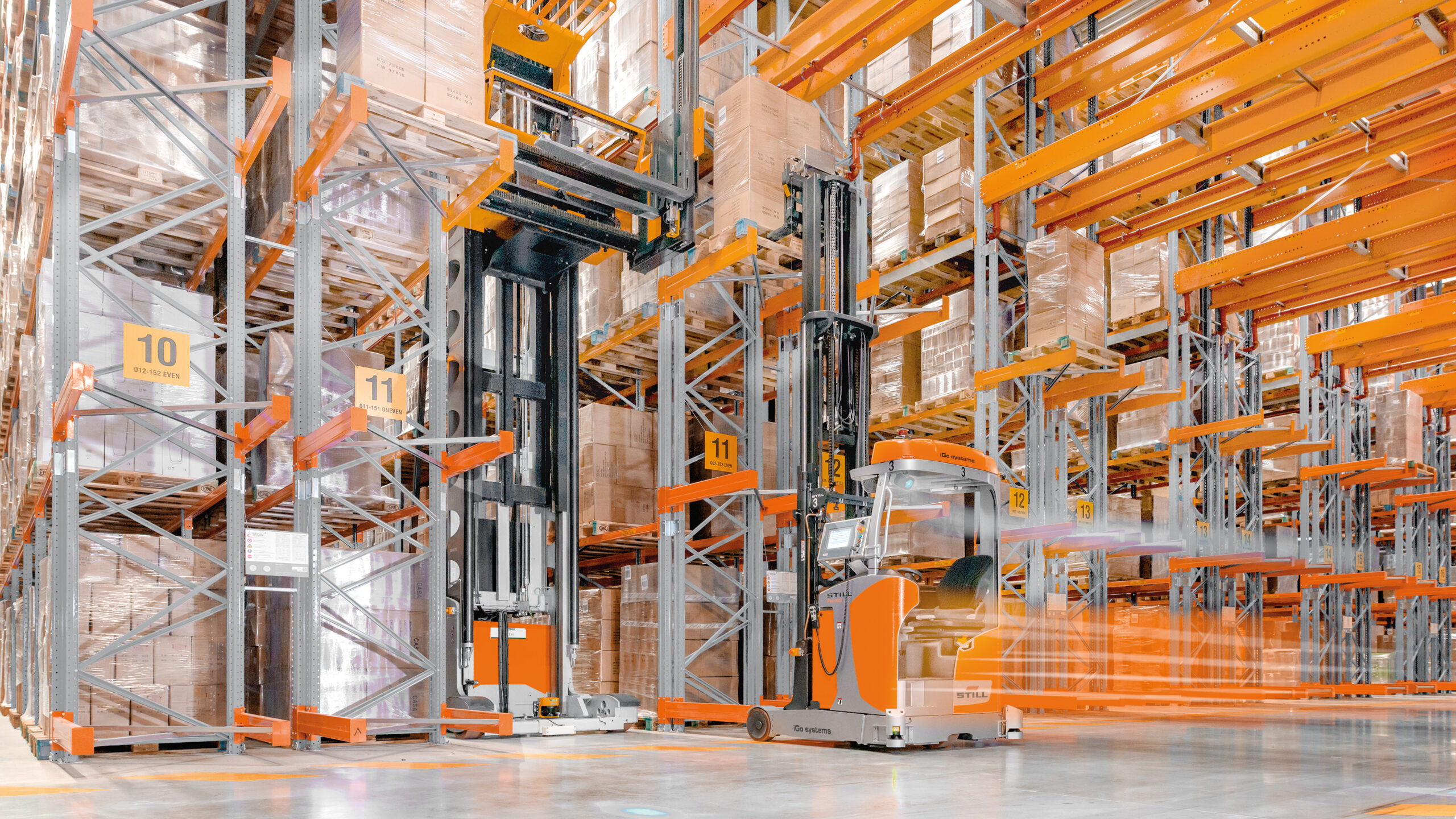
Still UK’s Automation Business Unit has been formed to deploy the company’s expertise and experience in intralogistics automation solutions. Paul Hamblin spoke to the company’s Paul McCann.
For most of us, STILL is a manufacturer of materials handling equipment of premium class – forklifts, pallet trucks, order pickers, and a great deal more. It’s the ‘orange one’ in the powerhouse KION Group stable that also includes fellow big players, Linde and Dematic, among others.
But like many traditional manufacturers, STILL has followed the needs of its customers and evolved into an all-round provider of intralogistics solutions, including its proprietary automated storage and retrieval offerings, incorporating both MHE and integrating software.
In short, if you believe STILL just makes trucks, think again. STILL UK, one of the company’s largest territories, has begun a mission to change this mindset, communicating to its largest accounts and dealer network not only how well-developed its automation portfolio really is, but how skilled and highly experienced its staff are in selecting, managing and servicing the equipment as part of a true partnership with customers.
STILL UK’s Automation Business Unit (ABU) was formed in January 2026 to connect all aspects of warehousing automation into a single entity. It ensures that three important revenue streams – storage solutions (including racking, rack-supporting floors and mezzanines), VNA trucks, and order pickers – are now united into one in order to offer a fully integrated solution portfolio.

Of course, STILL has for many years offered these different components; this change is about enabling a more holistic, consultative partnership with customers.
“In the past, a customer decided they needed a manual or an automated solution or a particular product from one segment of the portfolio,” explains Paul McCann, Senior Manager, STILL (UK) ABU. “We want to talk to clients about the full picture. Maybe this is an old term, but we are solution-selling, not simply costing an automated versus a manual piece of MHE. We are talking about several options, based on asking the customer what they want to achieve and helping them meet that objective. It is about true partnership.”
Integrating these three crucial strands is a logical step because they have a natural link to each other, he says.
“Consider the shuttle system,” he explains. “Racking is frequently the most important and most expensive part of the structure, so it’s vital to pay particular attention to its integration both with the shuttles and with the controlling software. Think about an automated VNA or any kind of automation using moving pallets, the equipment will usually be tied to a storage solution system.”
He says that STILL(UK) expertise is front and centre in its partnership with customers.

“We pride ourselves on professionalism and we have the experience to take a true collaborative approach,” says McCann (pictured, below). “We don’t just speak to customers about what they want the system to achieve, we go a great deal further to ensure that there are no unforeseen problems further down the track.
“To give you one example, we will also address the existing building infrastructure. A new build is fairly straightforward, generally you can do what you wish within cost and regulation restraints. Not so with a brownfield site, though. It’s important to consider the building envelope across all three revenue streams: with a shuttle system, the point load of the columns of the upright is important, for instance. Then, there is the floor. Is the slab strong enough and flat enough? We will establish what the imposed load of the racking system will be and can thus determine the suitability of the slab.”
They are important points that can sometimes be forgotten or postponed, he says. “A partnership with an experienced integrator such as us will prevent many headaches later on. Do you have a sprinkler system? We have a contractor we work with on all systems. Construction, Design and Management (CDM) regulations and building control regulations are an important part of our offering. We will raise this at initial conversations, discharging our duties as a good contractor. You cannot ignore the building envelope and a good automation partner will highlight this.”

Partnership and a consultative approach are keys. “We’re not just selling you a product. We’re partnering with you to ensure you have the right solution. A true consultative approach.”
Customers are generally seeking the same kinds of efficiencies in their automation enquiries, he says. “They are looking for more pallets, more efficiencies and to redeploy their people. And we will explore how best to achieve that with them across our solutions portfolio.”
The range of offerings, from plug ’n’ play to completely integrated fleets, is grouped under iGO, STILL’s modular automation ecosystem. It covers the full spectrum, from autonomous trucks and compact storage systems to intelligent software analysis tools. ROI figures are attractive to customers, he says. “They differ from project to project, for obvious reasons, but three to five years offers a broad timeframe.”
How about lead-time from initial meet to go-live? “It depends on the application. A four-way shuttle could be 12-18 months, including commission phase, build phase and installation phase. If you’re talking a tote to person system, it could be six months. An AGV moving from point to point can be running a month after delivery to site.”
It’s an exciting set-up – but does Paul McCann fear the march of Chinese and Far Eastern technology will hurt STILL?
“We build high-quality bits of kit,” he reflects. “But the most important thing about automation is the service provision behind it. Our Net Promoter Score is industry-leading in client satisfaction and callout times. You can have good kit but without good service and tech support behind it, you’re in trouble. The handshake between the software and the WMS is vital, and we are talking about the software interface at all stages of the project.”
Successful sectors for the company include pharmaceuticals, fresh food and fruit, 3PLs freezer and temperature control. “Automated cold stores are growing in popularity because of the difficult working conditions for people,” he points out. For now, he and his team are concentrating on building awareness of the STILL ABU offering. “In six months we’ve increased our pipeline by a large percentage,” he confirms. “A holistic partnership can reap real dividends for all parties.”