Inchcape partners with Horizon in the Americas

Inchcape Shipping Services and Horizon Air Freight have formed a new partnership they say will streamline Inchcape’s last-mile spares logistics and door-to-deck delivery throughout the Americas.

The alliance is set to strengthen Inchcape’s new Marine Supply Chain Solutions (MSCS) service line that manages integrated marine services for shipping companies across all ports, for enhanced customer efficiency, simplicity and value.

Inchcape customers can now use the Horizon WorldTrack portal, which gives them real-time, consolidated updates on all their purchase orders.

“Prior to partnering with Horizon, management of this service was a detail-intensive process internally. Horizon has really streamlined that process, allowing our customers to log in and extract any documents or data they require,” said Crystal Waldroup, senior manager of MSCS – Americas.

Inchcape, as one of the world’s oldest and largest port agency and marine services providers, has created MSCS as part of its vision for a “smoother, smarter ocean”.

In this connection, the company needed a logistics partner with excellent internal processes, timely communications, resourceful solutions and technical sophistication – and Horizon fit the bill.

“I was in search of a marine logistics company which would partner closely with us as we built this service line together,” Waldroup explained. “I wanted a partner which had a global network of transportation companies already in place, and could handle both last-mile and door-to-deck deliveries anywhere in the world.”

She added: “Horizon was the obvious choice. We had worked informally with Horizon before and knew their reputation as the logistics company that could solve the most complicated shipping challenges. The time was right to formalise a true partnership.”

Horizon CEO Steve Leondis said: “I couldn’t be happier with this new partnership. Inchcape shares our commitment to do whatever it takes to keep ships sailing safely and on schedule. We look forward to serving their customers throughout the Americas.”

Whittan celebrates 70 years

Whittan is celebrating its 70th anniversary as a trusted supplier of storage products and solutions.

Whittan’s story – capturing 70 years of British design, manufacture and installation of pallet racking, shelving and lockers by one company – remains unique today. It was in 1951 that father and son James and Peter Kinnear established The Handy Angle Company at Brierley Hill in the heart of England’s industrial ‘Black Country’. They set up a small workshop with an original staff of six. From there, they started manufacturing a range of practical slotted steel angles.

The region was already considered influential in shaping trends and consumer tastes, and the company was well placed to tap into that growth. They developed a tensioning plate design which provided a stable and highly configurable storage system. Building on this innovation, the business grew to meet the increasing demand for improved, purpose-built storage equipment. In 1966, it changed its name to Link51, combining the year of incorporation and the word Link which described the various types of storage equipment and techniques grouped within one company. It has never looked back.

Throughout the seven decades, Whittan tracked the changing needs for storage while innovating and setting trends. Today it is the UK’s largest manufacturer and supplier of steel storage systems, recognised for their extensive range of solutions that expand capabilities with storage.

The backbone for many of the UK’s leading and household brands and organisations, Whittan’s solutions continue to meet the demand for rigorous and effective storage management for all types of industries and specifications. They are present in warehouses, retail, stores, offices and organisations across industries and sectors – from creating the space to store defence equipment on board a Royal Navy submarine; housing 13.5 million litres of Macallan single malt; protecting Stella McCartney’s couture archives; to providing secure storage lockers for offices, schools and gyms, or storing decades of film reel for the BFI.

Jon Templeman, Whittan CEO, commented on the achievement: “Not many businesses have the durability to last 70 years. Whittan and its predecessor businesses, Link51 and Apex, have demonstrated their resilience and ability to adapt to a changing market over the years.”

As the largest UK manufacturer, Whittan has been at the forefront of changes in the industry. It has also been influential in the development of industry standards, at SEMA in the UK and in Europe, where it has become an increasingly important player since its acquisition of the Permar (now Polypal) business in Spain.

Templeman added: “Our use of technology, and the knowledge and experience of our experts has enabled us to respond to the growing demand for inventive, automated solutions. We have also changed our customer service approach from being product-based to focusing on solutions for customer challenges. However, it has been the commitment and innovation of generations of Link51-Apex-Whittan staff that has enabled the business to thrive. I am confident that this dedication and success will continue.”

As Whittan celebrates seven decades of expanding storage capabilities and maximising opportunities with Link51, it brings an outstanding range of trusted storage brands. These include Link51 and Apex, providing design, manufacture and installation of racking and shelving products; HiStore, for mezzanine floors; market-leading display and storage solutions for retail sectors from Polypal UK and an extensive range of lockers and workplace products from Probe and Link Lockers.

Whittan products are part of the UK legacy showcasing quality in manufacturing. The company is committed to sustainability and is moving towards net-zero. All Whittan products are manufactured locally, keeping them close to installation sites. This cuts down on carbon emissions, delays, cancellations to orders and disruptions to timelines. It also maps against an extensive UK-wide network with experts to help with queries and handle simple to full turnkey environmentally-efficient installations.

In the tradition established in 1951 by James and Peter Kinnear, Whittan continues to bring the power of storage to help businesses large and small, across sectors, with a huge array of storage needs. Throughout, it makes space work harder by providing the most innovative, flexible and future-proof storage solution possible.

TESISQUARE acquires Aptos’ SCM business

TESISQUARE, a leading partner to build digital supply chain ecosystems, has acquired the supply chain management (SCM) business unit of Aptos, a recognised market leader in retail technology solutions.

As part of its go-to-market plan to penetrate the European market with a strong presence in such a strategic country like Germany, TESISQUARE says it has raised the bar to step-up investments abroad and put down roots to create a talented German team.

Combining Aptos’ SCM business unit coverage and reputation with TESISQUARE’s supply chain execution expertise, TESISQUARE says its clients will benefit from enhanced end-to-end visibility and operational excellence across a broad range of industries and locations.

Based in Chemnitz, Germany, Aptos’ SCM business unit relies on its long-standing experience in supply chain processes, delivering powerful tools to boost supply chain performance, from order to logistics collaboration and quality control.

Aptos’ SCM business unit adds value to the TESISQUARE Platform by empowering network collaboration and orchestration of all players along the value supply chain with a remarkable end-to-end approach.

“This is a significant step in our strategic development and puts our business on a broader basis,” said Roberto Graziotin (pictured), Chief of International Sales and Operations at TESISQUARE. “This acquisition complements our supply chain management expertise, providing the best way forward to unlock the product potential, by creating further value for clients and improving our competitive positioning. We are very pleased to welcome Aptos’ SCM business unit team to the TESISQUARE family.”


Interview: an invitation to open source

Four big names, one big project: Anchoring open source in logistics across the globe. Dachser, DB Schenker, duisport and Rhenus have jointly founded the Open Logistics Foundation to open the next chapter of digitisation in logistics. A technology initiative of this kind is not only unique in logistics to date, but the founders are also taking on a pioneering role in the future topic of open source. However, this shall only be the beginning.

A conversation with the founders and the person who brought them together about their motives, thick planks that must be drilled, and what open source has to do with the World Logistics Championship.

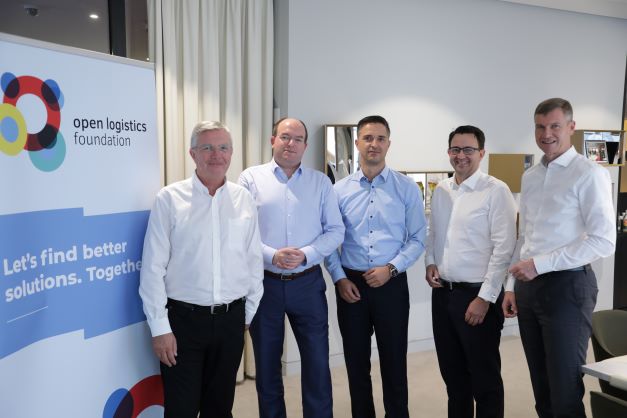
In the interview (pictured from left): Prof. Dr. Dr. h. c. Michael ten Hompel (Managing Director of the Fraunhofer Institute for Material Flow and Logistics (IML), Chairman of the Board of Trustees of the Open Logistics Foundation); Markus Bangen (CEO of Duisburger Hafen AG (duisport), Member of the Board of Trustees of the Open Logistics Foundation); Christian Bockelt (Executive Vice President Global IT Land and Digital Solutions, DB Schenker); Stefan Hohm (Chief Development Officer, Dachser SE, Vice Chairman of the Open Logistics Foundation); Dr. Stephan Peters (Member of the Board of Management of Rhenus SE & Co. KG, Vice Chairman of the Open Logistics Foundation).

The Open Logistics Foundation joins the ranks of the large non-profit open-source foundations. Open source means that the source code of a software is publicly accessible. This is not new; many successful business models are based on this principle. We all use open-source produced services every day. Web browsers like Firefox or Chrome and most of all programming languages are so. Linux, the world’ s most used operating system, is open source. It runs on all Android smartphones and on countless servers worldwide, in our Internet routers and even in smart light bulbs. Open source is everywhere, except in logistics, as it seems. So, the question is not “Why open source?” but “Why only now?”

Bangen: With open source, Michael ten Hompel has placed a topic in logistics of which everyone knows that it is overdue. We all know that we must develop commodities together. We just have not been able to get over the threshold of competitive thinking. There were just always too many buts. Pooling resources and themes give us a unique opportunity to set de facto standards instead of creating more monoliths.

Bockelt: To actively drive truly disruptive innovations, you need the right companions and a serious push. Fraunhofer IML has recognised that this constellation can be effective and brought us together.

Hohm: The digitisation tasks are too big for one company to solve alone. It can only be done together. Open source has a very decisive advantage: it simplifies the entry into digitisation and is therefore an important success factor for the entire logistics industry. At the same time, open source is a driver for a standardised process landscape in digital value chains.

Peters: After all, you often need a momentum. Especially in the weeks leading up to the founding, it became clear to us that the Foundation brought together exactly those who have been researching on innovations in the innovation environment in Dortmund and at Fraunhofer Labs for years. We have brought together what fits together and what we have been developing for years. Because of this innovation research, there is a trust and a natural affinity. When the critical phase of setting up the foundation with the legal experts began, you could clearly feel that.

The right people, at the right time, with the right mindset in the right place. Sounds reasonable. But as we all know, the devil lies in the details. In-house IT development is something like the holy grail of logistics. Is this sector ready for open source?

Bockelt: A large part of our software is already built with open source. Now it’s all a matter of enriching open source with logistics aspects and creating standards. That’ s an extremely exciting aspect…

Peters: …and bringing logistics expertise together in a repository, in an open-source community, is a crucial argument. This open-source approach guarantees an open standard for the digitisation of logistics processes and at the same time offers a high degree of flexibility for individual adaptations.

Hohm: Intelligent logistics is based on powerful IT systems. At Dachser, this principle has applied for decades and will continue to do so. That is why Dachser is also well known for its in-house IT development. However, it makes little sense to program every line of code in a standard application in-house. This is neither economical nor does it offer a competitive advantage. On the contrary, it often even prevents the pragmatic networking of partners and customers. Therefore, it is advantageous for all supply chain parties, if in the future, that selected software components are available to everyone free of charge as open-source elements and continuously updated via a neutral authority.

ten Hompel: The logistics sector must become more software-driven to play a role in the forthcoming platform economy and to self-determine its future based on European legal standards and values. Digitisation is the goal, and open source is the key to taking all companies along this journey, regardless of size and sector.

The first step has been taken. Now it’s time to drill some thick planks so that open source goes viral in logistics. The founding members declare: “We consider the Open Logistics Foundation to be the first step towards a platform economy based on European legal standards and values. It is both a beginning and an appeal to the logistics sector to think of technology and processes together and actively participate in the open-source community”. Open-source community: participate, preferably everyone – is the motto. Why should they do so? What is the added value?

Bockelt: This approach will replace individual investments in the digitisation of commodities. Every company involved will benefit from this.

Bangen: In a classic port like duisport, just a few years ago it would have been “waste of time and money” to talk for example about a joint slot system for all terminals. Today we are doing it. The psychological strain is higher, and we have simply realised that we will only succeed together; we won’t achieve anything with isolated solutions.

Hohm: Acceptance in the logistics industry will depend very much on which use case we place first. Let us take the truck driver app – we already have one or two of them (everyone laughs). That is the best example of wasted resources. Every company builds its own app, and every driver has countless apps on his mobile device. An enormous effort is put into this, but no company generates any added value through it. With such simple but widespread use cases, the realisation will catch on quickly.

Peters: The use cases we are talking about are obvious: e-pallet bill, e-delivery bill, driver app, ETA, and a few others. But the thickest plank will be getting the logistics and software industries enthusiastic about using and collaborating on the open-source repository. We could reduce complexity and be so much more innovative, faster, and better if there were no longer one hundred completely incompatible individual solutions to such problems, but one common standard.

ten Hompel: That’s exactly how it is, and creating this common basis is the core goal of the Foundation. There is always a tendency to tie the Foundation and open source to specific applications, it’ not about four competitors doing something together. It is about raising the jump height into digitisation because many people still underestimate the complexity that is coming with AI and predictive algorithms as a basis in data-based business models. This change – and this is important – is also a cultural change. Many companies have long since understood that they can generate added value for themselves if they do not have to take care of every interface themselves but can create value-added software.

Catchword cultural change: The willingness to share is growing in general. Not because sharing is trendy now, but because the success of the company’s own business models is at stake. Business has recognised that AI-based platforms will not get them far, since the chain is only as strong as its weakest link. Moreover, business leaders know very well that even the most valuable services do not make money these days unless they are perceived as a differentiator. And in the logistics sector, valuable services are just teeming. Everyone uses the same consignment note, everyone plans tours in the same way, calculates the ETA or offers tracking & tracing. However, cultural change also means adopting a different internal structure if you want to be successful with open source. Sounds so easy and harmless. But if you think about it more closely, it is a call for a paradigm shift. Is the motto meant to be that disruptive? How do the developers or IT service providers feel about the project?

Bockelt: Logistics has always been innovative, and IT played a key role early on. Today, almost all logistics processes are based on digital solutions, but the era of large software monoliths is about to end. We are thinking in terms of end-to-end supply chains, and the key here is to make processes more efficient and secure. If we use modular, standardised components for this purpose, we will be much faster and more agile when it comes to implementing truly value-creating ideas. In any case, you are preaching to the choir.

Peters: Logistics is very fragmented, both geographically and structurally. If we want to inspire people from the logistics sector to join us, we need to have an open mindset right from the start and not get bogged down in committees and bureaucracy. Incidentally, we are also unattractive as an industry if we are not open source. Many of our employees aspire that go beyond Rhenus. They want to be part of a bigger picture and drive the innovation of an industry and society forward. We are much more attractive as an employer if we can offer the big picture.

Bangen: Our developers also immediately said, yes, we will do that. So far, we have been using software that only we have – and if you take a closer look, 80% of it is already open source. The fraction of those who rely on exclusive specialised applications is becoming smaller, because at today’s speed of innovation, all of this will no longer be compatible in just two years.

The foundation’s offer is more than tempting. It is good to have confidence and be transparent but how do you guarantee neutrality in the development and participation for interested parties?

ten Hompel: The Open Logistics Foundation is the ultimate transparency. It is clear from the outset that there is no business purpose behind it or a single company that wants to monopolise the market on its own. Everything is completely open down to the very last detail, is accessible free of charge, and anyone can use it. The foundation’s purpose can be defined in terms of support for small businesses or start-ups. Here at the table, everyone is big enough to compete in the platform economy. But it is about bringing along those we work with. Start-ups or medium-sized companies are much faster if they have a basic software on which they can build their business models.

Bangen: In terms of confidence, however, logistics still has room for improvement. There are industries that are much further along in this understanding that you must sit in the same boat on the one hand and develop USPs as a competitor on the other.

Peters: Start-ups are much more disruptive here, and with a level of commitment that will probably challenge us quite a bit. We’ve talked about culture change. One of the main things here is to stop the feeling that the last 10% is not being disclosed. For example, we are all able to find the next flight connection from Berlin to Papua New Guinea on our mobiles in 30 seconds, including prices. Try that for intra-European transport. Why is there no rate transparency? Why does everyone have different interfaces for exchanging data? It is piecemeal and not very customer friendly.

Bangen: Our customers also want to be able to switch service providers at any time without having to rebuild the entire IT structure. They no longer accept raising the switching level via the complexity of the IT connection. On the contrary, it challenges them to switch in any case.

Hohm: Nevertheless, we clearly separate content and application. The content, for example the amount of prices as well as data, will continue to be exchanged between companies confidentially and inaccessible to third parties, for instance between the customer and the logistics service provider. We are focused on the ways and means of exchanging this information. That is what we are focusing on.

ten Hompel: You can compare this development with the introduction of an e-commerce. The consumer interface became simpler, and at the same time the algorithm ensured that people got the right offers. That is where we are headed in logistics as well. We come from a business that has lived very much on know-how and are going into a world that lives on algorithms. With their platforms, start-ups are suddenly making dominant knowledge freely available. Success is determined not by better information, but by better algorithms.

Let us talk about time and money. How much time and money can you save developing with open source?

Peters: In our case, it depends very much on the application, but the expectations are clearly in the double digits. Digitisation is not an end in itself. It overcomes interfaces and pays off in terms of higher-level goals such as transparency, efficiency, and sustainability. However, it must also be economically feasible and successful to the market.

Hohm: Dachser’s focus is on the business case. For us, it is about making on-site applications leaner and more standardised. For us, IT is an orchestrator. It uses a variety of building blocks. There are applications which scream out to be downloaded from a repository and made available to a large community. And more people thinking about the same topic usually results in something better.

Bockelt: There are topics that we can only solve together and there are differentiating topics for which you build your own software. And there will be algorithms that we donate to the repository, and thus to the public. For us, it is important to give access to all players in the industry.

Peters: We can only achieve that by transparency, and the basis for it is trust. We must communicate that, in addition to what we initially place in the repository.

In 2022, the setup of the logistics repository is high on the agenda. For the minutes: For the record: A repository is a database for centrally managing digital objects. The logistics repository is therefore a kind of public global central warehouse for open-source hardware and software components. Companies can use it to expand their own platforms, for example, or to set up new products and business models more quickly. A major undertaking. Which projects will you initiate and which components will you open-source? And how does that work?

Peters: At our Fraunhofer IML Rhenus Lab, we have developed a tracker for measuring the temperature and filling level of our intelligent container, which you can use just as well elsewhere. Whether you use the filling level indicator for a container, a waste bin or a rat trap, the technology is the same. We are contributing this tracker to the logistics repository, along with a standard interface so that anyone can connect their own devices. Of course, if we place the software open, we also hope that it will be further developed by many.

Bockelt: We have components that would be suitable for kicking off into the open-source world, and some examples have already been mentioned. We will go along with that.

Hohm: Dachser will also provide resources; we will determine more details in the coming weeks once the first lighthouse project has been defined.

Peters: There are two ways to get involved. Variant one is to merge existing applications into one. Variant two is a kind of supermarket shelf where, for example, different driver apps are placed next to each other. The market decides who continues to program on what and which app will be the most popular. In practice, it will be a mixture. Personally, I favour variant two because we do not need to keep working on things when there are better solutions. By voting with our feet, it will be transparent what is available and what of it is used and how often. This would allow us to allocate development capacities in a much more targeted way.

Hohm: But it is not the foundation founders who determine what is best for everyone. The foundation management and the open-source community will define a process that allows participation for everyone.

The foundation has just started its work. What expectations do you have in terms of the foundation’s operational work? Where are the priorities? What needs to go to the top of the agenda? What matters in practice to make open-source fly in logistics?

Hohm: Creative approach, complete transparency, common applications, maximum usability, and the question of how we involve all companies so that the right business case can be set as a flagship. That is what matters.

Bangen: The platform must be cool to developers, and we have to offer the community something in the repository that excites them, to motivate as many as possible to be part of it and to bring an open-source community with thousands of developers forward in logistics…

Peters: …and that also should not take twelve months. Either the first project is so convincing that it is worth joining, or it will be incomparably harder to convince the community.

Bockelt: For me, the focus is not on us founders, but on the issues that concern the entire supply chain industry. We have only thrown a first stone into the water. For our open-source project to get off to a successful start, it will be important to function as a network and to continue to develop technologies in a continuous dialog with users.

Demanding digitisation is easy; implementing it changes everything. We are writing the year 2031: Looking back, what should be said about today and about the Open Logistics Foundation?

Peters: I would love the headline: “Germany logistics world champion thanks to open source” or “From logistics world champion to open-source world champion”.

Bangen: We have finally crossed the threshold of transparency and trust that everyone has been talking about for 20 years, but no one has overcome yet. We have just got our act together.

Bockelt: The Open Logistics Foundation has unleashed a wave of transformation. The courageous step toward open source has paid off for both the logistics industry itself and its customers.

Hohm: I would like us to say that October 22, 2021, was the day we succeeded in raising logistics to a new level and enabling collaboration – through open source.

ten Hompel: I hope that in three years I will be able to say: Who would have thought back then that the open-source community would grow exponentially. And I think the best thing would be if, in ten years, we do not even remember what it was like before open source.

Michael ten Hompel, you brought the donors together. What advice do you give to the logistics industry?

ten Hompel: Companies should ask themselves one question: What are we doing with open source? Because the logistics community must be aware of one thing: In the upcoming platform economy, money will be made with AI. The use of software will increase exponentially in a brief time, and that can only be done with open source. Dachser, DB Schenker, duisport, and Rhenus have laid the groundwork for an open-source community by establishing the non-profit Open Logistics Foundation. Now it is important for logistics as an industry to reposition and join forces. My advice? Never walk alone.

Benefits of automating depalletising

Depalletising refers to the process of unloading bags or boxes from a pallet. Traditionally, it involves a strenuous set of physical activities, such as heavy lifting, bending, and stretching repetitively. This physical exertion could prove to be dangerous, if the package is over 25kg.

In fact, manual pickers are under constant pressure to lift objects of different sizes, shapes, loads, etc. This Stock Keeping Unit (SKU) variation skyrocketed with the rise of e-commerce in 2020.

Moreover, the requirement for manual labour in warehouses rose to 1.2 million in the US. Amidst that, social distancing and quarantine measures also posed huge roadblocks. Due to all those factors, automating the depalletising process seemed to be a reliable option.

Limitations with traditional depalletising methods

Previously, robotic technology was limited to picking items of similar attributes. Due to this, the pre-programmed system could not cope with SKU variations. Generally speaking, human pickers are experts in identifying and handling SKU variations, even with mixed-SKU pallets.

There is no denying the fact that humans are gifted with cognitive intelligence to locate the item, pick it at their own pace, and place it accordingly. In order to achieve accurate performance, warehouse workers are bound to undergo job and safety training.

Despite following an intended training module, they are still at risk of falling prey to chronic physical ailments. According to a report by the University of North Carolina, more than 36% of manual workers in the warehouses account for back and shoulder injuries, leading to missed workdays due to lifting and handling heavy objects.

Human workers at risk cost companies injury claim expenses, safety training, and legal compliance costs, contributing to a high turnover rate. Besides, the companies tend to juggle between hiring new workers and delivering consistent or even better throughput outcomes.

Some other common concerns with manual handling include physical constraints, lack of supervision, and poor ergonomics. As a result, there was a need to build a reliable depalletisation cell, free from human pickers.

Automating the depalletising process is not elusive, as it was before. Thanks to deep-learning algorithms, warehouses can now employ a suitable robotic depalletising cell with a cutting-edge vision system and an appropriate gripper to lift the heaviest of objects.

Things to consider

Essentially, manual pickers do not optimally use the warehouse working space. Installing robust depalletiser cells in warehouses can efficiently utilise the designated area, both the floor and the vertical space. Moreover, this can accelerate the overall performance by enabling manual workers to focus on other value-adding tasks. Otherwise, for instance, if three out of six workers performed depalletising operations along with multiple other duties, the depalletising station would suffer.

On the other hand, a robotic depalletiser features 3D vision systems and a gripper for pick-and-place depalletising operations. The 3D machine vision systems consist of multiple cameras, vision software, and laser sensors. Not only does it capture the environment, but a cutting-edge 3D vision system also calculates the coordinates of randomly placed objects.

It allows robots to scan each object, recognise their pick point, and place the item on a conveyor belt. After all, recognising unknown objects placed at different heights is a clear-cut step. Even detecting a box with tapes as a single item instead of six separate boxes is possible with the advanced robotic depalletiser cell.

Lastly, installing robust vision software integrates hardware and software components seamlessly for a robotic depalletising cell. The vision software can improve the accuracy of segmenting objects and enable robots to pick heavy objects from a random stack. Fizyr’s vision software is a plug-and-play product used by system integrators as a module to even deal with closely stacked and overlapping boxes.

Automating depalletisation with vision technology

Robots can effortlessly unload overlapping items or shiny objects, thanks to AI-driven vision technology and machine-learning algorithms.

This advanced vision software allows a robotic depalletiser to seamlessly handle a continuous flow of mixed-SKU pallets in any sequence. It can easily identify the item on the pallet, recognise the variations, and manage them accordingly.

The cutting-edge vision software segments the item, classify it and proposes over 100 grasp poses based on the trained neural network, enabling robots to move faster in challenging environments. Broadly, it alleviates common manual handling mishaps, while also maintaining a predictable throughput rate.

Whether mixed-SKU pallets or multiple pallets of the same SKU, automated robotic depalletising enhances productivity, reduces operating costs, and creates a safe working environment. That said, warehouse staff are less prone to chronic illnesses, injuries, and other health detriments. Best of all, the company can reap the benefits of both artificial and human cognitive intelligence.

IMAGE CREDIT: AWL

Goodman teams up with Geek+ in China

Goodman Group, a leading global industrial property group and Geek+, a global market leader in autonomous mobile robot technology, have signed a strategic co-operation agreement. Goodman and Geek+ will collaborate to share technical and logistics property expertise to develop cutting-edge, customised automation solutions for their customers across Greater China.

Kristoffer Harvey, Chief Executive Officer, Greater China at Goodman Group, said: “China continues to be a world leader in e-commerce and online retail already makes up over 27% of total retail sales. This is expected to increase by 63% to 2025. Our customers are always looking for ways to create efficiencies in their supply chains to meet growing consumer expectations for cost effectiveness and rapid delivery. Well-located smart warehouses are the answer. By partnering with Geek+, we are giving our customers and China’s consumers access to the latest warehouse robotics and technology.”

Geek+ products and solutions include Goods-to-Person systems, vertical storage systems, robotic sorting, and autonomous forklifts, known for their precision, reliability, and cost savings logistics for retail, e-commerce, manufacturing customers. As part of the co-operation, Goodman will be able to provide its warehousing customers with the highly flexible and scalable Geek+ Robot-as-a-Service package.

Lit Fung, VP, Managing Director APAC, UK and Americas at Geek+, said: “With our extensive logistics management experience from over 300 automation projects worldwide, Geek+ can provide comprehensive automation solutions that take full advantage of Goodman’s well located and high-quality properties.”

Goodman and Geek+ will continue to explore cooperative ventures to drive innovation in smart warehousing, including joint development of warehousing products and building specialised automated warehouse properties.

TDS invests in BYD emission-free trucks

Top Delivery Services (TDS) has made a major commitment to emission-free city distribution following the purchase of 10 BYD ETM6 pure-electric eTrucks in collaboration with Bluekens EV, strategic partner and BYD eTruck dealer for the Netherlands. The vehicles will be used specifically for eco-friendly zero-emission delivery services of IKEA in Amsterdam.

René Wissink, Director of TDS, said: “TDS has already done a lot in the field of electric transport. This is an exciting development as we instantly become one of the major players in the market for emission-free distribution. The collaboration with strategic partner Bluekens EV is indispensable in this regard.”

In the search for a solution for the goal of IKEA, TDS got in touch with Bluekens EV. BYD eTruck dealer, Bluekens EV based in Breda, is an expert in emission-free city logistics and also fleet management solutions. René Wissink continued: “TDS would not have been able to take this step without Bluekens EV, being such a major name in the transport world. The organisation has enormous expertise in the field of electric transport and we have the assurance of aftersales and maintenance, all of which gives us a lot of confidence.”

As well as this knowledge, Bluekens EV also offered TDS the advantage of a 360° sales and aftersales service plan. This is enhanced further with a range of added-value services including charging infrastructure, fleet management and complete leasing solutions.

A multitude of innovative features inherent to the BYD ETM6 eTrucks makes them the ideal zero-emission vehicles to fulfil environmental goals, while also being very safe, quiet and practical for operating in high density city centres. Powered by BYD Iron-Phosphate Battery technology, the BYD ETM6 zero-emission electric truck offers the longest driving range, 200km with a full load, in the market within its 7.5 tonnes category, as well as extended battery life and high levels of safety.

TDS is a joint venture of logistic service providers comprising Holwerda Transport, Transportbedrijf P.A. van Rooyen and Brakenhoff Transport. Wissink concluded: “There is an increasing need from the customer for electric transport, a trend which has been going on for some time. As a transporter, you automatically go along with such developments, but we always try to anticipate.”

Gert-Jan Jonker, General Manager, Bluekens EV, said: “The BYD ETM6 is perfect for emission-free city logistics. Compared to most electric trucks, this model drives smoothly, has a long range for everyday use, a low TCO and fast charging technology. In addition, smart solutions for the charging infrastructure at TDS were considered in the preliminary phase. As a result, new charging facilities have been developed at one location, which will allow the surplus of solar energy from the solar panels to be used for charging.

“Bluekens EV also takes care of the fleet management, which supports TDS. It is our job to monitor the fleet, keep it running and provide insights into costs. The uptime of the vehicles should be as high as possible. In the event of a breakdown, we contact the driver and help him or her to get back on the road quickly. We initially try this by telephone, otherwise our technicians will quickly arrive on site to solve the problem.”

Mahmut Mobassit, eTruck Director, BYD Europe B.V., said: “We are proud that BYD eTrucks have been selected by such a well-known name as TDS and also for the role they will play in providing such an important zero-emission delivery service for IKEA in Amsterdam.  Quiet, clean and safe, our BYD ETM6 eTrucks embrace a new era in electric powered commercial transportation, without compromising on performance, efficiency and practicality. Together with our partner in the Netherlands, Bluekens EV, we are pleased to support TDS with a comprehensive aftersales service and fleet management solution to continually elevate operating efficiencies, in the knowledge that our eTrucks are being sympathetic to the environment.”

Transporeon acquires Logit One

Transporeon has strengthened its international ocean visibility capabilities through the acquisition of Logit One.

As adoption of in-transit visibility has become a must-have, the focus has mainly been on outbound transportation visibility, improving customer satisfaction and delivery accuracy. The next phase for customers is to build a complete End-to-End supply chain visibility, expanding coverage of inbound visibility across multimodal tracking. Connecting transport execution to multimodal visibility across Ocean, Road, and Air is when transportation gets in sync with the world, and the real value is unlocked.

Bringing in Logit One, an industry technology leader of Ocean visibility and end-to-end multimodal planning capabilities in real time enables Transporeon’s mission of bringing transportation in sync with the world. This is achieved through the execution of predictive transportation across multiple modes enabled through high accuracy and global coverage of its in-transport visibility network.

Logit One’s technology will be immediately made available to all existing Transporeon customers and prospects. It serves as a perfect extension of the established Transporeon Sixfold Visibility and Tracking portfolio.

Transporeon is continuing to build up the most powerful visibility network in the world, delivering predictive transportation across multiple modes. The acquisition of Logit One expands the Transporeon Sixfold Visibility and Tracking offering across Ocean. It makes Transporeon the only company to provide an execution platform with an integrated multimodal visibility offering. For clients, the integration of Logit One represents a major development in transport visibility and predictive transportation across all modes.

Stephan Sieber, CEO of Transporeon: “Expanding our visibility offering to Ocean is the logical next step. It shows our continued commitment to combining visibility with execution. This will enable our customers to continuously improve their operations and open a whole new set of innovation potentials to all of us! We are excited to welcome the Logit One family to Transporeon.”

Integrating the Logit One solution into Europe’s largest network of shippers and carriers will generate important scaling effects. This means that all parties to the Transporeon platform can enjoy far greater transparency than any individual visibility solution could offer. Logit One will be a great extension to Transporeon Sixfold currently monitoring over €500m worth of goods in real-time every day for customers in 40+ countries with 25 languages.

“Shippers and forwarders are facing huge dynamics in the ocean transport system and international transportation needs to become greener, more agile, and responsive. Through this acquisition, Transporeon’s customers will be able to expand the scope of their transportation visibility to international movements and to synchronise ocean and overland transportation. We are very excited about this step because we share a common vision and this will bring our solutions to a worldwide market,” said Frank Knoors, CEO of Logit One.

Transporeon’s one-platform approach ensures all users instantly benefit from the integration of new functionalities and services. Existing Transporeon customers will automatically benefit from the integration of the Ocean Visibility data feed into their transport planning and execution. The Transporeon platform includes a bird’s-eye view control tower of all their shipments across modes. Furthermore, additional multimodal planning functionalities will help to utilise the available capacity and reduce the environmental impact.

The Transporeon logistics platform is a 360° logistics services platform, and not only a standalone in-transit visibility provider. The strength of the Platform lies within its unique services supporting the customers’ complete transport lifecycle demands. Transporeon’s services include Market intelligence, freight procurement, planning and execution, tracking/proof of delivery, visibility, and freight audit. All the above are built on the world’s largest road carrier network. With the addition of Logit One, Transporeon significantly strengthens its services across all transport modes.

“As a well-known and recognised provider of global 4PL solutions we offer our clients with visibility and transparency in their supply chain in order to keep in control and to react fast on exceptions said Amaury Luycks, Managing Director of Polytra NV (part of Fracht Group).

“For us, the future of logistics service providers comes from analysing data, moving from reactive to proactive to predictive. We believe that logistics is not only finding the cheapest solution but also the most reliable, the fastest, and the greenest. Our partnership with Logit One is an important building block to achieve this. Their visibility solution gives us the tools to achieve superior service for our customers and even for our customers’ customers.”

Randex launches vertical storage-robotics integrator

Vertical storage lift company Randex is launching Compact 24/7, a solution that integrates the company’s Compact family of automated vertical storage systems with robotics technology to allow continuous, 24/7 warehouse picking with, it says, up to 50% fewer warehouse workers.

Compact 24/7 allows automated vertical storage to be integrated with a wide range of robotic types including autonomous mobile robots (AMRs), collaborative robots (cobots) and automated guided vehicles (AGVs).

“Automated vertical storage already delivers proven benefits for warehousing and logistics users,” said Randex director James Roberts. “Randex user feedback shows that robotics doubles its impact.”

Compact vertical storage lifts already save up to 90% of floor space compared to standard shelving and pallet racking. They can manage loads of up to 100 tonnes and already enable warehouse operatives to complete up to four times more picks than in a traditional warehouse, with goods automatically presented to the picker. When the same goods are presented to a robot using Compact 24/7, picking performance improves by a further 100% according to Randex users.

Randex Ltd is the sole UK distributor for Compact Vertical Storage Lifts, manufactured in Sweden by Weland Solutions, a member of the privately owned, global group Weland AB. Randex customers include Bombardier, DHL, Fujifilm, Howdens, Hutchison Ports, Jaguar Land Rover, Ministry of Defence, P&G, Pfizer, Rolls Royce and Specsavers.

Descartes helps Dover Hamilton with Brexit challenges

Descartes Systems Group, a global leader in uniting logistics-intensive businesses in commerce, is helping customs clearance agent Dover Hamilton Ltd’s customers navigate post-Brexit EU customs complexities and grow their business with Descartes’ e-Customs.

Established immediately after Brexit in January 2020, Dover Hamilton has put together a team with expert knowledge of new Brexit regulations, customs clearance processes, procedures and compliance – many of whom closely monitored the changes as they were drafted and published by Government lawmakers. In the last 18 months, the company has grown into an international organisation with three branches across the UK and Europe.

Following the UK’s decision to leave the EU, Dover Hamilton identified an opportunity to work closely with its customers – predominantly small- and medium-sized businesses – to help them optimise their road freight import and export operations within the UK, whilst ensuring regulatory compliance at both origin and destination.

Descartes’ e-Customs allows Dover Hamilton to offer exceptional customer service and a high level of responsiveness for its clients.  Descartes is supporting Dover Hamilton further by providing the Pentant CSP Badge for imports and exports at non-inventory ports and Dover.

“We recognised that Brexit offered a business opportunity, specifically for road freight imports and exports with the EU,” said Monica Stefan, EU-GB General Customs Manager, Dover Hamilton Ltd. “Descartes’ e-Customs is a comprehensive, efficient and user-friendly platform for customs declarations.  It is highly flexible and is incredibly easy to train our customs agents on. One of the most valuable aspects for us is the ability to access it from a secure system when connected to the internet locally or through an encrypted laptop, as this enables us to optimise our customer responsiveness. The level of Brexit expertise at Descartes has been exemplary and has supported us in driving our business growth.”

“We’re proud to be supporting Dover Hamilton’s customs brokerage business as it continues to grow,” said Pól Sweeney, VP Sales UK and Ireland for Descartes. “Dover Hamilton spotted an opportunity in the market and has developed its expertise and knowledge to offer its customers an exemplary service in response to the market changes caused by Brexit – and is consequently thriving.”

Subscribe

Get notified about New Episodes of our Podcast, New Magazine Issues and stay updated with our Weekly Newsletter.