Qatar Airways Cargo has announced the launch of its first scheduled freighter services from Helsinki, Finland, effective 2nd September.
Operating once weekly with a Boeing 777 freighter on the Doha – Budapest – Helsinki – Doha route, the new service will provide 100 tonnes of export cargo capacity out of Helsinki each week. Complementing the airline’s existing 7 weekly passenger services on the Doha-Helsinki-Doha route, the dedicated freighter will increase total weekly cargo capacity from Helsinki to more than 170 tonnes, while the widebody belly-hold flights offer over 70 tonnes weekly, each way.
The launch of Qatar Airways Cargo’s first scheduled freighter service to Helsinki, alongside the reinstatement of Qatar Airways passenger frequencies provides customers in Finland greater access to the airline’s extensive network in Europe, Middle East, Africa, India, Asia and Australia through its state-of-the-art hub in Doha.
Helsinki is a strategic gateway for high-value and specialised cargo, connecting Finnish and Nordic businesses to global supply chains. Key export commodities from Finland include high-tech products, electronics, industrial machinery and spare parts, pharmaceuticals, healthcare products, perishables and e-commerce shipments.
Import flows are driven by electronics, consumer goods, automotive components, industrial equipment and e-commerce, underscoring Helsinki’s role as both a manufacturing and distribution hub.
Qatar Airways Cargo’s portfolio, including TechLift, Pharma, Fresh, and Courier among other products, is designed to meet the unique transport and specialised handling requirements of these commodities, ensuring quality, efficiency, and reliability throughout the journey.
In coordination with its Road Feeder Service (RFS) partners, Qatar Airways Cargo also provides scheduled and ad hoc trucking solutions to and from Helsinki across Scandinavia and the Baltic region. These services extend the reach of the airline’s global network beyond the airport, providing customers with seamless connectivity, greater flexibility, and efficient access to key regional markets.
Customers can book their cargo on the new Helsinki freighter service through a digital booking platform, where they can seamlessly book shipments across the airline’s global network and full portfolio of products.
Poland’s position at the heart of Europe is increasingly making it a focal point for investment in logistics, e-commerce and warehouse automation. In a new interview with Poland Today, Logistics Business Editor Peter MacLeod discusses the forces shaping the country’s rapidly developing logistics sector.
From the continued growth of e-commerce to changing international trade flows, Poland has emerged as an increasingly important link between European markets and the wider global supply chain. Its location, expanding logistics infrastructure and growing warehousing market have helped attract investment from retailers, manufacturers, logistics operators and technology providers.
One particularly significant influence is China. Chinese businesses are taking an increasingly active role in European logistics, while technology developed by Chinese automation and robotics companies is becoming a more familiar sight inside warehouses and fulfilment centres across the continent.
During the conversation, MacLeod explores the development of robotics and warehouse automation, drawing on his experience covering logistics technology and visiting operations, manufacturers and industry events around the world. As businesses face pressure to increase throughput, make better use of warehouse space and respond to changing labour markets, automation is becoming an increasingly important part of the discussion.
The interview also considers the extraordinary influence of e-commerce on logistics. Consumer expectations around choice, availability and delivery speed have transformed fulfilment requirements, creating demand for more sophisticated distribution networks and increasingly flexible warehouse technology.
For Poland, the combination of its geographic position, growing logistics infrastructure, e-commerce market and proximity to major European economies presents a significant opportunity. As global supply chains continue to evolve, the country could play an even greater role in connecting international trade, technology and European distribution.
Watch the full Poland Today interview with Logistics Business Editor Peter MacLeod below.
Artificial intelligence is becoming one of the biggest talking points in logistics, with technology providers promising smarter decision-making, greater efficiency and increasingly autonomous warehouse operations.
But there is a fundamental problem: AI can only make good decisions if the data behind those decisions accurately reflects what is happening on the warehouse floor.
In the latest episode of Logistics Business Conversations, host Peter MacLeod is joined by Oana Jinga, Chief Commercial and Product Officer atDexory, to explore why accurate physical data could be the missing ingredient in many warehouse AI strategies.
The discussion looks at the gap that can exist between what a Warehouse Management System says is happening and the physical reality inside the building. Jinga explains that warehouse data accuracy can sometimes be significantly lower than operators believe, creating problems that can ripple through picking, fulfilment, productivity and customer service.
Inventory accuracy is only part of the picture. Effective AI also needs to understand the physical environment around the stock — including warehouse space, rack structures, movement, machinery and the shape and size of goods. It is this combination of digital and physical information that is helping drive the development of Physical AI in logistics.
The episode also explores whether AI could eventually capture the instinctive knowledge of experienced warehouse managers. While technology is becoming increasingly capable of analysing complex datasets and making recommendations, Jinga argues that human experience and operational understanding still have an important role to play.
There are significant commercial implications too. Even relatively small inventory inaccuracies can result in wasted picking time, stock investigations, incomplete orders and disrupted production. Jinga discusses how improving and continuously maintaining inventory accuracy can therefore affect not only productivity, but also wider KPIs, customer service and profitability.
Looking ahead, the conversation considers how increasingly connected data, robotics and AI could create warehouses that are not simply more automated, but far better informed — enabling faster and increasingly sophisticated operational decisions.
Ultimately, however, the message is not to adopt technology simply because it is available. Businesses should first identify the operational problems they need to solve, understand the quality of the data they already have and then find the technology capable of addressing those challenges.
Listen to the full episode of Logistics Business Conversations below to discover why the future of warehouse AI may depend on getting the basics right first.
Will we soon see humanoid robots operating in UK and European warehouses? Russell Hutchinson (pictured, below), business development manager at Daifuku is not totally convinced.
Back in 1985, Roger Smith, chairman and CEO of General Motors, had a lightbulb moment. What if the American car giant, under increasing pressure from its more efficient Japanese competition, adopted emerging technology to slash costs and regain leadership in the market? Inspired by what new automation could do, he exclaimed, “Do you know what really impresses me? I saw a robot pick up an egg!”.
Within just a couple of years, the experiment in automation was over. Research suggests that from 1985 to 1991, when it was introducing significant levels of robotics into its factories, GM’s productivity continued to lag significantly behind that of main rival Toyota. Stories of robots welding doors shut and painting cars the wrong colour were well documented at the company’s new ‘lights out’ operations. GM had reportedly spent $90bn on automation that just didn’t work. By 1995, the corporation pulled the plug on this sobering chapter in its history.
The humanoids are here
Fast forward to 2026 and we are seeing similar interest with humanoid automation. The internet is awash with examples of clever robots chasing wild boars down a street in Poland; beating a world ranking Chinese player at table tennis or winning a marathon. Similarly, Tesla’s development of its Optimus 3 factory robots has generated huge amounts of media attention with Elon Musk saying the technology will be ‘transformative’.
However, will the excitement and anticipation surrounding humanoid robotics translate into practical warehouse solutions? It’s still too early to say. Nevertheless, there will doubtless be niche operations that will benefit from this type of automation.
The challenges we’re facing
Look at any modern warehouse and you see the same challenges: more orders, increased order complexity, huge numbers of SKUs and far less time to dispatch goods. At the same time, customer behaviour has become harder to predict. Order patterns now produce sharper spikes with fewer warnings, especially in facilities shared between multiple vendors such as 3PL operations, multi-tenant warehouses or Amazon-type fulfilment environments. Facilities that appear manageable one hour can suddenly face a surge of orders that must be processed immediately.
In this kind of environment, flexibility is no longer a nice-to-have. It is essential. Human labour remains the most adaptable resource in the warehouse. People can respond to shifting priorities, changing order profiles and unexpected workflow changes far more easily than any automation system available today. But that flexibility comes with limits. Human-based operations are difficult to scale quickly, and performance is rarely consistent. Throughput depends heavily on operator efficiency, which means planned capacity is not always achieved in practice.
Traditional conveyor systems present the opposite trade-off. They deliver predictability and stable output, but they do so at a fixed rate and cannot easily flex when demand suddenly spikes.
Some look at humanoid robots as the next step but replacing labour altogether with such technology is not yet a practical answer either. These robots remain expensive and, in most warehouse environments, are still largely unproven.
The lesson here is clear: we should not avoid innovation, but we should be wary of confusing novelty with readiness. Perhaps we need to keep the lessons of the past in mind and resist getting swept along by the excitement of the ‘shiny new toy’ as GM’s Roger Smith did back in the eighties.
Operational elasticity
For fulfilment operations, the real challenge is no longer basic automation, but operational elasticity and built-in redundancy; the ability to expand and contract capacity in response to volatile demand without fixed infrastructure. And this needs to be achieved while avoiding single points of failure.
Given the current rate of technological change, it might be tempting to conclude that humanoid robotics are where it’s at, but our practical experience suggests otherwise. Granted, humanoids will no doubt play a role in the warehouse of tomorrow, but what’s really needed is a solid middle ground, where proven, highly efficient technology delivers the commercial requirement. It’s all about evolution, not revolution.
Responding to demand volatility
One way to address this challenge is to move away from fixed, continuously running systems and toward a model where capacity can adjust dynamically. Daifuku’s SOTR-S is designed with this objective in mind. In retail and e-commerce fulfilment, much of the complexity comes at the piece level. Batch picking is widely used, where the same SKUs required by multiple orders are picked together in a single pass, then sorted and consolidated.
The SOTR-S supports this stage by using a fleet of mobile robots to transport individual items between process points. Operators place picked items onto the robots, which then carry them to their assigned destinations. Unlike traditional sorters, each robot stops for item placement, removing the need for operators to aim at a moving target. This reduces stress and makes the process more controlled and consistent.
Each robot receives its destination from the warehouse control system via an RTC (robot traffic controller), which dynamically assigns tasks and routes. Vehicles operate independently, but are centrally coordinated, allowing the system to continuously adjust to current workload conditions.
A new operating model
By replacing fixed flow with mobile, task-based movement, the SOTR-S introduces the flexibility and real-time adaptability that traditional systems lack.
This difference in design leads directly to a new operating model. With traditional conveyors and sorters, as discussed earlier, systems must be in place regardless of whether they handle peak volumes or minimal flow. While well-designed conveying systems minimize runtime by stopping conveyor zones one by one to avoid unnecessary movement and electrical consumption, some residual and unavoidable inefficient energy use, along with mechanical wear, still remains even when throughput is limited. The SOTR-S allows capacity to follow demand. Because each robot operates independently, fleet activity is continuously aligned with actual throughput requirements. In practice, only the vehicles required at a given moment are moving, based on real-time workload. This intelligent, task-based control minimizes unnecessary robot movement, leading to optimized energy use and more efficient utilization of equipment. In addition, during extended off-peak periods, such as the months following the Black Friday and holiday season, part of the fleet can be taken offline, further improving overall efficiency.
As a result, the SOTR-S enables a more efficient operating model in which energy consumption and equipment usage are closely tied to actual workload, rather than fixed system capacity.
Sweat the asset
This distributed, multi robot operating structure also transforms system resilience. In traditional systems, a single failure can disrupt the entire operation. When a sorter stops, everything stops. With the SOTR-S, loads are distributed across multiple robots and alternative routes. Failures are therefore localised: if one robot stops, only the load on that vehicle is affected while the rest of the system continues to operate.
The same principle applies not only to unexpected failures, but also to routine maintenance. Individual robots can be taken offline as needed, allowing maintenance to be performed without interrupting the system.
This built in resilience, achieved by isolating impact at the robot level, allows the SOTR-S to maintain continuous operation during both failures and maintenance. As a result, system uptime increases and assets are used more efficiently and predictably.
Focus on automation performance
The SOTR S enables a demand driven operating model in which capacity, energy use, and system availability adjust continuously to actual workload. Throughput can be matched precisely to actual demand, allowing the system to adapt to volume fluctuations without carrying unnecessary cost. At the same time, because there is no single point of failure, the system continues to run even if one unit stops. The result is a model where resources are used only when they contribute to processing, ensuring efficient performance without waste.
Humanoid robots will no doubt find a place within the warehouse fulfilment environment over the next few years. However, I suspect we may see several examples of rapid deployment – followed by withdrawal – before that day comes.
A £35m+ skincare business run by a team of just 18 has revealed how a nearly 20-year third-party logistics partnership with Europa Worldwide Group has helped it scale distribution to major UK retailers and expand across Europe.
ET Browne UK is the business behind the globally recognised Palmer’s skincare brand, importing and distributing more than 100 products across the UK and Europe.
Palmer’s is stocked by the UK’s largest retailers, including Boots, Tesco, Superdrug and Sainsbury’s, and serves customers across European markets, including Poland, the Netherlands and Germany. Its success comes as the UK Beauty & Personal Care market continues to expand, with revenue projected to reach US$17.87bn in 2026.
Within this competitive market, ET Browne has built a £35m+ operation by combining a strong retail presence and growing product portfolio with a logistics infrastructure capable of supporting it, building a resilient supply chain that has facilitated growth and expansion across Europe.
As Finance Director Errol Thomas puts it: “We’ve built a business that consistently performs beyond its size.” Helping achieve this has been its successful partnership of nearly 20 years with Europa Warehouse in Dartford (Kent), the specialist third-party logistics division of independent logistics provider Europa Worldwide Group.
The collaboration has provided the warehousing capacity, operational resources and flexibility needed to support ET Browne as it has increased sales, expanded its retail distribution and entered new European markets.
Scaling a Complex Retail Operation
ET Browne’s products are imported from the United States before being distributed to more than 100 retail distribution centres and wholesalers in the UK, as well as customers in Poland, the Netherlands, Germany and other European countries.
Managing between five and ten consignments every day, from single-pallet shipments to full trailer loads, means balancing seasonal demand, fluctuating shipping schedules and strict retail delivery windows, all while continuing to introduce new products and expand across Europe.
Doubling in Size
Over the past 15 years, ET Browne has doubled its sales. As demand for Palmer’s products has increased, the logistics operation has expanded with it, providing additional warehouse capacity, operational resources and flexibility. Growth has brought new opportunities for ET Browne, but it has also increased the complexity of its logistics operation. Growth has not always been predictable. Delayed containers, changing import schedules and rising order volumes have required the operation to respond quickly, often at short notice.
But the partnership with Europa has also helped ET Browne navigate major changes affecting UK and European supply chains, including Brexit and new French VAT requirements.
As ET Browne’s dynamic requirements have evolved, both companies have worked closely together to anticipate additional capacity and resource needs before they impact customers. This approach has enabled ET Browne to continue increasing sales and expanding distribution, confident that its logistics operation can scale alongside the business.
Logistics Team Supporting Retail Success
Day-to-day operations between ET Browne and Europa depend on close communication, shared knowledge and the confidence that both teams are working towards the same goal: ensuring Palmer’s products reach retailers and customers accurately and on time.
ET Browne continues to expand its product portfolio and grow across established and emerging UK and European markets. Its latest successes include the Palmer’s Tahitian Vanilla Range, which is its fastest-growing product, by both value and units sold.
For Ryan Woor, Managing Director, UK & Europe at ET Browne, strengthening the infrastructure has been essential. Ryan said:
“Over the past two decades, ET Browne UK has grown significantly, expanding Palmer’s presence across major UK retailers and into European markets. That growth has required us to continually strengthen the infrastructure behind the brand, and Europa has been an important partner throughout that journey. As we look ahead, our ambition is to accelerate Palmer’s growth across the UK and Europe, broaden our product portfolio and build even stronger relationships with our retail and distribution partners. To achieve that, we need a logistics operation that is resilient, agile and capable of scaling with us. Our long-standing partnership with Europa gives us confidence that we have the operational platform to support the next stage of our growth.”
The partnership with Europa has adapted to ET Browne’s changing requirements, from increasing warehouse capacity and accommodating fluctuating import volumes to supporting the company through Brexit and continued expansion.
For Dionne Redpath, Chief Operating Officer at Europa Warehouse, the partnership demonstrates how an effective 3PL relationship can give a growing brand access to the infrastructure and expertise it needs without a substantial in-house logistics operation.
“ET Browne is a great example of a successful, fast-growing consumer brand that needs agility, reliability and smart supply chain solutions from its logistics partner. This collaboration reflects the strength of cooperation built on expertise and trust, using Europa’s understanding of the continual changes and complexities in today’s supply chain. We’re proud to be supporting ET Browne as it continues to expand, strengthen its retail distribution and bring Palmer’s products to more consumers across the UK and Europe.”
The partnership with Europa has helped ET Browne build a logistics platform capable of supporting a £35m+ business, major retail contracts and the continued expansion across the UK and Europe.
Warehouse leaders have heard the promises. AI will optimise labour. AI will reduce exceptions. AI will help teams do more with less, writes Alex MacPherson of Manhattan Associates.
The question is not whether AI can be useful in a warehouse environment – it undoubtedly will. The real question is how quickly that usefulness can be turned into measurable operational value.
The answer depends less on the brilliance of the AI model and more on where the AI lives. When AI is embedded directly inside the warehouse management environment, connected to live operational data and execution workflows, value can begin on day one rather than after a long integration and configuration cycle, where AI is layered over fragmented systems.
Compressing decisions lead to fast wins
In most warehouse operations, the first source of value is not full autonomy. It is decision compression. Managers and supervisors spend a surprising amount of time chasing answers that should be immediate: Why did a wave fail? Which constraints are driving deselections? Will today’s labour plan hold through the next volume spike? Which associates should be reassigned first?
In one Manhattan Associates example, answering questions like whether orders would be ready by the end of the day previously required digging through dashboards for 20 to 30 minutes. With an AI agent operating in context, that same decision process was reduced to just a few minutes, with the ability to actually implement the decision as well.
That is significant because in a warehouse context, every delayed decision compounds itself as downstream disruption. If a supervisor can resolve issues in minutes instead of half an hour, the positive impact shows up in throughput, labour balance, dock flow, and service performance long before anyone tries to calculate a grand AI transformation narrative.
Where value shows up fastest
If operations leaders want to know where AI can produce quick, defensible returns, labour is one of the strongest candidates. Warehouse management teams have long understood that labour productivity rises when labour management capabilities are introduced, and that these solutions tend to produce quick payback.
That aligns with how embedded warehouse agents are now being positioned. In a live warehouse environment, a labour-focused agent can proactively recommend staffing changes during the day and even suggest which specific associates to move based on training, certifications, and productivity history.
For warehouse leaders, that is a meaningful shift; instead of discovering imbalances after service slips or backlog builds, supervisors can act earlier, with guidance grounded in data and operating system they already use. Because the baseline is visible, this is also why labour use cases are easier to defend internally. The before-and-after is measurable and the operational gains are already understood by everyone on the floor.
Native AI matters more than AI theatre
There is another reason embedded AI can move faster. Warehouse workflows are highly specific. They depend on local order rules, inventory state, associate availability, certifications, standard operating procedures, device workflows, and exception paths that often make sense only inside the application running the operation.
Most warehouse workers are not moving between multiple enterprise applications during a shift. They are living inside the warehouse workflow, often through a handheld device. If AI is going to help them at the point of work, it has to show up there, not on a separate platform.
That is where the difference between embedded AI and AI theatre becomes visible. One helps a worker complete the task in context. The other gives a organisation yet another screen and spreadsheet to look at.
What warehouse leaders should expect
The realistic expectation for AI in a warehouse management environment should not be instant transformation; however, rapid, targeted operational lift should be. For warehouse leaders under pressure to improve efficiency and throughput at the same time, the AI conversation is quickly becoming a platform and architecture conversation.
As such, agents that are embedded within unified, cloud-native systems and domain-specialised (where data is integrated, trusted, and governed consistently) are the clear choice for warehouse operations teams in their ongoing battle to stay ahead.
What happens to a logistics operation when a crisis or disruption hits? One day everything could be running smoothly: routes are getting completed, goods are getting delivered and service levels are on track.
But what happens when something goes wrong? What happens when fuel prices increase? Suppose a vehicle breaks down, a driver leaves unexpectedly, or a large delivery is stopped by a bridge closure. Can the business survive these kinds of setbacks?
Many businesses would love to say ‘Yes’ to this question. But the reality is, many businesses can’t right now. With the current geopolitical landscape remaining uncertain, fuel costs fluctuating, basic road infrastructure declining at an unprecedented rate and the constant threat of driver shortages, there are a number of unexpected issues that could compromise a logistics business’s bottom line at the drop of a hat in 2026.
Andrew Tavener (pictured, below), Head of Marketing at Descartes, believes that ‘OK’ delivery performance is no longer good enough in 2026 and advises how businesses can future proof their organizations moving forward.
Tight Margins Leave Little Room for Hidden Inefficiency
With fleets operating on tighter margins, typically around 2–3%, according to industry data from the Road Haulage Association, there’s little room for error for logistics operations in the current climate. While a one-off disruption to a business’s last-mile delivery probably won’t cause immediate failure, it may gradually erode profitability. So, operators need to ensure they are staying ahead of the curve and ensuring their hidden inefficiencies don’t compound quickly, impacting both profitability and service.
Service Failures Put Customer Loyalty at Risk
Customers won’t tolerate a drop off in service when a business is disrupted by a vehicle breakdown or shortage of drivers. In fact, Descartes’ Ecommerce and Home Delivery Consumer Sentiment Study found that 66% of consumers experienced delivery issues, rising to 79% among under-35s, highlighting a clear gap between what businesses deliver and what customers expect.
At the same time, satisfaction remains low, with only 11% of under-35s saying they are consistently satisfied with delivery experiences. With these challenges, even the smallest issue in the logistics pipeline may lead to a negative customer review and ruin any long-term loyalty.
From Reactive Planning to Resilient Fleet Operations
The operators leading the way have already taken a new approach to planning. These businesses are looking beyond their current fleet performance and are stress testing their businesses consistently. This type of scenario-based planning exposes weaknesses early, which allows them to act before issues begin to impact cost or service performance.
One of the best ways to move towards scenario-based planning is to enlist a system that allows access to real operational data. Organisations can test network configurations, refine routes based on actual constraints, and balance cost, capacity and service more effectively.
With this kind of technology usage, previous time-consuming decisions can be made far more efficiently. When visibility or data is limited, routes aren’t as effective, and ETAs become unreliable. Therefore, operational inefficiencies increase, driving up costs and reducing service consistency. However, with real-time execution data, businesses can continuously refine routes, respond to issues as they arise and build operations that reflect how deliveries actually perform on the road, helping to create more cost-effective and resilient operations.
Logistics operations rarely operate in predictable conditions for long. As cost pressures increase, networks become more complex and customer expectations continue to rise, the margin for error continues to shrink. In this environment, performance that is simply “OK” won’t remain viable.
With the geopolitical climate affecting almost all aspects of logistics operations, businesses must strengthen how their operations perform under pressure. That means improving planning accuracy, increasing visibility across execution and using data to make more informed decisions at both a strategic and operational level. Those that take steps to address these areas will be better positioned to control costs, maintain service levels and adapt as conditions change. Those who don’t risk being exposed when disruption inevitably occurs.
I feel somewhat uncomfortable when highlighting a potential supply chain benefit that has come about as a result of climate change.
While Europe’s been battling wildfires, drought, and dangerously low water levels on major rivers, the simultaneous melting of Arctic sea ice is opening up a new maritime corridor between Asia and Europe. Chinese shipping company Sea Legend has just begun what is being described as the first regular container service through Russia’s Northern Sea Route, sailing from Ningbo in China to Felixstowe in the UK in around 18 days. That cuts the traditional Suez Canal transit time by more than half.
It is a remarkable illustration of how climate change is reshaping logistics in unexpected ways.
The Northern Sea Route runs for roughly 5,500km along Russia’s Arctic coastline. Retreating sea ice is making it increasingly accessible, although it remains a seasonal and technically demanding route. For shippers, the attraction is obvious: fewer nautical miles mean potentially lower fuel consumption, faster transit times, and an alternative to increasingly vulnerable chokepoints such as Suez, the Red Sea and now the Strait of Hormuz.
China is the obvious beneficiary. The route provides another option for getting goods into European markets while reducing reliance on maritime chokepoints controlled or influenced by other powers. For exporters of relatively time-sensitive products such as electric vehicles and solar equipment, shaving days off the journey could be commercially significant.
Russia wins too. Its geography gives it control over much of the Northern Sea Route, including access, infrastructure and icebreaker services. At a time when Western sanctions have restricted many of its traditional trading relationships, the Arctic offers another way to connect Russian resources with Asian markets. Russian oil shipments through the route have already increased sharply this year.
European consumers could ultimately benefit from shorter transit times and potentially lower transport costs. But I wouldn’t expect cheaper TVs, trainers and washing machines to suddenly appear on the high street. Arctic shipping remains a niche operation, with ice-class vessels, icebreaker support, insurance, infrastructure and unpredictable seasonal conditions all adding cost. The route also depends heavily on cooperation with Russia – hardly an insignificant commercial risk.
Which brings us to the losers. Egypt and the ports and logistics ecosystems built around the Suez route have something to worry about if Arctic shipping eventually becomes a meaningful alternative. More importantly, the Arctic itself could be the biggest loser. Increased shipping brings risks of oil spills, black carbon and disturbance to one of the world’s most fragile environments, potentially accelerating the very warming that made the route possible in the first place.
Then there is geopolitics. The Arctic is rapidly becoming another arena for competition between Russia, China, the US and other Arctic nations. Russia’s control of the Northern Sea Route gives Moscow significant leverage, while China’s growing presence creates an increasingly important Sino-Russian partnership.
The great irony is that climate change may make global supply chains more geographically diverse at precisely the moment it makes them more vulnerable elsewhere. That isn’t a reason to celebrate the melting Arctic, but a reminder that climate change is as much a logistics story as it is an environmental one.
How much should AI decide on its own, and when should human oversight intervene? Eugene Amigud of Infios explains to Paul Hamblin how supply chain operators should answer this key question.
Try some word association games with the now-ubiquitous term ‘AI’. Chances are the words ‘fear’ and ‘trust’ (or lack of it in the latter case) are likely to feature quite highly. This matters, says Eugene Amigud, because he argues that lack of trust is a key reason why AI projects can fail. On the other side of the coin, when trust is sought, fostered, nurtured and achieved, great things can happen.
As a 25-year veteran supplying technical solutions to the supply chain and retail sectors, Eugene Amigud (pictured, below) is well-placed to advise. He serves as Chief Innovation Officer at Infios, the global supply chain execution software company formed by Körber AG and KKR that unites warehousing, transportation and order management into a seamless, adaptable network and now serves over 5,000 customers across 70 countries.
He likens the path to autonomous AI to a loop, or a flywheel. “You sense, you decide, you act, you learn, you repeat. If you keep this framework in mind, you embark on the road to successful autonomy. If you simply take unilateral action outside of this repeating framework, you’re unlikely to be successful.”
The process is known as Graduated Autonomy.
“Graduated Autonomy is about building the trust with the system,” he explains. “Start small, optimise a single decision, then you learn, build the trust, decision by decision, until you have the trust and confidence to build a fully autonomous supply chain.”
How might this work for an operator in a warehouse? He cites the example of a weather event with the potential to disrupt schedules and operations.
“The AI may ask itself: ‘Do I need to replan my loads within my inbound transportations, because the weather event will affect them? Alternatively, it may be that no loads are due in the next few days from the weather-affected region, so I do not need to take action. Or do I need to escalate the decision to humans, based on the criteria that I have been set?”
The point is that decisions are made, some autonomous, some manual, constantly collecting data, learning and assessing the impacts of those decisions on customers and on efficiencies. The loop is in place – sensing, deciding, acting, learning and repeating. It’s the Graduated Autonomy concept in practice. “As AI builds the trust with the operators, it is about how much it can now be autonomous with decisions and actions, rather than simply informative.”
It is about action, rather than information.
“Let me give the example of analytics dashboards,” he says. “They look great, they are clean and smart, easy to use. They show a lot of information, but the crucial difference is that they do not act on that information. Their usefulness is limited.”
Intelligent supply chain execution is very action-oriented. “This might include altering loads, meeting flexible customer commitments, optimising labour in the warehouse, continuous optimisation on many fronts. It’s that change from simply showing the data to acting upon it. That’s the Graduated Autonomy difference – it’s pretty easy to just show the data, to see how your systems are performing, but now you have a system of actions, such as sending trucks to different locations, informing customers of delays, projecting different staff requirement on warehouse floor. So it’s very impactful.”
Fear of AI often stems from a perceived fear of losing control. Amigud points out that this is a fallacy, because control always ultimately rests with the user.
“The user is always in control. But, over time, the user is happy to cede control to the supply chain software, allowing it to start making adjustments once that operator is confident that the system can be trusted to do so.”
He divides systems into three separate categories – Assisted, Automated, and Autonomous. “You could start with Assisted which makes recommendations only, and the user approves every decision. So for instance, in bad weather, a shipment will be rerouted, but the user supervises. The next stage is more automated. The user sets new criteria and policy, so for instance, the system might be enabled to make decisions on all projected delays of up to 48 hours, with further exceptions reported for human supervision.
“The third stage is autonomous and again, the user will apply guardrails. For instance, instead of an explicit number of hours, the system evaluates dynamically the amount of delay and intelligently notifies users.”
Transparency is front and centre at all times. “Bear in mind that with all decisions, there is a full audit trail, a full evidence file explaining why decisions were made, what constraints were considered and what were not. The objective is to build and retain trust with the operators. Once that trust is in place, autonomous AI can be allowed to take over with confidence.”
What advice would he give to companies embarking on an AI-powered supply chain software transformation? “My advice would be to address the business need first, which may include some capabilities from warehouse and transport powered by AI. There is no point considering AI capability without defining the business need it serves first. That connection is vital to successful implementation.”
And it doesn’t have to be a huge process, he confirms.
“Start small. But with an understanding of where you want to end up. That’s vital.”
Artificial intelligence is moving rapidly from an emerging technology to something that is already changing the way logistics businesses operate. But with new AI tools, demonstrations and predictions appearing almost daily, separating genuine opportunity from the latest technological “shiny ball” is becoming increasingly difficult.
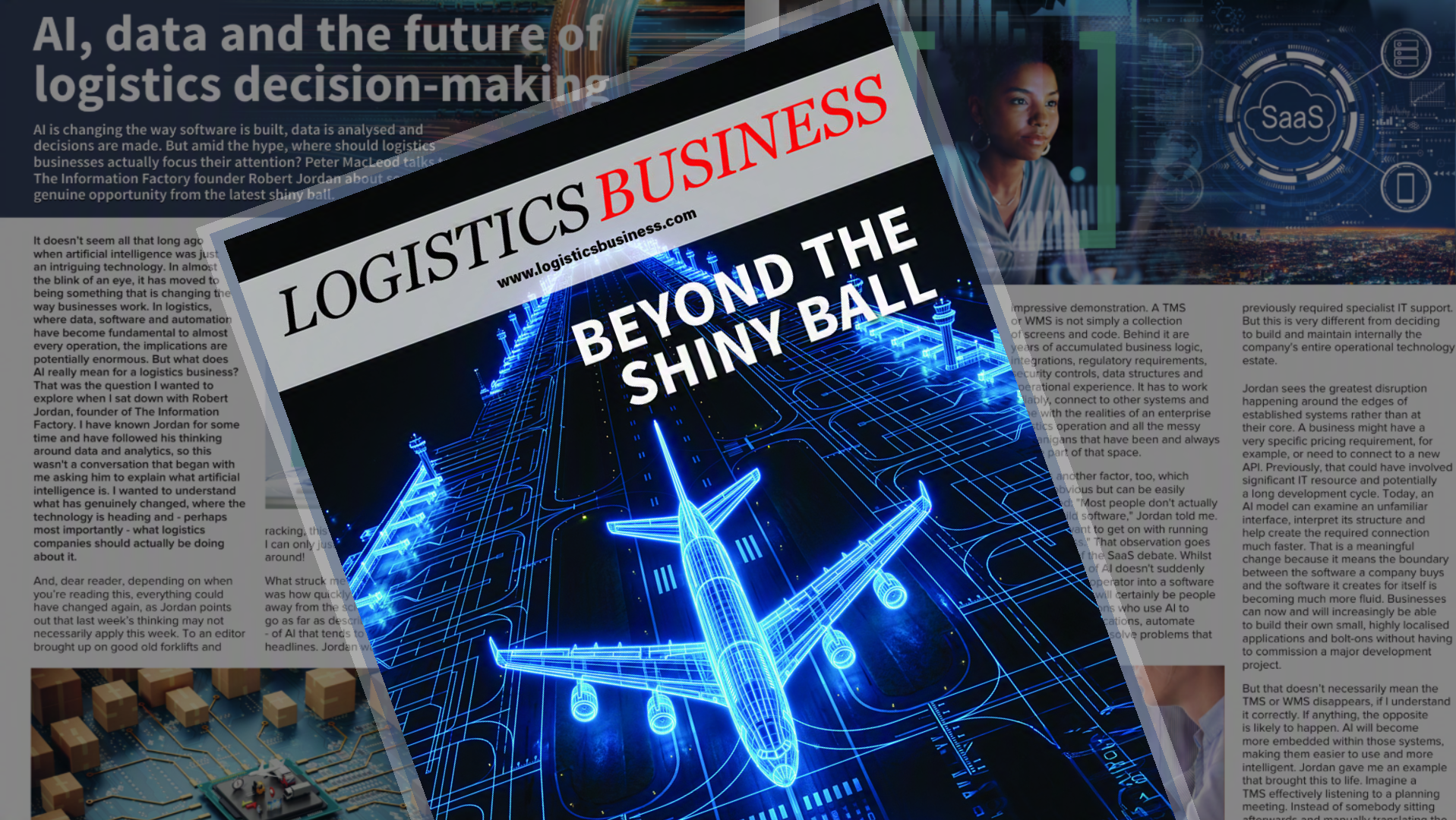
In our new eBook, Beyond the Shiny Ball, Logistics Business joins forces with The Information Factory to explore what AI really means for the logistics industry – and, more importantly, where businesses should be focusing their attention today.
Drawing on an in-depth conversation between Logistics Business Editor Peter MacLeod and Robert Jordan, CEO and Founder of The Information Factory, the eBook looks beyond some of the more spectacular predictions surrounding AI. Instead, it examines how the technology is becoming embedded within the software, data and decision-making processes that already underpin logistics operations.
From the future of SaaS and business intelligence to AI-assisted decision-making, data quality and the changing role of people, the discussion considers what the next phase of AI adoption could look like in practice. It also asks where businesses are likely to see the fastest returns – which may be less about autonomous warehouses and more about improving everyday activities such as customer service, RFQs, documentation, compliance, reporting and routine operational queries.
Crucially, Beyond the Shiny Ball also explores the foundations businesses need before scaling AI. Understanding existing processes, improving the quality and accessibility of data, establishing clear governance and deciding where human approval must remain are all fundamental to becoming genuinely AI-ready. The objective isn’t simply to deploy more AI, but to use it where it can solve real problems and support better decisions.
The opportunity is significant. AI can help logistics organisations connect information, analyse disruption and identify risks at a speed that would be difficult for an individual or team to match. The competitive advantage, the eBook argues, won’t come from having the most impressive AI demonstration – it will come from being able to make better decisions, faster.
For logistics leaders trying to understand where AI can deliver real value – without getting distracted by the hype – Beyond the Shiny Ball offers a practical look at what comes next and where to begin.