
Geopost puts delivery skills in the spotlight

Geopost has brought together 32 delivery professionals from 24 business units in Warsaw for the fifth edition of its Delivery Excellence Challenge, putting the practical skills behind safe and sustainable parcel delivery under the spotlight.

Held on 16 and 17 September, the international competition is designed around real-life situations faced by delivery professionals every day. Participants were assessed on everything from vehicle checks and precision driving to route management, emergency response and customer experience.

Since its launch in 2022, the event has developed into a Group-wide competition bringing drivers from across Geopost’s international network together to share experience and good practice.

Safety starts before the journey

Health and safety remain at the heart of the Challenge, with participants completing physical warm-ups and pre-departure vehicle checks before taking to the road.

The competition also tests drivers’ ability to respond to unexpected situations, while precision driving and route management exercises focus on the practical skills needed to deliver safely and reliably.

Marie-Ange Debon, Chairwoman and CEO of La Poste Groupe, attended the Warsaw event alongside Yves Delmas, Executive Vice-president of La Poste Groupe and CEO of Geopost.

Marie-Ange Debon said:

“Their professionalism and commitment are remarkable, but what matters above all is that they can carry out their work safely and look after their physical and mental well-being. At Geopost, we are working to make prevention part of everyday operations, through training, safer working practices, vehicle checks and initiatives designed to reduce physical strain.”

Electric vehicles put to the test

Sustainability is also built into the competition. Drivers were assessed on eco-driving techniques including smooth acceleration and braking and anticipating road conditions, all of which can help reduce energy consumption while supporting safer driving.

All pickup and delivery challenges were carried out using electric vehicles. For the first time in 2026, an electric truck was also used in the competition.

Geopost says the exercises demonstrate the connection between driver behaviour, operational efficiency and lower-emission delivery as it works towards its target of Net Zero by 2040.

Ireland and Germany take top honours

Phil Coulter from DPD Ireland won the Pickup and Delivery category, while Mathias Klingebiel from DPD Germany took the Long-distance Transport title.

Coulter and Klingebiel also shared the Sustainability Special Award for their respective categories.

The Safety Special Awards went to Marek Janák and Marek Škorvánek, both from DPD Slovakia.

For Geopost, the Challenge provides more than a competition. It gives delivery professionals from across its international network an opportunity to compare practices and demonstrate the skills that underpin safer, more reliable and more sustainable operations.

Geopost operates in more than 50 countries through delivery brands including DPD, Chronopost, SEUR, BRT, Speedy, Jadlog and Asendia. The group employs 55,000 people and delivered 2.2 billion parcels worldwide in 2025.

DHL expands Colombia operations with Open Market deal

DHL Supply Chain has agreed to the acquisition of logistics and transport operator Open Market, adding significant warehousing, transport and temperature-controlled capabilities to its network in Colombia.

The deal will bring 21 warehouses covering a combined 120,000m², 13 cross-docking platforms and an owned transport fleet into DHL’s Colombian operation. Around 4,100 Open Market employees will also join DHL Supply Chain.

The acquisition is part of DHL Group’s Strategy 2030 and is intended to strengthen its presence in Latin America, with a particular focus on life sciences, healthcare and other specialised supply chains.

Hendrik Venter, CEO of DHL Supply Chain, said:

“This step reflects our strategic focus on strengthening our capabilities in regions and sectors that show sustained, long-term growth. By expanding our presence here and integrating Open Market’s expertise, particularly in managing complex supply chains for pharmaceuticals, medical products and personal care, we further advance our global DHL Health Logistics capabilities.”

Adding specialist capabilities

Open Market brings capabilities spanning transportation, packaging and temperature-controlled operations, alongside its warehousing and cross-docking network.

The business serves sectors including life sciences and healthcare, consumer goods, engineering and manufacturing. DHL says the combination will strengthen its ability to manage more specialised supply chains across Colombia and the wider Latin American region.

Agustín Croche, CEO Latin America at DHL Supply Chain, added:

“Open Market’s experience strongly complements our existing offering in Latin America. Their transport network with cross-docks and temperature-controlled warehouses, combined with its experience supporting dynamic sectors such as life sciences and healthcare, consumer, and engineering and manufacturing enhances the quality and reliability of the services we provide.”

DHL has also recently expanded its Constellation Distribution Center in Cota, near Bogotá, adding further capacity for specialised supply chains.

Open Market employees join DHL

The acquisition will also bring Open Market’s workforce into DHL Supply Chain.

“At DHL Supply Chain, people are central to our success,” said Robinson Vasquez, CEO of DHL Supply Chain Colombia. “By welcoming Open Market’s employees into our organisation, we gain colleagues with extensive experience, deep market knowledge and strong customer relationships.”

The transaction remains subject to customary closing conditions.

Open Market’s chairman Anibal Wadih said the sale forms part of the company’s strategy to focus investment and capabilities on Brazil, adding that the priority is to maintain continuity and service quality during the transition.

The deal follows DHL’s recent expansion elsewhere in Latin America, including its acquisition of Aero Cargas in Uruguay, as the group continues to build its regional logistics network.

Four signs your business has outgrown its 3PL

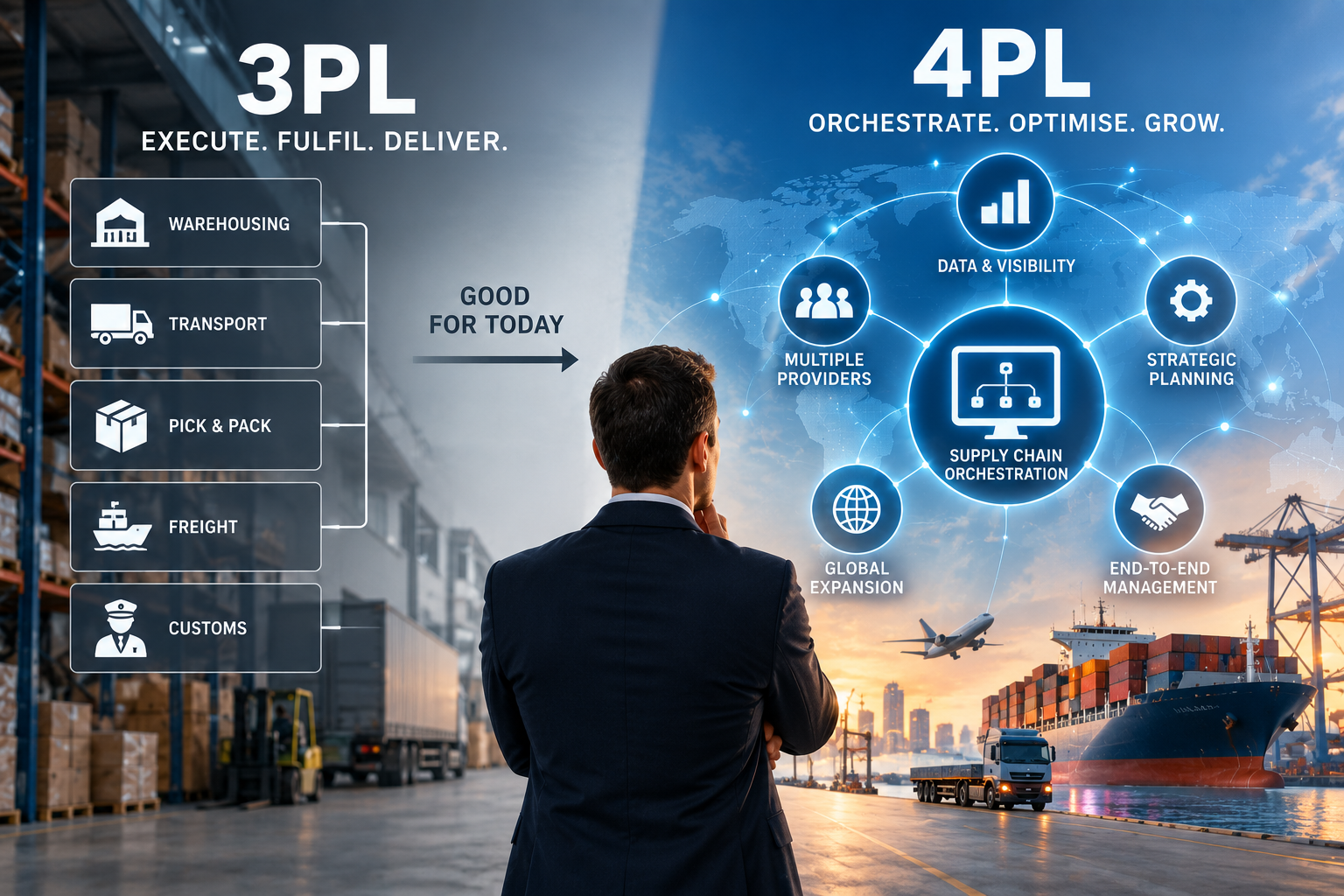
A good third-party logistics provider (3PL) can be the backbone of a growing business. But as a supply chain expands across markets, carriers and systems, the problem may no longer be the performance of the 3PL. It may be that the logistics model itself has reached its limits.

That is the argument made by Paul Lockwood, UK and Ireland Group Managing Director at SEKO Logistics, who identifies four signs that a business may have outgrown its existing 3PL model.

The distinction is important. A 3PL manages one or more logistics services, while a fourth-party logistics provider, or 4PL, manages multiple logistics providers and takes on a broader orchestration role.

The visibility gap widens

Growth can bring new markets, carriers and regional partners, each with different systems, service levels and reporting formats. Individual providers may perform well, but the business can lose its ability to see inventory, orders and performance across the network as a whole.

The 2026 30th Annual Third-Party Logistics Study found that 90% of shippers consider technological capabilities critical when selecting a 3PL, while only 57% say they are satisfied with their provider’s technology capabilities. Lockwood said:

“There’s a real gap between what businesses expect from technology and what they’re getting. Selecting a provider on technology capability is one thing; actually being satisfied with it once you’re in the relationship is another.”

Growth outpaces the network

A provider that works well in one region may not have the network needed when its customer expands into new markets.

According to the study, half of shippers and 62% of 3PLs report that shippers are actively consolidating the number of 3PL partners they use.

“We’re seeing this consolidation play out with our own clients,” Lockwood said. “Once a business is managing four or five separate provider relationships across different markets, adding another one rarely solves the problem.”

Instead, the requirement may become one of network-level management, with a single party coordinating multiple providers.

The relationship becomes strategic

As a business grows, the role expected of its logistics partner can change. What starts with reliable execution can develop into questions around inventory strategy, landed costs, resilience and market entry.

The 2026 study found that 81% of shippers cite supply chain disruption and complexity, while 76% cite cost optimisation through collaboration, among their reasons for pursuing more strategic logistics partnerships.

That does not necessarily mean moving to a 4PL model. It does, however, suggest that logistics relationships can evolve beyond straightforward execution.

Systems stop talking

Multiple logistics providers can also create multiple WMS, TMS and EDI environments. Data that should flow through the supply chain can instead become fragmented across different systems, requiring separate reconciliation and management.

A 4PL model can address this by providing an orchestration layer across multiple providers and systems.

Not every business needs a 4PL

Moving to 4PL is not automatically the answer. It can mean greater transfer of control, a more involved transition and a different cost structure.

For a business still operating within one or two markets, strengthening its existing 3PL relationship may be more appropriate than adding another layer of management.

Lockwood concluded:

“None of this means a business’s 3PL has failed. Outgrowing a model is usually a sign of success.”

The key question, therefore, is not whether 4PL is the next inevitable step. It is whether the complexity of the supply chain has reached the point where managing individual logistics providers is itself becoming a problem.

Subscribe

Get notified about New Episodes of our Podcast, New Magazine Issues and stay updated with our Weekly Newsletter.